NDS-DLL7
SUCHEN SIE DIE PASSENDE
INDUSTRIELLE LÖSUNG?
Entdecken Sie Embedded-, Kommunikations- und Automatisierungslösungen für Ihre Anwendung.
- Dual Independent CAN Channels: Two fully independent CAN 2.0A/B compliant ports, each capable of operating separately or bridged for network redundancy or gateway applications.
- Optical Isolation: 2500 Vrms galvanic isolation between CAN channels and system bus, ensuring robust protection against electrical noise and ground loops.
- High‑Speed Communication: Supports programmable baud rates up to 1 Mbps; standard DeviceNet rates of 125 kbps, 250 kbps, and 500 kbps are pre‑configured.
- Bridge Functionality: Allows inter‑CAN communication bridging for network segmentation or protocol conversion.
- CAN Controller: Philips/NXP SJA1000 CAN controller with advanced error detection, bus arbitration, and automatic retransmission.
- CAN Transceiver: Philips 82C250 transceivers providing differential signal interface (CAN_H, CAN_L).
- Plug‑and‑Play Configuration: Fully PCI Plug‑and‑Play compliant; no manual jumper or address configuration required.
- Rear I/O Connectivity: CompactPCI rear I/O interface for backplane signal routing, minimizing front‑panel cabling.
- Software Support: Comprehensive driver and library support for DOS, Windows 95/98, and Windows NT environments.
- Application Layer Support: Built‑in software library for CANopen, DeviceNet, and SDS (Smart Distributed System) protocols.
- Diagnostic and Control Functions: LED status indicators, error counters, and programmable error warning limits.
- Industrial‑Grade Design: Operating temperature 0 °C – 60 °C, humidity 5 % – 95 % non‑condensing.
- Optical Isolation: 2500 Vrms galvanic isolation between CAN channels and system bus, ensuring robust protection against electrical noise and ground loops.
- High‑Speed Communication: Supports programmable baud rates up to 1 Mbps; standard DeviceNet rates of 125 kbps, 250 kbps, and 500 kbps are pre‑configured.
- Bridge Functionality: Allows inter‑CAN communication bridging for network segmentation or protocol conversion.
- CAN Controller: Philips/NXP SJA1000 CAN controller with advanced error detection, bus arbitration, and automatic retransmission.
- CAN Transceiver: Philips 82C250 transceivers providing differential signal interface (CAN_H, CAN_L).
- Plug‑and‑Play Configuration: Fully PCI Plug‑and‑Play compliant; no manual jumper or address configuration required.
- Rear I/O Connectivity: CompactPCI rear I/O interface for backplane signal routing, minimizing front‑panel cabling.
- Software Support: Comprehensive driver and library support for DOS, Windows 95/98, and Windows NT environments.
- Application Layer Support: Built‑in software library for CANopen, DeviceNet, and SDS (Smart Distributed System) protocols.
- Diagnostic and Control Functions: LED status indicators, error counters, and programmable error warning limits.
- Industrial‑Grade Design: Operating temperature 0 °C – 60 °C, humidity 5 % – 95 % non‑condensing.
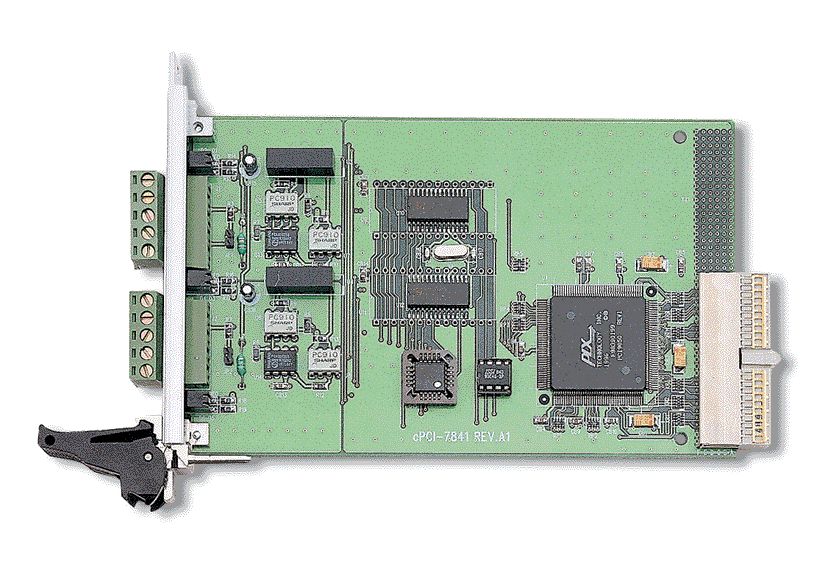
Comprehensive Product Summary – ADLINK cPCI‑7841R Dual‑Port Isolated CAN Interface Card
### 1. Product Overview
Product Name: cPCI‑7841R
Model: cPCI‑7841R (CompactPCI 2‑Port CAN Card, Rear I/O)
Series: PCI‑7841 / cPCI‑7841 / PM‑7841 CAN Interface Family
Article Number: cPCI‑7841R
Manufacturer: ADLINK Technology Inc.
Product Type: Dual‑Port Isolated Controller Area Network (CAN) Interface Card for CompactPCI systems
Bus Interface: CompactPCI (cPCI) 32‑bit bus, rear I/O configuration
Release Information:
- First Edition: June 1, 1998
- Manual Revision 3.00: May 28, 2000
- Copyright © 1998–2000 ADLINK Technology Inc.
The ADLINK cPCI‑7841R is a high‑performance, dual‑channel CAN interface card designed for industrial automation and control systems requiring reliable, isolated communication over the Controller Area Network (CAN) bus. It is part of ADLINK’s 7841 series, which includes PCI‑7841 (standard PCI), cPCI‑7841 (CompactPCI), and PM‑7841 (PC/104) variants. The “R” suffix denotes the rear I/O version optimized for CompactPCI backplane integration.
### 2. Key Features
- Dual Independent CAN Channels: Two fully independent CAN 2.0A/B compliant ports, each capable of operating separately or bridged for network redundancy or gateway applications.
- Optical Isolation: 2500 Vrms galvanic isolation between CAN channels and system bus, ensuring robust protection against electrical noise and ground loops.
- High‑Speed Communication: Supports programmable baud rates up to 1 Mbps; standard DeviceNet rates of 125 kbps, 250 kbps, and 500 kbps are pre‑configured.
- Bridge Functionality: Allows inter‑CAN communication bridging for network segmentation or protocol conversion.
- CAN Controller: Philips/NXP SJA1000 CAN controller with advanced error detection, bus arbitration, and automatic retransmission.
- CAN Transceiver: Philips 82C250 transceivers providing differential signal interface (CAN_H, CAN_L).
- Plug‑and‑Play Configuration: Fully PCI Plug‑and‑Play compliant; no manual jumper or address configuration required.
- Rear I/O Connectivity: CompactPCI rear I/O interface for backplane signal routing, minimizing front‑panel cabling.
- Software Support: Comprehensive driver and library support for DOS, Windows 95/98, and Windows NT environments.
- Application Layer Support: Built‑in software library for CANopen, DeviceNet, and SDS (Smart Distributed System) protocols.
- Diagnostic and Control Functions: LED status indicators, error counters, and programmable error warning limits.
- Industrial‑Grade Design: Operating temperature 0 °C – 60 °C, humidity 5 % – 95 % non‑condensing.
### 3. Technical Specifications
| Parameter | Specification |
|----------------|-------------------|
| Bus Interface | CompactPCI (cPCI) 32‑bit bus |
| Ports | 2 × CAN channels (CAN 2.0 A/B compliant) |
| CAN Controller | Philips/NXP SJA1000 |
| CAN Transceiver | Philips 82C250 |
| Signal Lines | CAN_H, CAN_L |
| Isolation Voltage | 2500 Vrms optical isolation |
| Connectors | Dual rear I/O connectors (CompactPCI J3/J4 backplane interface) |
| Baud Rates | 125 kbps, 250 kbps, 500 kbps, 1 Mbps (user‑programmable) |
| IRQ Level | Assigned automatically by Plug‑and‑Play BIOS |
| I/O Port Address | Assigned automatically by Plug‑and‑Play BIOS |
| Power Consumption | 400 mA @ +5 V DC (typical), 900 mA @ +5 V DC (maximum) |
| Dimensions | 132 mm (L) × 98 mm (H) |
| Operating Temperature | 0 °C – 60 °C |
| Storage Temperature | −20 °C – 80 °C |
| Humidity | 5 % – 95 % RH, non‑condensing |
| Isolation Type | Optical, channel‑to‑bus and channel‑to‑channel |
| Compliance | CAN 2.0 A/B, CompactPCI 2.0, DeviceNet, CANopen |
| Software Environment | DOS, Windows 95/98, Windows NT |
| Typical Applications | Industrial automation, process control, manufacturing systems, product testing |
### 4. Functionality
Operational Concept:
The cPCI‑7841R provides two independent CAN communication channels that can operate as separate networks or be configured as a bridge. Each channel uses an SJA1000 controller to manage message arbitration, error detection, and retransmission. The card interfaces with the CompactPCI backplane via rear I/O connectors, enabling integration into modular industrial systems without front‑panel wiring.
Supported Protocols and Layers:
- Physical Layer: ISO 11898‑compliant differential signaling (CAN_H/CAN_L).
- Data Link Layer: CAN 2.0 A/B frame formats (11‑bit and 29‑bit identifiers).
- Application Layer: Supports CANopen, DeviceNet, and SDS through ADLINK’s software library.
Software and Driver Functions:
The ADLINK CAN library provides a comprehensive API for configuration, communication, and diagnostics. Key functions include:
- Initialization and Configuration: `CanOpenDriver()`, `CanConfigPort()`, `CanDetectBaudrate()`
- Data Transmission and Reception: `CanSendMsg()`, `CanRcvMsg()`
- Error Handling: `CanGetErrorCode()`, `CanClearOverrun()`, `CanSetErrorWarningLimit()`
- Status Monitoring: `CanGetPortStatus()`, `CanGetLedStatus()`
- DeviceNet Layer Functions: `SendDeviceNetPacket()`, `RcvDeviceNetPacket()`, `DNetOpenExp()`, `DNetScan()`, `DNetSetBaud()`
Use Cases:
- Industrial automation networks using CANopen or DeviceNet.
- Distributed control systems requiring deterministic communication.
- Machine‑to‑machine communication in manufacturing lines.
- Product testing and monitoring systems.
- Embedded control applications using CompactPCI platforms.
Compatibility:
- Compatible with CompactPCI chassis supporting rear I/O.
- Software drivers for DOS, Windows 95/98, and Windows NT.
- API libraries for C/C++ and Visual Basic environments.
### 5. Components & Accessories
Package Contents:
- cPCI‑7841R Dual‑Port CompactPCI Isolated CAN Interface Card (rear I/O version)
- ADLINK “All‑xxxxxx” CD‑ROM containing:
- Device drivers for DOS/Windows 95/98/NT
- Software development libraries and header files
- Example source code and documentation
- Printed User’s Manual
On‑Board Components:
- Two SJA1000 CAN controllers
- Two 82C250 CAN transceivers
- Optical isolation circuitry (2500 Vrms)
- On‑board 120 Ω termination resistors (enabled via jumpers JP1/JP2)
- Rear I/O connectors J1 and J2 for CAN channels
- Status LEDs for channel activity and error indication
Optional Accessories:
- Rear transition module (RTM) for CompactPCI backplane connection
- CAN bus cables (DB‑9 or terminal block adapters depending on RTM)
- Software development kit (SDK) updates from ADLINK
### 6. Installation & Setup
Handling Precautions:
The cPCI‑7841R contains static‑sensitive components. Installation should be performed on a grounded anti‑static mat with the operator wearing an ESD wrist strap. Inspect the module for shipping damage before installation.
Installation Steps:
1. Power off the CompactPCI system and disconnect power.
2. Insert the cPCI‑7841R into an available CompactPCI slot supporting rear I/O.
3. Secure the module using the front‑panel screws.
4. Connect the CAN bus lines via the rear I/O transition module.
5. Power on the system; the card will be automatically detected by the Plug‑and‑Play BIOS.
6. Install the appropriate ADLINK driver from the provided CD‑ROM.
7. Verify installation using the diagnostic utilities or sample programs.
Termination Configuration:
Each CAN port includes a 120 Ω termination resistor.
- JP1: Enables termination for Port 0
- JP2: Enables termination for Port 1
Software Configuration:
- No manual base address or IRQ configuration required (Plug‑and‑Play).
- Use ADLINK’s configuration utilities or API functions to set baud rate, acceptance code, and mask.
Environmental Requirements:
- Operating temperature: 0 °C – 60 °C
- Humidity: 5 % – 95 % non‑condensing
- Ensure adequate ventilation within the CompactPCI chassis.
### 7. Performance & Capabilities
Communication Performance:
- Maximum Baud Rate: 1 Mbps (programmable)
- Standard DeviceNet Rates: 125 kbps, 250 kbps, 500 kbps
- Message Buffering: Hardware FIFO (64 bytes) with driver‑level buffering for up to 21 packets.
- Error Handling: Automatic retransmission, error counters, and programmable warning limits.
- Latency: Deterministic response suitable for real‑time control applications.
Electrical and Isolation Performance:
- Isolation: 2500 Vrms optical isolation between CAN channels and system bus.
- Signal Integrity: Differential signaling with high noise immunity.
- Power Draw: 400 mA @ 5 V DC typical; 900 mA @ 5 V DC maximum.
Software Performance:
- Driver Efficiency: Low‑latency interrupt‑driven communication.
- Event Handling: Supports callback functions (DOS) and event objects (Windows 95/98/NT).
- Error Detection: Bit, form, stuff, and CRC error identification with detailed segment decoding.
Limitations:
- Designed for CompactPCI systems only (not compatible with standard PCI slots).
- Operating temperature limited to 60 °C; requires adequate cooling in high‑density systems.
- Software support limited to legacy operating systems (DOS/Win9x/NT).
### 8. Standards & Compliance
Bus and Interface Standards:
- CompactPCI 2.0 compliant (32‑bit, 33 MHz)
- CAN 2.0 A/B compliant (ISO 11898 physical and data link layers)
Protocol Support:
- CANopen, DeviceNet, and SDS (Smart Distributed System) application layers supported via ADLINK libraries.
Electrical and Safety Compliance:
- Optical isolation: 2500 Vrms (channel‑to‑bus)
- Designed for industrial EMC environments with high noise immunity.
Software and API Standards:
- C/C++ and Visual Basic API compatibility
- DOS and Windows 95/98/NT driver models
- DeviceNet conformance for communication stack
Environmental Compliance:
- Operating temperature: 0 °C – 60 °C
- Storage temperature: −20 °C – 80 °C
- Humidity: 5 % – 95 % non‑condensing
### 9. Additional Information
Warranty:
Standard ADLINK limited hardware warranty (typically one year from date of purchase). Warranty covers defects in materials and workmanship under normal use.
Technical Support:
ADLINK provides technical support through its global service network. Support resources include:
- Driver and library updates via ADLINK website
- Example source code and programming guides
- Application notes for CANopen and DeviceNet integration
Maintenance:
- Periodically inspect connectors and backplane contacts for contamination.
- Ensure proper termination resistors are configured for network stability.
- Firmware and driver updates should be applied as recommended by ADLINK.
Software Updates and SDK:
The ADLINK “All‑xxxxxx” CD‑ROM includes the latest drivers and libraries. Updated SDKs may be downloaded from ADLINK’s support portal, providing enhanced compatibility with newer development environments.
Documentation and Resources:
- *User’s Guide* (Rev. 3.00, May 2000)
- *API Reference Manual* for CAN and DeviceNet functions
- *Sample Programs* for DOS and Windows environments
Product Family Overview:
The cPCI‑7841R belongs to a family of dual‑port isolated CAN interface cards:
- PCI‑7841: Standard PCI bus version with front‑panel DB‑9 connectors.
- cPCI‑7841R: CompactPCI version with rear I/O connectivity.
- PM‑7841: PC/104 form factor version with DIP switch configuration and 1000 Vrms isolation.
Each variant shares the same core architecture and software interface, allowing seamless migration between platforms.
### Summary
The ADLINK cPCI‑7841R is a robust, dual‑port isolated CAN interface card engineered for CompactPCI systems requiring reliable, high‑speed communication in industrial environments. Featuring 2500 Vrms optical isolation, dual independent CAN 2.0 A/B channels, and full support for DeviceNet and CANopen protocols, it provides a flexible and dependable solution for distributed control and automation networks. Its plug‑and‑play design, comprehensive software library, and industrial‑grade construction make it ideal for applications in manufacturing automation, process control, and embedded system integration.

### 1. Product Overview
Product Name: cPCI‑7841R
Model: cPCI‑7841R (CompactPCI 2‑Port CAN Card, Rear I/O)
Series: PCI‑7841 / cPCI‑7841 / PM‑7841 CAN Interface Family
Article Number: cPCI‑7841R
Manufacturer: ADLINK Technology Inc.
Product Type: Dual‑Port Isolated Controller Area Network (CAN) Interface Card for CompactPCI systems
Bus Interface: CompactPCI (cPCI) 32‑bit bus, rear I/O configuration
Release Information:
- First Edition: June 1, 1998
- Manual Revision 3.00: May 28, 2000
- Copyright © 1998–2000 ADLINK Technology Inc.
The ADLINK cPCI‑7841R is a high‑performance, dual‑channel CAN interface card designed for industrial automation and control systems requiring reliable, isolated communication over the Controller Area Network (CAN) bus. It is part of ADLINK’s 7841 series, which includes PCI‑7841 (standard PCI), cPCI‑7841 (CompactPCI), and PM‑7841 (PC/104) variants. The “R” suffix denotes the rear I/O version optimized for CompactPCI backplane integration.
### 2. Key Features
- Dual Independent CAN Channels: Two fully independent CAN 2.0A/B compliant ports, each capable of operating separately or bridged for network redundancy or gateway applications.
- Optical Isolation: 2500 Vrms galvanic isolation between CAN channels and system bus, ensuring robust protection against electrical noise and ground loops.
- High‑Speed Communication: Supports programmable baud rates up to 1 Mbps; standard DeviceNet rates of 125 kbps, 250 kbps, and 500 kbps are pre‑configured.
- Bridge Functionality: Allows inter‑CAN communication bridging for network segmentation or protocol conversion.
- CAN Controller: Philips/NXP SJA1000 CAN controller with advanced error detection, bus arbitration, and automatic retransmission.
- CAN Transceiver: Philips 82C250 transceivers providing differential signal interface (CAN_H, CAN_L).
- Plug‑and‑Play Configuration: Fully PCI Plug‑and‑Play compliant; no manual jumper or address configuration required.
- Rear I/O Connectivity: CompactPCI rear I/O interface for backplane signal routing, minimizing front‑panel cabling.
- Software Support: Comprehensive driver and library support for DOS, Windows 95/98, and Windows NT environments.
- Application Layer Support: Built‑in software library for CANopen, DeviceNet, and SDS (Smart Distributed System) protocols.
- Diagnostic and Control Functions: LED status indicators, error counters, and programmable error warning limits.
- Industrial‑Grade Design: Operating temperature 0 °C – 60 °C, humidity 5 % – 95 % non‑condensing.
### 3. Technical Specifications
| Parameter | Specification |
|----------------|-------------------|
| Bus Interface | CompactPCI (cPCI) 32‑bit bus |
| Ports | 2 × CAN channels (CAN 2.0 A/B compliant) |
| CAN Controller | Philips/NXP SJA1000 |
| CAN Transceiver | Philips 82C250 |
| Signal Lines | CAN_H, CAN_L |
| Isolation Voltage | 2500 Vrms optical isolation |
| Connectors | Dual rear I/O connectors (CompactPCI J3/J4 backplane interface) |
| Baud Rates | 125 kbps, 250 kbps, 500 kbps, 1 Mbps (user‑programmable) |
| IRQ Level | Assigned automatically by Plug‑and‑Play BIOS |
| I/O Port Address | Assigned automatically by Plug‑and‑Play BIOS |
| Power Consumption | 400 mA @ +5 V DC (typical), 900 mA @ +5 V DC (maximum) |
| Dimensions | 132 mm (L) × 98 mm (H) |
| Operating Temperature | 0 °C – 60 °C |
| Storage Temperature | −20 °C – 80 °C |
| Humidity | 5 % – 95 % RH, non‑condensing |
| Isolation Type | Optical, channel‑to‑bus and channel‑to‑channel |
| Compliance | CAN 2.0 A/B, CompactPCI 2.0, DeviceNet, CANopen |
| Software Environment | DOS, Windows 95/98, Windows NT |
| Typical Applications | Industrial automation, process control, manufacturing systems, product testing |
### 4. Functionality
Operational Concept:
The cPCI‑7841R provides two independent CAN communication channels that can operate as separate networks or be configured as a bridge. Each channel uses an SJA1000 controller to manage message arbitration, error detection, and retransmission. The card interfaces with the CompactPCI backplane via rear I/O connectors, enabling integration into modular industrial systems without front‑panel wiring.
Supported Protocols and Layers:
- Physical Layer: ISO 11898‑compliant differential signaling (CAN_H/CAN_L).
- Data Link Layer: CAN 2.0 A/B frame formats (11‑bit and 29‑bit identifiers).
- Application Layer: Supports CANopen, DeviceNet, and SDS through ADLINK’s software library.
Software and Driver Functions:
The ADLINK CAN library provides a comprehensive API for configuration, communication, and diagnostics. Key functions include:
- Initialization and Configuration: `CanOpenDriver()`, `CanConfigPort()`, `CanDetectBaudrate()`
- Data Transmission and Reception: `CanSendMsg()`, `CanRcvMsg()`
- Error Handling: `CanGetErrorCode()`, `CanClearOverrun()`, `CanSetErrorWarningLimit()`
- Status Monitoring: `CanGetPortStatus()`, `CanGetLedStatus()`
- DeviceNet Layer Functions: `SendDeviceNetPacket()`, `RcvDeviceNetPacket()`, `DNetOpenExp()`, `DNetScan()`, `DNetSetBaud()`
Use Cases:
- Industrial automation networks using CANopen or DeviceNet.
- Distributed control systems requiring deterministic communication.
- Machine‑to‑machine communication in manufacturing lines.
- Product testing and monitoring systems.
- Embedded control applications using CompactPCI platforms.
Compatibility:
- Compatible with CompactPCI chassis supporting rear I/O.
- Software drivers for DOS, Windows 95/98, and Windows NT.
- API libraries for C/C++ and Visual Basic environments.
### 5. Components & Accessories
Package Contents:
- cPCI‑7841R Dual‑Port CompactPCI Isolated CAN Interface Card (rear I/O version)
- ADLINK “All‑xxxxxx” CD‑ROM containing:
- Device drivers for DOS/Windows 95/98/NT
- Software development libraries and header files
- Example source code and documentation
- Printed User’s Manual
On‑Board Components:
- Two SJA1000 CAN controllers
- Two 82C250 CAN transceivers
- Optical isolation circuitry (2500 Vrms)
- On‑board 120 Ω termination resistors (enabled via jumpers JP1/JP2)
- Rear I/O connectors J1 and J2 for CAN channels
- Status LEDs for channel activity and error indication
Optional Accessories:
- Rear transition module (RTM) for CompactPCI backplane connection
- CAN bus cables (DB‑9 or terminal block adapters depending on RTM)
- Software development kit (SDK) updates from ADLINK
### 6. Installation & Setup
Handling Precautions:
The cPCI‑7841R contains static‑sensitive components. Installation should be performed on a grounded anti‑static mat with the operator wearing an ESD wrist strap. Inspect the module for shipping damage before installation.
Installation Steps:
1. Power off the CompactPCI system and disconnect power.
2. Insert the cPCI‑7841R into an available CompactPCI slot supporting rear I/O.
3. Secure the module using the front‑panel screws.
4. Connect the CAN bus lines via the rear I/O transition module.
5. Power on the system; the card will be automatically detected by the Plug‑and‑Play BIOS.
6. Install the appropriate ADLINK driver from the provided CD‑ROM.
7. Verify installation using the diagnostic utilities or sample programs.
Termination Configuration:
Each CAN port includes a 120 Ω termination resistor.
- JP1: Enables termination for Port 0
- JP2: Enables termination for Port 1
Software Configuration:
- No manual base address or IRQ configuration required (Plug‑and‑Play).
- Use ADLINK’s configuration utilities or API functions to set baud rate, acceptance code, and mask.
Environmental Requirements:
- Operating temperature: 0 °C – 60 °C
- Humidity: 5 % – 95 % non‑condensing
- Ensure adequate ventilation within the CompactPCI chassis.
### 7. Performance & Capabilities
Communication Performance:
- Maximum Baud Rate: 1 Mbps (programmable)
- Standard DeviceNet Rates: 125 kbps, 250 kbps, 500 kbps
- Message Buffering: Hardware FIFO (64 bytes) with driver‑level buffering for up to 21 packets.
- Error Handling: Automatic retransmission, error counters, and programmable warning limits.
- Latency: Deterministic response suitable for real‑time control applications.
Electrical and Isolation Performance:
- Isolation: 2500 Vrms optical isolation between CAN channels and system bus.
- Signal Integrity: Differential signaling with high noise immunity.
- Power Draw: 400 mA @ 5 V DC typical; 900 mA @ 5 V DC maximum.
Software Performance:
- Driver Efficiency: Low‑latency interrupt‑driven communication.
- Event Handling: Supports callback functions (DOS) and event objects (Windows 95/98/NT).
- Error Detection: Bit, form, stuff, and CRC error identification with detailed segment decoding.
Limitations:
- Designed for CompactPCI systems only (not compatible with standard PCI slots).
- Operating temperature limited to 60 °C; requires adequate cooling in high‑density systems.
- Software support limited to legacy operating systems (DOS/Win9x/NT).
### 8. Standards & Compliance
Bus and Interface Standards:
- CompactPCI 2.0 compliant (32‑bit, 33 MHz)
- CAN 2.0 A/B compliant (ISO 11898 physical and data link layers)
Protocol Support:
- CANopen, DeviceNet, and SDS (Smart Distributed System) application layers supported via ADLINK libraries.
Electrical and Safety Compliance:
- Optical isolation: 2500 Vrms (channel‑to‑bus)
- Designed for industrial EMC environments with high noise immunity.
Software and API Standards:
- C/C++ and Visual Basic API compatibility
- DOS and Windows 95/98/NT driver models
- DeviceNet conformance for communication stack
Environmental Compliance:
- Operating temperature: 0 °C – 60 °C
- Storage temperature: −20 °C – 80 °C
- Humidity: 5 % – 95 % non‑condensing
### 9. Additional Information
Warranty:
Standard ADLINK limited hardware warranty (typically one year from date of purchase). Warranty covers defects in materials and workmanship under normal use.
Technical Support:
ADLINK provides technical support through its global service network. Support resources include:
- Driver and library updates via ADLINK website
- Example source code and programming guides
- Application notes for CANopen and DeviceNet integration
Maintenance:
- Periodically inspect connectors and backplane contacts for contamination.
- Ensure proper termination resistors are configured for network stability.
- Firmware and driver updates should be applied as recommended by ADLINK.
Software Updates and SDK:
The ADLINK “All‑xxxxxx” CD‑ROM includes the latest drivers and libraries. Updated SDKs may be downloaded from ADLINK’s support portal, providing enhanced compatibility with newer development environments.
Documentation and Resources:
- *User’s Guide* (Rev. 3.00, May 2000)
- *API Reference Manual* for CAN and DeviceNet functions
- *Sample Programs* for DOS and Windows environments
Product Family Overview:
The cPCI‑7841R belongs to a family of dual‑port isolated CAN interface cards:
- PCI‑7841: Standard PCI bus version with front‑panel DB‑9 connectors.
- cPCI‑7841R: CompactPCI version with rear I/O connectivity.
- PM‑7841: PC/104 form factor version with DIP switch configuration and 1000 Vrms isolation.
Each variant shares the same core architecture and software interface, allowing seamless migration between platforms.
### Summary
The ADLINK cPCI‑7841R is a robust, dual‑port isolated CAN interface card engineered for CompactPCI systems requiring reliable, high‑speed communication in industrial environments. Featuring 2500 Vrms optical isolation, dual independent CAN 2.0 A/B channels, and full support for DeviceNet and CANopen protocols, it provides a flexible and dependable solution for distributed control and automation networks. Its plug‑and‑play design, comprehensive software library, and industrial‑grade construction make it ideal for applications in manufacturing automation, process control, and embedded system integration.

-
PCI7841 Manual.PDF
Manual
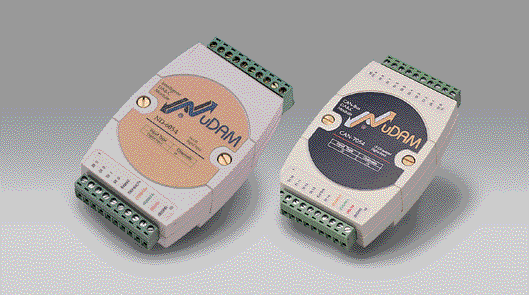
- NDS-DLL7 - DLL driver for NuDAM CAN moduls