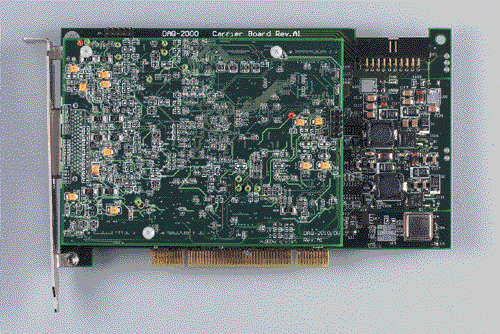
Comprehensive Product Summary: ADLINK DAQ‑2214 PCI Data Acquisition Card
### 1. Product Overview
Product Name: DAQ‑2214
Model: DAQ‑2214
Series: DAQ‑2000 Series (DAQ‑/DAQe‑2213/2214 Family)
Article Number: DAQ‑2214
Manufacturer: ADLINK Technology Inc.
Product Type: PCI Multi‑Function Data Acquisition (DAQ) Card
Form Factor: 32‑bit PCI Bus Card (3.3 V / 5 V compatible)
Interface: PCI (DAQ‑2214) / PCI Express (DAQe‑2214 variant)
The ADLINK DAQ‑2214 is a high‑performance, low‑cost, multifunction data acquisition card designed for precision analog and digital signal measurement and generation. It integrates 16‑bit analog‑to‑digital conversion, dual 12‑bit analog outputs, 24‑channel digital I/O, and dual 16‑bit general‑purpose timers/counters. The card supports both single‑ended and differential analog input configurations, auto‑calibration, and multiple triggering modes. It is ideal for laboratory automation, industrial testing, and embedded measurement systems requiring high‑speed, high‑accuracy data acquisition.
### 2. Key Features
- High‑Resolution Analog Input:
16‑bit A/D converter with no missing codes, supporting up to 16 single‑ended or 8 differential channels.
Maximum sampling rate: 250 kS/s.
- Dual Analog Output Channels:
Two 12‑bit D/A converters with waveform generation capability.
Maximum update rate: 1 MS/s per channel.
- Flexible Input Ranges:
Bipolar: ±10 V, ±5 V, ±2.5 V, ±1.25 V
Unipolar: 0–10 V, 0–5 V, 0–2.5 V, 0–1.25 V
Programmable gain: ×1, ×2, ×4, ×8.
- Auto‑Calibration:
Fully automatic calibration for both A/D and D/A circuits using onboard 5.000 V reference (±2 ppm/°C).
- Triggering and Synchronization:
Supports software, external analog, and digital triggers.
Multiple trigger modes: pre‑trigger, post‑trigger, middle‑trigger, delay‑trigger, and re‑trigger.
Synchronization of multiple cards via SSI (System Synchronization Interface) bus.
- Digital I/O and Timing:
24‑channel TTL‑compatible programmable digital I/O (8255 PIO).
Two 16‑bit general‑purpose timers/counters (up to 10 MHz external clock).
- High‑Speed Data Transfer:
Scatter‑gather DMA for efficient, high‑throughput data movement.
1 k‑sample FIFO buffers for both A/D and D/A operations.
- Software and OS Support:
Compatible with Windows 7/8 x86/x64 and Linux.
Drivers and SDKs for LabVIEW®, MATLAB®, C/C++, Visual Basic, and Visual Studio .NET.
Utility software: AD‑Logger for data logging and configuration.
- Connectivity:
Two 68‑pin VHDCI connectors for analog, digital, and timing signals.
Optional terminal boards and cables: DIN‑68S‑01, ACL‑10568‑1, ACL‑SSI‑2/3/4.
### 3. Technical Specifications
Analog Input (AI):
- Channels: 16 SE or 8 DI (software‑selectable per channel)
- Resolution: 16 bits, no missing codes
- Max Sampling Rate: 250 kS/s
- Input Coupling: DC
- Input Ranges: ±10 V, ±5 V, ±2.5 V, ±1.25 V; 0–10 V, 0–5 V, 0–2.5 V, 0–1.25 V
- Programmable Gain: ×1, ×2, ×4, ×8
- Channel Gain Queue: 512 entries
- Input Impedance: 1 GΩ / 100 pF (power on)
- Overvoltage Protection: ±30 V (power on), ±15 V (power off)
- Offset Error: ±1 mV after calibration
- Gain Error: ±0.06 % FSR before calibration, ±0.01 % after calibration
- CMRR (DC–60 Hz): up to 93 dB
- FIFO Buffer: 1 k samples
- Data Transfer: Polling or scatter‑gather DMA
Analog Output (AO):
- Channels: 2 voltage outputs
- Resolution: 12 bits
- Output Ranges: 0–10 V, ±10 V, 0–AOEXTREF, ±AOEXTREF
- Max Update Rate: 1 MS/s (1 µs per update)
- Slew Rate: 20 V/µs
- Settling Time: 3 µs to ±0.5 LSB
- Output Drive: ±5 mA, stable up to 1500 pF load
- Offset Error: ±2 mV after calibration
- Gain Error: ±0.04 % max output
- FIFO Buffer: 1 k samples (512 per channel when both active)
- Trigger Sources: Software, external analog/digital, SSI bus
Digital I/O:
- Channels: 24 TTL‑compatible (8255 PIO)
- Logic Levels:
- Input Low ≤ 0.8 V, High ≥ 2.0 V
- Output Low ≤ 0.5 V @ 8 mA, High ≥ 2.7 V @ 400 µA
- Data Transfer: Programmed I/O
Timer/Counter:
- Channels: 2 independent 16‑bit up/down counters
- Clock Source: Internal 40 MHz or external ≤ 10 MHz
- Compatibility: TTL
- Modes: Event counting, pulse generation, period/pulse‑width measurement, gated and triggered modes
General Specifications:
- Auto‑Calibration: Yes (±2 ppm/°C reference)
- Dimensions: 175 mm × 107 mm (6.82 " × 4.17 ")
- Connectors: 2 × 68‑pin VHDCI female
- Operating Temperature: 0 °C – 55 °C
- Storage Temperature: −20 °C – 70 °C
- Humidity: 5 – 95 % RH, non‑condensing
- Power Requirements: +5 V @ 1.2 A typical
- Bus Compatibility: 32‑bit PCI, 3.3 V/5 V signaling
### 4. Functionality
The DAQ‑2214 performs simultaneous analog input and output operations with precise timing control.
Analog Input Function: Converts analog signals to 16‑bit digital data using a high‑speed ADC. Supports single‑ended or differential configurations for noise immunity.
Analog Output Function: Generates analog voltages or waveforms from digital data using dual 12‑bit DACs.
Digital I/O: Provides programmable TTL lines for control, monitoring, or synchronization.
Timer/Counter: Enables event counting, frequency measurement, or pulse generation.
Triggering: Supports software, external analog, and digital triggers with multiple modes for pre/post‑event data capture.
Synchronization: Multiple DAQ‑2214 cards can be synchronized via the SSI bus for simultaneous multi‑channel acquisition.
Compatibility: Works with standard PCI slots in desktop PCs and industrial computers.
Typical Applications:
- Laboratory and industrial automation
- Automotive and cable testing
- Transient signal measurement
- Automated Test Equipment (ATE)
- Biotech instrumentation and process monitoring
### 5. Components & Accessories
Included Items:
- DAQ‑2214 PCI DAQ card
- ADLINK All‑in‑One Software CD
- Software Installation Guide
- User’s Manual
Optional Accessories:
- Terminal Boards: DIN‑68S‑01, ACL‑10568‑1
- Cables: ACL‑SSI‑2/3/4 for synchronization
- SSI Bus Cable: For multi‑card synchronization
Connectors:
- CN1: Analog inputs (AI0–AI15), AISENSE, EXTATRIG, AIGND
- CN2: Analog outputs (DA0OUT, DA1OUT, AOEXTREF), digital I/O (PA, PB, PC ports), GPTC signals, AFI inputs, EXTTIMEBASE, EXTWFTRIG, EXTDTRIG
- SSI Connector: 20‑pin header for synchronization signals (TIMEBASE, ADCONV, SCAN_START, AD_TRIG, DAWR, DA_TRIG)
### 6. Installation & Setup
Requirements:
- Available 32‑bit PCI slot (3.3 V or 5 V)
- Supported OS: Windows 7/8 x86/x64 or Linux
- Administrator privileges for driver installation
Installation Steps:
1. Power off the PC and insert the DAQ‑2214 into an available PCI slot.
2. Secure the card and reconnect power.
3. The system BIOS automatically assigns IRQ and I/O resources (Plug‑and‑Play).
4. Install ADLINK drivers and software from the provided CD.
5. Verify installation using the PCI_SCAN utility or AD‑Logger.
Mounting Options:
Standard PCI slot mounting; no jumpers required (software‑configurable).
Configuration:
All parameters (input range, gain, trigger mode, channel configuration) are software‑selectable.
### 7. Performance & Capabilities
- Analog Input Throughput: Up to 250 kS/s aggregate sampling rate.
- Analog Output Throughput: Up to 1 MS/s per channel.
- FIFO Buffers: 1 k samples for both A/D and D/A operations.
- DMA Transfer: Scatter‑gather DMA for continuous high‑speed data streaming.
- Accuracy:
- A/D offset error ±1 mV, gain error ±0.01 % FSR after calibration.
- D/A offset error ±1 mV, gain error ±0.02 % FSR after calibration.
- Noise Performance: < 1 LSBrms typical.
- CMRR: Up to 93 dB (DC–60 Hz).
- Stability: Onboard reference 5.000 V ± 2 ppm/°C, 6 ppm/1000 h long‑term drift.
- Limitations:
- Maximum analog input rate 250 kS/s shared across channels.
- D/A output limited to ±10 V or 0–10 V ranges.
- External clock input limited to 40 MHz.
### 8. Standards & Compliance
- Bus Interface: PCI 2.2 compliant (DAQ‑2214), PCI Express x1 (DAQe‑2214 variant)
- Electrical Compatibility: 3.3 V and 5 V signaling
- Digital Logic Levels: TTL/CMOS compatible
- Environmental:
- Operating: 0 °C – 55 °C, 10 – 90 % RH non‑condensing
- Storage: −20 °C – 70 °C, 5 – 95 % RH non‑condensing
- Safety & EMC: Designed to meet CE and FCC Class A industrial standards
- RoHS Compliance: Yes
- Calibration Reference: ±2 ppm/°C precision voltage reference
### 9. Additional Information
Warranty:
- Standard limited two‑year warranty (one year in China).
- Covers manufacturing defects under normal use.
- Excludes damage from misuse, improper installation, or environmental factors.
Support & Service:
- Global technical support via ADLINK regional offices (Taiwan, USA, Europe, Singapore, India, China).
- Email: service@adlinktech.com
- Website: [www.adlinktech.com](http://www.adlinktech.com)
Maintenance:
- Periodic calibration recommended for long‑term accuracy.
- Auto‑calibration can be performed via software without external equipment.
- Warm‑up time: 15 minutes before calibration.
Software Updates:
- Driver and SDK updates available from ADLINK’s website.
- Compatible with ADLINK’s D2K‑DASK, DAQ‑LVIEW PnP (LabVIEW driver), and D2K‑OCX ActiveX libraries.
Documentation:
- User’s Manual (Rev 2.00, Part No. 50‑11222‑2000)
- Software Installation Guide
- Signal Connection Diagrams and Pin Assignments
### Summary
The ADLINK DAQ‑2214 is a robust, multifunction PCI data acquisition card offering a balanced combination of precision, speed, and flexibility. With 16‑bit analog input resolution, dual 12‑bit analog outputs, 24 digital I/O lines, and dual 16‑bit timers/counters, it provides a complete measurement and control solution for industrial and laboratory environments. Its auto‑calibration, multiple trigger modes, and synchronization capabilities make it suitable for complex, high‑accuracy data acquisition systems. The card’s compatibility with major programming environments and operating systems ensures seamless integration into existing test and automation frameworks.



 SUCHEN SIE DIE PASSENDE
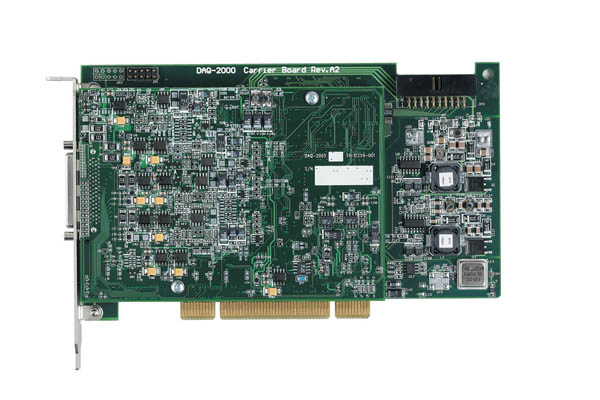
 DAQ_DAQe_2213_2214_Datasheet.pdf
PDF Catalog
DAQ_DAQe_2213_2214_Datasheet.pdf
PDF Catalog