Nuvo-PA-60W
SUCHEN SIE DIE PASSENDE
INDUSTRIELLE LÖSUNG?
Entdecken Sie Embedded-, Kommunikations- und Automatisierungslösungen für Ihre Anwendung.
- ARM‑based Industrial Gateway: Built around the TI Sitara AM3352 1 GHz ARM Cortex‑A8 processor, optimized for low‑power, high‑reliability embedded control.
- Pre‑installed Debian OS: Ships with Debian 8 or 9 for immediate deployment and compatibility with open‑source IoT frameworks.
- Dual microSDHC Storage: One internal and one external T‑Flash slot for flexible OS and data partitioning, simplifying mass deployment and maintenance.
- Rich Industrial I/O:
- 4 × isolated digital inputs and 4 × isolated digital outputs (IGT‑20)
- 2 × software‑configurable RS‑232/422/485 serial ports
- 1 × 10/100 Mbps Ethernet port
- 1 × USB 2.0 host port
- 1 × 3‑wire RS‑232 console port
- Wireless Expansion: Full‑size mini‑PCIe slot (USB 2.0 signal only) and external USIM holder for 3G/4G/LTE or Wi‑Fi modules.
- Programmable Controls: Six user‑programmable LEDs and two user‑programmable buttons for custom functions and system feedback.
- Rugged Design: Fanless operation from –25 °C to +70 °C at 100 % CPU load; vibration tolerance 5 Grms; shock resistance 50 Grms.
- Wide Power Input Range: 8 – 25 V DC input with terminal block connector.
- Compact Footprint: 41 mm (W) × 77 mm (D) × 104 mm (H), weight 0.4 kg.
- DIN‑Rail Mounting: Industrial‑grade mounting kit included for quick installation in control cabinets.
- Compliance: CE/FCC Class A, EN 55032 EMC compliance, shock and vibration certified.
- Pre‑installed Debian OS: Ships with Debian 8 or 9 for immediate deployment and compatibility with open‑source IoT frameworks.
- Dual microSDHC Storage: One internal and one external T‑Flash slot for flexible OS and data partitioning, simplifying mass deployment and maintenance.
- Rich Industrial I/O:
- 4 × isolated digital inputs and 4 × isolated digital outputs (IGT‑20)
- 2 × software‑configurable RS‑232/422/485 serial ports
- 1 × 10/100 Mbps Ethernet port
- 1 × USB 2.0 host port
- 1 × 3‑wire RS‑232 console port
- Wireless Expansion: Full‑size mini‑PCIe slot (USB 2.0 signal only) and external USIM holder for 3G/4G/LTE or Wi‑Fi modules.
- Programmable Controls: Six user‑programmable LEDs and two user‑programmable buttons for custom functions and system feedback.
- Rugged Design: Fanless operation from –25 °C to +70 °C at 100 % CPU load; vibration tolerance 5 Grms; shock resistance 50 Grms.
- Wide Power Input Range: 8 – 25 V DC input with terminal block connector.
- Compact Footprint: 41 mm (W) × 77 mm (D) × 104 mm (H), weight 0.4 kg.
- DIN‑Rail Mounting: Industrial‑grade mounting kit included for quick installation in control cabinets.
- Compliance: CE/FCC Class A, EN 55032 EMC compliance, shock and vibration certified.
Comprehensive Product Summary – Neousys IGT‑20 Industrial IoT Gateway
### 1. Product Overview
Product Name: Neousys IGT‑20
Model: IGT‑20
Series: IGT‑20 / IGT‑21 / IGT‑22 Industrial IoT Gateway Series
Article Number: IGT‑20
Manufacturer: Neousys Technology Inc.
Product Type: Industrial Grade ARM‑based Smart Wireless IoT Gateway
Processor Platform: Texas Instruments Sitara AM3352 ARM Cortex‑A8, 1 GHz
Operating System: Pre‑installed Debian Linux (Debian 8 or Debian 9 depending on configuration)
Intended Use: Industrial Internet of Things (IIoT) gateway for data acquisition, control, and communication in Industry 4.0 environments.
Form Factor: Compact, fanless, DIN‑rail‑mountable embedded box PC.
The Neousys IGT‑20 is part of Neousys’ rugged embedded gateway family designed for industrial automation, remote monitoring, and smart factory applications. It integrates a low‑power ARM processor, isolated digital I/O, serial communication ports, and wireless expansion capability in a compact, robust enclosure suitable for harsh environments.
### 2. Key Features
- ARM‑based Industrial Gateway: Built around the TI Sitara AM3352 1 GHz ARM Cortex‑A8 processor, optimized for low‑power, high‑reliability embedded control.
- Pre‑installed Debian OS: Ships with Debian 8 or 9 for immediate deployment and compatibility with open‑source IoT frameworks.
- Dual microSDHC Storage: One internal and one external T‑Flash slot for flexible OS and data partitioning, simplifying mass deployment and maintenance.
- Rich Industrial I/O:
- 4 × isolated digital inputs and 4 × isolated digital outputs (IGT‑20)
- 2 × software‑configurable RS‑232/422/485 serial ports
- 1 × 10/100 Mbps Ethernet port
- 1 × USB 2.0 host port
- 1 × 3‑wire RS‑232 console port
- Wireless Expansion: Full‑size mini‑PCIe slot (USB 2.0 signal only) and external USIM holder for 3G/4G/LTE or Wi‑Fi modules.
- Programmable Controls: Six user‑programmable LEDs and two user‑programmable buttons for custom functions and system feedback.
- Rugged Design: Fanless operation from –25 °C to +70 °C at 100 % CPU load; vibration tolerance 5 Grms; shock resistance 50 Grms.
- Wide Power Input Range: 8 – 25 V DC input with terminal block connector.
- Compact Footprint: 41 mm (W) × 77 mm (D) × 104 mm (H), weight 0.4 kg.
- DIN‑Rail Mounting: Industrial‑grade mounting kit included for quick installation in control cabinets.
- Compliance: CE/FCC Class A, EN 55032 EMC compliance, shock and vibration certified.
### 3. Technical Specifications
Processor:
- Texas Instruments Sitara AM3352, ARM Cortex‑A8, 1 GHz
Memory:
- 1 GB DDR3L SDRAM (onboard SODIMM)
Storage:
- 1 × internal microSDHC (T‑Flash) slot
- 1 × external microSDHC (T‑Flash) slot (supports SDHC)
Networking:
- 1 × 10/100 Mbps Ethernet (RJ‑45)
USB Interface:
- 1 × USB 2.0 Type‑A host port
Serial Communication:
- 2 × software‑configurable RS‑232/422/485 ports (up to 115.2 kbps, auto‑flow control for RS‑485)
- 1 × 3‑wire RS‑232 console port
Digital I/O:
- 4 × isolated digital inputs (photo‑coupler interface)
- Isolation voltage: 2500 Vrms
- Logic “0”: 5 – 24 V
- Logic “1”: 0 – 1.5 V
- 4 × isolated digital outputs (N‑channel MOSFET)
- Isolation voltage: 2500 Vrms
- Output voltage: up to 24 V DC
- Output current: 100 mA max per channel
- Connector pitch: 3.81 mm
Wireless Expansion:
- 1 × full‑size mini‑PCIe slot (USB 2.0 signal only)
- 1 × external SIM card slot
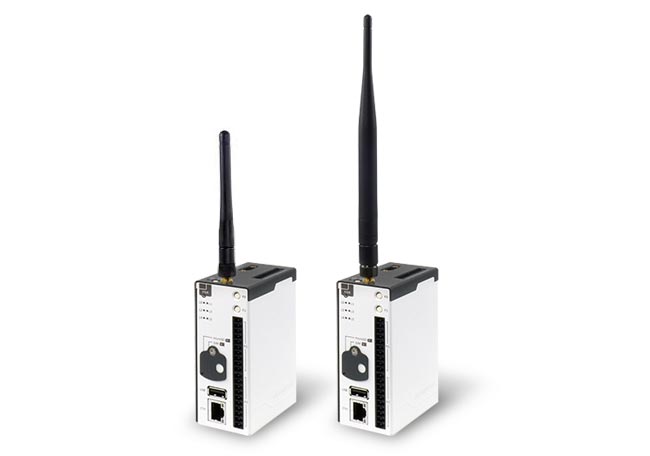
- 1 × antenna opening for SMA connector
Indicators and Controls:
- 6 × user‑programmable LEDs (amber)
- 2 × user‑programmable buttons
- 1 × power button
- 1 × reset button
Power Supply:
- Input voltage: 8 – 25 V DC
- Connector: 3‑pin terminal block (V+, V–, FG)
Mechanical:
- Dimensions: 41 mm (W) × 77 mm (D) × 104 mm (H)
- Weight: 0.4 kg
- Mounting: DIN‑rail mount kit included
Environmental:
- Operating temperature: –25 °C to +70 °C (*wide‑temperature microSD required for sub‑zero operation*)
- Vibration: 5 Grms
- Shock: 50 Grms
- Cooling: Fanless conduction design
Certifications:
- CE/FCC Class A (EN 55032)
- Shock and vibration tested to industrial standards
### 4. Functionality
The IGT‑20 functions as an industrial IoT gateway that bridges field‑level sensors, actuators, and control systems with higher‑level networks or cloud platforms. It collects data from serial devices, digital sensors, or PLCs, processes it locally using Debian Linux, and transmits it via Ethernet or wireless networks.
Typical Use Cases:
- Industrial automation and machine monitoring
- Smart factory and Industry 4.0 data aggregation
- Remote asset management and predictive maintenance
- Environmental and energy monitoring systems
- Edge computing for sensor data pre‑processing
Operation:
- Digital inputs receive discrete signals from sensors, switches, or buttons.
- Digital outputs control actuators, relays, or indicators.
- Serial ports connect to legacy industrial equipment using RS‑232, RS‑422, or RS‑485 protocols.
- Ethernet and optional wireless modules enable data transmission to SCADA systems or cloud servers.
- User‑programmable LEDs and buttons allow custom control logic without external input devices.
Compatibility:
- Compatible with standard Linux software stacks, Python, Node‑RED, and MQTT frameworks.
- Supports integration with 3G/4G LTE modems and Wi‑Fi modules via mini‑PCIe.
### 5. Components & Accessories
Included Items (Packing List):
1. IGT‑20 Gateway unit × 1
2. 3‑pole DC terminal block × 1
3. 10‑pole terminal block × 3 (for DI/DO and serial connections)
4. Cover plate × 1
5. M3 flat screw × 1
6. DIN‑rail clip set × 1
Optional Accessories:
- NSIO‑LTE‑7455: Cat. 6 LTE embedded socket modem for cellular connectivity.
- Wi‑Fi mini‑PCIe module: for wireless LAN communication.
- SMA antenna kit: for external antenna mounting through top panel opening.
Connectors:
- Digital I/O Connectors (2 × 10‑pin): Provide DI/DO and console signals.
- Serial Port Connector (top): RS‑232/422/485 multi‑protocol interface.
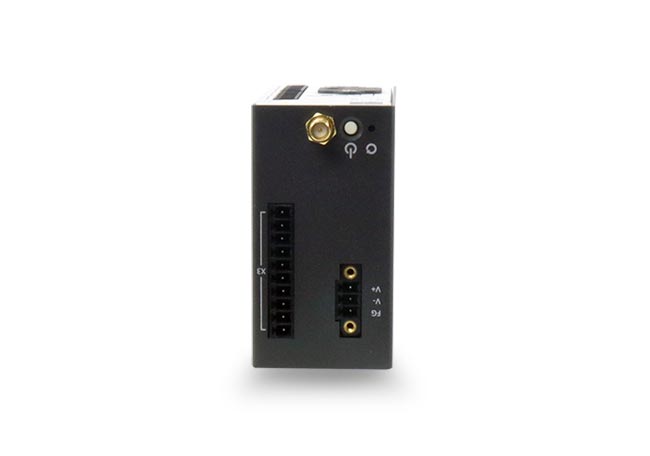
- DC Power Connector (top): 3‑pin (V+, V–, FG).
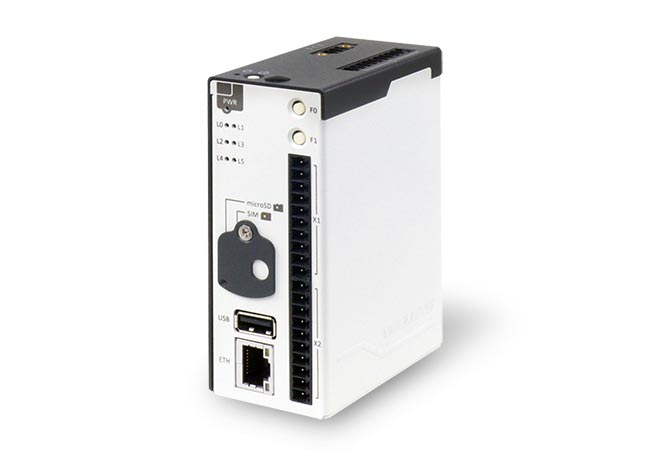
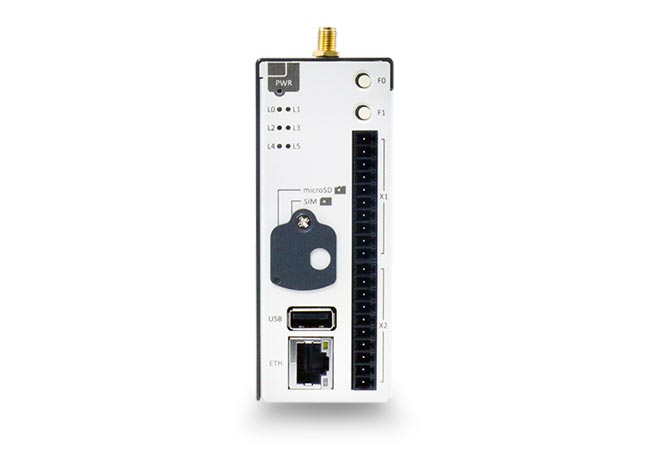
- Ethernet RJ‑45 port, USB 2.0 port, microSD and SIM slots on front panel.
### 6. Installation & Setup
Mounting:
- Designed for DIN‑rail installation using the included clip set.
- Attach mount plate to rear of enclosure with M4 screws, then clip onto DIN rail from top down.
- Verify secure fit to prevent vibration displacement.
Power Connection:
- Connect 8 – 25 V DC input to V+ and V– pins on the 3‑pin terminal block; connect FG to frame ground.
Storage and SIM Installation:
- External microSDHC and SIM slots are behind a front cover plate; remove screw to access.
- Internal microSDHC slot requires enclosure disassembly.
- Cards are not hot‑swappable; power off before insertion or removal.
Wireless Module Installation:
- Remove enclosure cover to access mini‑PCIe slot.
- Insert module at 45° angle, secure with dedicated screw, and route antenna cable to SMA opening.
- Install SMA female connector before reassembling cover.
Initial Login and Configuration:
- Via Console Port: Connect host PC to console pins (CTX, CRX, GND) using cross‑over cable; use PuTTY or similar terminal at 115200 bps; login as `root` (no password by default).
- Via Ethernet: Connect host PC to Ethernet port (192.168.8.2 default IP); set PC IP to 192.168.8.1; SSH login as `root`.
- Change default password after first login for security.
### 7. Performance & Capabilities
Processing Performance:
- 1 GHz ARM Cortex‑A8 CPU suitable for lightweight edge computing, protocol conversion, and data aggregation.
Memory and Storage:
- 1 GB DDR3L RAM supports multi‑threaded Linux applications.
- Dual microSD design enables separation of system and user data for reliability and easy OS deployment.
I/O Throughput:
- Serial ports up to 115.2 kbps with auto‑flow control.
- Ethernet supports 10/100 Mbps full‑duplex communication.
- Digital I/O isolated to 2500 Vrms for noise immunity in industrial environments.
Environmental Performance:
- Operates reliably from –25 °C to +70 °C at full CPU load without active cooling.
- Withstands 5 Grms vibration and 50 Grms shock, suitable for factory and transport applications.
Limitations:
- No native HDMI or display output (terminal access only).
- Limited to USB 2.0 speed and 10/100 Ethernet bandwidth.
- Wireless connectivity requires optional mini‑PCIe module.
### 8. Standards & Compliance
Certifications:
- CE Marking: Complies with European Union directives for EMC and safety.
- FCC Class A: Conforms to Part 15 of FCC Rules for commercial digital devices.
- Shock and Vibration: Tested to industrial standards (5 Grms vibration, 50 Grms shock).
EMC Standard:
- EN 55032 (Class A) for electromagnetic compatibility.
Environmental Compliance:
- Fanless design reduces dust ingress and maintenance requirements.
- Wide‑temperature operation requires industrial‑grade microSD cards for sub‑zero conditions.
Safety Guidelines:
- Installation by qualified personnel only.
- Observe ESD precautions when handling internal modules.
- Disconnect power before servicing or component replacement.
### 9. Additional Information
Warranty and Support:
- Covered under Neousys Technology’s standard hardware warranty policy.
- Firmware and software updates available via Neousys website or authorized service partners.
- Technical support available through regional offices in Taiwan, USA, and China.
Maintenance:
- Fanless design minimizes moving parts and maintenance needs.
- Periodic inspection of terminal connections and cleaning of enclosure recommended.
- Replacement of microSD cards or wireless modules should be performed with power off and ESD protection.
Software Updates and Compatibility:
- Neousys may release updated Debian images or firmware without prior notice.
- Users should verify third‑party software compatibility before installation.
- Supports open‑source development environments for custom IoT applications.
Manufacturer Contact Information:
- Neousys Technology Inc. (Headquarters)
15F, No. 868‑3, Zhongzheng Rd., Zhonghe Dist., New Taipei City 23586, Taiwan
Tel: +886‑2‑2223‑6182 Fax: +886‑2‑2223‑6183
Email: sales@neousys‑tech.com Website: www.neousys‑tech.com
- Neousys Technology America Inc.
3384 Commercial Avenue, Northbrook, IL 60062, USA
Tel: +1‑847‑656‑3298
- Neousys Technology (China) Ltd.
Room 612, Building 32, Guiping Road 680, Shanghai, China
Tel: +86‑21‑61155366
Legal and Trademark Notices:
- Neousys and the Neousys logo are registered trademarks of Neousys Technology Inc.
- Texas Instruments and Sitara are registered trademarks of Texas Instruments Incorporated.
- All other product names and brands are property of their respective owners.
### Summary
The Neousys IGT‑20 is a compact, rugged, and energy‑efficient industrial IoT gateway engineered for reliable operation in demanding environments. Powered by a TI Sitara AM3352 1 GHz ARM Cortex‑A8 processor and pre‑installed with Debian Linux, it provides a flexible platform for edge computing, data acquisition, and industrial communication. Its combination of isolated DI/DO, multi‑protocol serial ports, Ethernet, and wireless expansion options makes it ideal for connecting legacy equipment to modern IoT networks.
With a wide operating temperature range, fanless design, and DIN‑rail mounting, the IGT‑20 is optimized for industrial automation, machine monitoring, and remote data collection applications where reliability and longevity are paramount.

### 1. Product Overview
Product Name: Neousys IGT‑20
Model: IGT‑20
Series: IGT‑20 / IGT‑21 / IGT‑22 Industrial IoT Gateway Series
Article Number: IGT‑20
Manufacturer: Neousys Technology Inc.
Product Type: Industrial Grade ARM‑based Smart Wireless IoT Gateway
Processor Platform: Texas Instruments Sitara AM3352 ARM Cortex‑A8, 1 GHz
Operating System: Pre‑installed Debian Linux (Debian 8 or Debian 9 depending on configuration)
Intended Use: Industrial Internet of Things (IIoT) gateway for data acquisition, control, and communication in Industry 4.0 environments.
Form Factor: Compact, fanless, DIN‑rail‑mountable embedded box PC.
The Neousys IGT‑20 is part of Neousys’ rugged embedded gateway family designed for industrial automation, remote monitoring, and smart factory applications. It integrates a low‑power ARM processor, isolated digital I/O, serial communication ports, and wireless expansion capability in a compact, robust enclosure suitable for harsh environments.
### 2. Key Features
- ARM‑based Industrial Gateway: Built around the TI Sitara AM3352 1 GHz ARM Cortex‑A8 processor, optimized for low‑power, high‑reliability embedded control.
- Pre‑installed Debian OS: Ships with Debian 8 or 9 for immediate deployment and compatibility with open‑source IoT frameworks.
- Dual microSDHC Storage: One internal and one external T‑Flash slot for flexible OS and data partitioning, simplifying mass deployment and maintenance.
- Rich Industrial I/O:
- 4 × isolated digital inputs and 4 × isolated digital outputs (IGT‑20)
- 2 × software‑configurable RS‑232/422/485 serial ports
- 1 × 10/100 Mbps Ethernet port
- 1 × USB 2.0 host port
- 1 × 3‑wire RS‑232 console port
- Wireless Expansion: Full‑size mini‑PCIe slot (USB 2.0 signal only) and external USIM holder for 3G/4G/LTE or Wi‑Fi modules.
- Programmable Controls: Six user‑programmable LEDs and two user‑programmable buttons for custom functions and system feedback.
- Rugged Design: Fanless operation from –25 °C to +70 °C at 100 % CPU load; vibration tolerance 5 Grms; shock resistance 50 Grms.
- Wide Power Input Range: 8 – 25 V DC input with terminal block connector.
- Compact Footprint: 41 mm (W) × 77 mm (D) × 104 mm (H), weight 0.4 kg.
- DIN‑Rail Mounting: Industrial‑grade mounting kit included for quick installation in control cabinets.
- Compliance: CE/FCC Class A, EN 55032 EMC compliance, shock and vibration certified.
### 3. Technical Specifications
Processor:
- Texas Instruments Sitara AM3352, ARM Cortex‑A8, 1 GHz
Memory:
- 1 GB DDR3L SDRAM (onboard SODIMM)
Storage:
- 1 × internal microSDHC (T‑Flash) slot
- 1 × external microSDHC (T‑Flash) slot (supports SDHC)
Networking:
- 1 × 10/100 Mbps Ethernet (RJ‑45)
USB Interface:
- 1 × USB 2.0 Type‑A host port
Serial Communication:
- 2 × software‑configurable RS‑232/422/485 ports (up to 115.2 kbps, auto‑flow control for RS‑485)
- 1 × 3‑wire RS‑232 console port
Digital I/O:
- 4 × isolated digital inputs (photo‑coupler interface)
- Isolation voltage: 2500 Vrms
- Logic “0”: 5 – 24 V
- Logic “1”: 0 – 1.5 V
- 4 × isolated digital outputs (N‑channel MOSFET)
- Isolation voltage: 2500 Vrms
- Output voltage: up to 24 V DC
- Output current: 100 mA max per channel
- Connector pitch: 3.81 mm
Wireless Expansion:
- 1 × full‑size mini‑PCIe slot (USB 2.0 signal only)
- 1 × external SIM card slot
- 1 × antenna opening for SMA connector
Indicators and Controls:
- 6 × user‑programmable LEDs (amber)
- 2 × user‑programmable buttons
- 1 × power button
- 1 × reset button
Power Supply:
- Input voltage: 8 – 25 V DC
- Connector: 3‑pin terminal block (V+, V–, FG)
Mechanical:
- Dimensions: 41 mm (W) × 77 mm (D) × 104 mm (H)
- Weight: 0.4 kg
- Mounting: DIN‑rail mount kit included
Environmental:
- Operating temperature: –25 °C to +70 °C (*wide‑temperature microSD required for sub‑zero operation*)
- Vibration: 5 Grms
- Shock: 50 Grms
- Cooling: Fanless conduction design
Certifications:
- CE/FCC Class A (EN 55032)
- Shock and vibration tested to industrial standards
### 4. Functionality
The IGT‑20 functions as an industrial IoT gateway that bridges field‑level sensors, actuators, and control systems with higher‑level networks or cloud platforms. It collects data from serial devices, digital sensors, or PLCs, processes it locally using Debian Linux, and transmits it via Ethernet or wireless networks.
Typical Use Cases:
- Industrial automation and machine monitoring
- Smart factory and Industry 4.0 data aggregation
- Remote asset management and predictive maintenance
- Environmental and energy monitoring systems
- Edge computing for sensor data pre‑processing
Operation:
- Digital inputs receive discrete signals from sensors, switches, or buttons.
- Digital outputs control actuators, relays, or indicators.
- Serial ports connect to legacy industrial equipment using RS‑232, RS‑422, or RS‑485 protocols.
- Ethernet and optional wireless modules enable data transmission to SCADA systems or cloud servers.
- User‑programmable LEDs and buttons allow custom control logic without external input devices.
Compatibility:
- Compatible with standard Linux software stacks, Python, Node‑RED, and MQTT frameworks.
- Supports integration with 3G/4G LTE modems and Wi‑Fi modules via mini‑PCIe.
### 5. Components & Accessories
Included Items (Packing List):
1. IGT‑20 Gateway unit × 1
2. 3‑pole DC terminal block × 1
3. 10‑pole terminal block × 3 (for DI/DO and serial connections)
4. Cover plate × 1
5. M3 flat screw × 1
6. DIN‑rail clip set × 1
Optional Accessories:
- NSIO‑LTE‑7455: Cat. 6 LTE embedded socket modem for cellular connectivity.
- Wi‑Fi mini‑PCIe module: for wireless LAN communication.
- SMA antenna kit: for external antenna mounting through top panel opening.
Connectors:
- Digital I/O Connectors (2 × 10‑pin): Provide DI/DO and console signals.
- Serial Port Connector (top): RS‑232/422/485 multi‑protocol interface.
- DC Power Connector (top): 3‑pin (V+, V–, FG).
- Ethernet RJ‑45 port, USB 2.0 port, microSD and SIM slots on front panel.
### 6. Installation & Setup
Mounting:
- Designed for DIN‑rail installation using the included clip set.
- Attach mount plate to rear of enclosure with M4 screws, then clip onto DIN rail from top down.
- Verify secure fit to prevent vibration displacement.
Power Connection:
- Connect 8 – 25 V DC input to V+ and V– pins on the 3‑pin terminal block; connect FG to frame ground.
Storage and SIM Installation:
- External microSDHC and SIM slots are behind a front cover plate; remove screw to access.
- Internal microSDHC slot requires enclosure disassembly.
- Cards are not hot‑swappable; power off before insertion or removal.
Wireless Module Installation:
- Remove enclosure cover to access mini‑PCIe slot.
- Insert module at 45° angle, secure with dedicated screw, and route antenna cable to SMA opening.
- Install SMA female connector before reassembling cover.
Initial Login and Configuration:
- Via Console Port: Connect host PC to console pins (CTX, CRX, GND) using cross‑over cable; use PuTTY or similar terminal at 115200 bps; login as `root` (no password by default).
- Via Ethernet: Connect host PC to Ethernet port (192.168.8.2 default IP); set PC IP to 192.168.8.1; SSH login as `root`.
- Change default password after first login for security.
### 7. Performance & Capabilities
Processing Performance:
- 1 GHz ARM Cortex‑A8 CPU suitable for lightweight edge computing, protocol conversion, and data aggregation.
Memory and Storage:
- 1 GB DDR3L RAM supports multi‑threaded Linux applications.
- Dual microSD design enables separation of system and user data for reliability and easy OS deployment.
I/O Throughput:
- Serial ports up to 115.2 kbps with auto‑flow control.
- Ethernet supports 10/100 Mbps full‑duplex communication.
- Digital I/O isolated to 2500 Vrms for noise immunity in industrial environments.
Environmental Performance:
- Operates reliably from –25 °C to +70 °C at full CPU load without active cooling.
- Withstands 5 Grms vibration and 50 Grms shock, suitable for factory and transport applications.
Limitations:
- No native HDMI or display output (terminal access only).
- Limited to USB 2.0 speed and 10/100 Ethernet bandwidth.
- Wireless connectivity requires optional mini‑PCIe module.
### 8. Standards & Compliance
Certifications:
- CE Marking: Complies with European Union directives for EMC and safety.
- FCC Class A: Conforms to Part 15 of FCC Rules for commercial digital devices.
- Shock and Vibration: Tested to industrial standards (5 Grms vibration, 50 Grms shock).
EMC Standard:
- EN 55032 (Class A) for electromagnetic compatibility.
Environmental Compliance:
- Fanless design reduces dust ingress and maintenance requirements.
- Wide‑temperature operation requires industrial‑grade microSD cards for sub‑zero conditions.
Safety Guidelines:
- Installation by qualified personnel only.
- Observe ESD precautions when handling internal modules.
- Disconnect power before servicing or component replacement.
### 9. Additional Information
Warranty and Support:
- Covered under Neousys Technology’s standard hardware warranty policy.
- Firmware and software updates available via Neousys website or authorized service partners.
- Technical support available through regional offices in Taiwan, USA, and China.
Maintenance:
- Fanless design minimizes moving parts and maintenance needs.
- Periodic inspection of terminal connections and cleaning of enclosure recommended.
- Replacement of microSD cards or wireless modules should be performed with power off and ESD protection.
Software Updates and Compatibility:
- Neousys may release updated Debian images or firmware without prior notice.
- Users should verify third‑party software compatibility before installation.
- Supports open‑source development environments for custom IoT applications.
Manufacturer Contact Information:
- Neousys Technology Inc. (Headquarters)
15F, No. 868‑3, Zhongzheng Rd., Zhonghe Dist., New Taipei City 23586, Taiwan
Tel: +886‑2‑2223‑6182 Fax: +886‑2‑2223‑6183
Email: sales@neousys‑tech.com Website: www.neousys‑tech.com
- Neousys Technology America Inc.
3384 Commercial Avenue, Northbrook, IL 60062, USA
Tel: +1‑847‑656‑3298
- Neousys Technology (China) Ltd.
Room 612, Building 32, Guiping Road 680, Shanghai, China
Tel: +86‑21‑61155366
Legal and Trademark Notices:
- Neousys and the Neousys logo are registered trademarks of Neousys Technology Inc.
- Texas Instruments and Sitara are registered trademarks of Texas Instruments Incorporated.
- All other product names and brands are property of their respective owners.
### Summary
The Neousys IGT‑20 is a compact, rugged, and energy‑efficient industrial IoT gateway engineered for reliable operation in demanding environments. Powered by a TI Sitara AM3352 1 GHz ARM Cortex‑A8 processor and pre‑installed with Debian Linux, it provides a flexible platform for edge computing, data acquisition, and industrial communication. Its combination of isolated DI/DO, multi‑protocol serial ports, Ethernet, and wireless expansion options makes it ideal for connecting legacy equipment to modern IoT networks.
With a wide operating temperature range, fanless design, and DIN‑rail mounting, the IGT‑20 is optimized for industrial automation, machine monitoring, and remote data collection applications where reliability and longevity are paramount.
-
IGT-20_21_22_Datasheet.pdf
PDF Catalog
- Nuvo-PA-60W - 60W AC/DC Power Adapter for Nuvo-100x/20xx and POC series