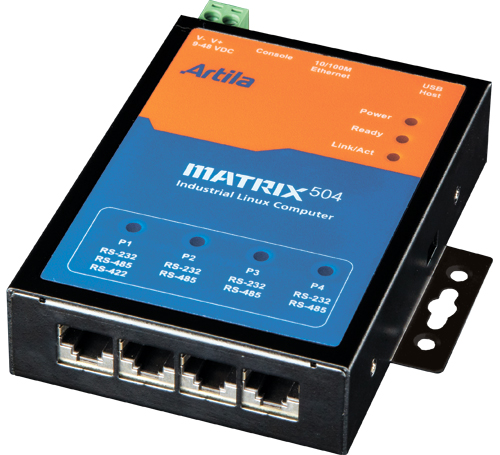
1. Product Overview
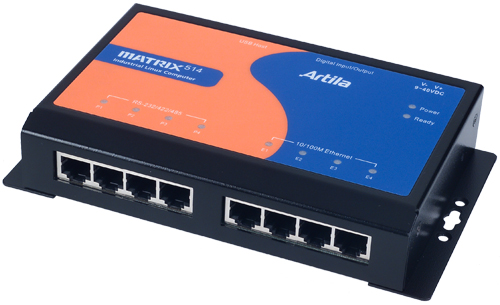
Product Name: Matrix-514
Model: Matrix-514
Series: Matrix Embedded Computer Series
Article Number: Matrix-514
Manufacturer: Artila Electronics Co., Ltd.
The Matrix-514 is an industrial-grade, ARM9-based embedded Linux computer designed for headless, run-only applications in automation, networking, and data acquisition environments. Built around the Atmel AT91RM9200 ARM9 processor running at 180 MHz, it integrates a rich set of communication interfaces including four 10/100 Mbps Ethernet ports, four RS-232/422/485 serial ports, two USB 2.0 host ports, and twenty-one programmable digital I/O channels. The system operates on a Linux 2.6.x kernel, offering a stable, open-source platform for embedded development. With its fanless metal enclosure, DIN-rail mount capability, and wide 9–40 VDC power input range, the Matrix-514 is engineered for reliability in industrial and embedded network applications.
2. Key Features
- ARM9 Processor Core: Powered by the Atmel AT91RM9200 ARM920T CPU (180 MHz, 200 MIPS) with integrated Memory Management Unit (MMU), 16 KB instruction cache, and 16 KB data cache.
- Linux-Ready Platform: Pre-installed Linux 2.6.x kernel with U-Boot 1.1.2 bootloader and full support for JFFS2, EXT2/EXT3, VFAT/FAT, and NFS file systems.
- Multi-Port Networking: Four independent 10/100Base-T Ethernet ports (RJ-45 connectors) with 1.5 kV magnetic isolation for robust wired networking.
- Flexible Serial Communication: Four software-selectable RS-232/422/485 ports (DB9 male connectors), supporting baud rates up to 921.6 Kbps. Port 2 includes full modem control signals.
- USB Expansion: Two USB 2.0 host ports supporting low-speed (1.5 Mbps) and full-speed (12 Mbps) devices such as flash drives, Wi-Fi dongles, and serial adapters.
- Digital I/O: 21 programmable TTL/CMOS-level GPIO pins accessible via DB25 connector, configurable individually as input or output.
- Storage Options: 16 MB onboard NOR Flash, 64 MB SDRAM, and one internal SD slot (SD 1.0 compliant, up to 2 GB non-SDHC).
- Low Power Consumption: Typical power draw of 300 mA at 12 VDC (less than 3 W total).
- Industrial Design: Fanless, compact metal enclosure (160 × 104 × 32 mm) suitable for DIN-rail or wall mounting.
- Wide Power Range: Operates from 9 to 40 VDC input, ensuring compatibility with industrial power systems.
- Operating Temperature: 0°C to 70°C (32°F to 158°F).
- Comprehensive Networking Stack: Supports IPv4, TCP/IP, UDP, DHCP, NTP, FTP, Telnet, HTTP, PPP, PPPoE, SNMP v1/v2, SSL, and SSH 1.0/2.0.
- Open Development Environment: Includes GNU C/C++ cross-compilation toolchain for Linux and Windows (via Cygwin).
- Security and Management: Integrated SSH, SSL, SNMP, and firewall (iptables) support.
- Optional Accessories: DIN-rail mounting kit, serial console cable, and RJ45-to-DB9 adapter cables.
3. Technical Specifications
Processor & Memory
- CPU: Atmel AT91RM9200 (ARM9, 180 MHz, 200 MIPS)
- Architecture: ARM920T with MMU
- Cache: 16 KB instruction, 16 KB data
- SDRAM: 64 MB
- Flash Memory: 16 MB NOR type
Networking
- Ethernet Ports: 4 × 10/100Base-T (RJ-45)
- Isolation: 1.5 kV magnetic isolation
- Daisy Chain Support: Bridge configuration via software (brctl)
Serial Communication
- Ports: 4 × RS-232/422/485 (software selectable)
- Connector: DB9 male
- Baud Rate: Up to 921.6 Kbps
- Parity: None, Even, Odd, Mark, Space
- Data Bits: 5, 6, 7, 8
- Stop Bits: 1, 1.5, 2
- Flow Control: RTS/CTS, XON/XOFF, None
- Modem Control: Supported on Port 2
USB Interface
- Ports: 2 × USB 2.0 Host
- Data Rate: 1.5 Mbps (low speed), 12 Mbps (full speed)
- Supported Devices: Flash disks, Wi-Fi dongles (IEEE 802.11b/g), USB-to-Serial adapters
Digital I/O (GPIO)
- Channels: 21 TTL/CMOS-level I/O pins
- Connector: DB25 female
- Voltage Outputs: VCC3 (3.3 VDC), VCC5 (5 VDC)
- Ground: Digital GND
- Programmable: Each pin configurable as input or output
Storage
- Internal Flash: 16 MB NOR
- SD Slot: 1 × SD 1.0 compliant (up to 2 GB, non-SDHC)
- File Systems: JFFS2, EXT2/EXT3, VFAT/FAT, NFS
Power & Environmental
- Input Voltage: 9–40 VDC
- Power Consumption: 300 mA @ 12 VDC (approx. 3 W)
- Operating Temperature: 0°C to 70°C
- Dimensions: 160 × 104 × 32 mm
- Enclosure: Fanless metal housing
- Mounting: Wall or DIN-rail (optional DK-35A kit)
- Certifications: CE Class A, FCC Class A
Indicators & Controls
- Power LED: Solid green when powered
- Ready LED: Solid green after successful boot
- Link/Act LEDs: Indicate Ethernet link and activity
- Serial Port LEDs: Dual-color (RXD = green, TXD = yellow)
- Reset Button: Hardware reset
4. Functionality
The Matrix-514 functions as a compact, embedded Linux web server and controller for industrial automation, networking, and data acquisition. It operates headlessly, meaning no display or keyboard is required, and is managed via network or serial interfaces.
Use Cases:
- Industrial automation controllers
- Data acquisition and logging systems
- Network gateways and protocol converters
- Remote monitoring and control nodes
- Embedded web servers for equipment management
- IoT edge computing devices
Operation:
The device boots from onboard Flash using U-Boot, loads the Linux 2.6.x kernel, and mounts a RAM-based root filesystem with a persistent Flash-based user disk (/disk). Users can access the system via SSH, Telnet, or serial console. Configuration files and user applications are stored in the Flash-based /disk partition to ensure persistence across reboots.
Compatibility:
- Supports standard Linux networking and file system utilities
- Compatible with USB Wi-Fi dongles (Ralink RT73 chipset) for wireless networking
- Works with standard Linux and Windows development environments via GNU toolchain
5. Components & Accessories
Included Items:
1. Matrix-514 embedded computer
2. Wall-mount bracket
3. Artila CD containing:
- GNU C/C++ toolchain
- User guide and documentation
- Example programs and utilities
Optional Accessories:
- CB-RJ45F9-150: RJ45-to-DB9 female serial cable
- CB-RJ2CON-100: Serial console cable
- DK-35A: DIN-rail mounting kit
Connectors:
- 4 × RJ-45 Ethernet ports
- 4 × DB9 serial ports
- 2 × USB Type-A host ports
- 1 × DB25 digital I/O port
- 1 × Power input terminal block
6. Installation & Setup
Power Requirements:
Supply 9–40 VDC regulated power. The Power LED should illuminate green upon successful power application.
Mounting Options:
- Wall mounting (default bracket included)
- DIN-rail mounting (optional DK-35A kit)
Network Configuration:
Factory default IP settings:
- LAN1: 192.168.2.127
- LAN2: DHCP
- LAN3: 192.168.3.127
- LAN4: 192.168.4.127
Login credentials:
- User: guest / guest
- Supervisor: root / root
Serial Console Setup:
- Baud rate: 115200
- Data bits: 8
- Parity: None
- Stop bits: 1
- Terminal type: ANSI
Wireless Configuration:
Supports USB Wi-Fi adapters (Ralink RT73). Configure using:
```
ifconfig wlan0 up
iwconfig wlan0 essid <SSID> key <KEY> mode managed
dhcpcd wlan0 &
```
File System Layout:
- Root filesystem: RAMDISK (volatile, 8 MB)
- User disk (/disk): Flash-based (persistent, ~11 MB)
- User programs must be stored in /disk to survive power cycles.
7. Performance & Capabilities
- Processing Speed: 180 MHz ARM9 CPU (200 MIPS)
- Memory Performance: 64 MB SDRAM ensures smooth multitasking for embedded applications.
- Networking Throughput: Four 10/100 Mbps Ethernet interfaces allow simultaneous multi-network operation or bridging.
- Serial Communication: Up to 921.6 Kbps per port, supporting industrial protocols such as Modbus RTU/TCP.
- Power Efficiency: Consumes less than 3 W, ideal for continuous operation in energy-sensitive environments.
- Storage Capacity: Expandable via SD card (up to 2 GB) and USB flash drives.
- Reliability: Watchdog timer and real-time clock ensure stable operation and time synchronization.
- Limitations: SD slot supports only non-SDHC cards (≤2 GB). Operating temperature limited to 70°C.
8. Standards & Compliance
- Regulatory Certifications:
- CE Class A (EMC compliance for industrial environments)
- FCC Class A (U.S. electromagnetic emission compliance)
- Software Standards:
- POSIX-compliant C/C++ libraries (GLIBC)
- GNU toolchain compatibility
- Linux 2.6.x kernel compliance
- Network Protocols Supported:
IPv4, ICMP, ARP, DHCP, NTP, TCP, UDP, FTP, Telnet, HTTP, PPP, PPPoE, CHAP, PAP, SMTP, SNMP v1/v2, SSL, SSH 1.0/2.0
- Security Standards:
- SSH and SSL encryption for secure remote access
- iptables firewall management
9. Additional Information
Warranty & Support:
Artila Electronics provides standard warranty coverage for manufacturing defects. Technical support and firmware updates are available through Artila’s official website and support channels.
Maintenance:
- Periodically check power and network connections.
- Use the `update` utility (supervisor mode only) to refresh loader, kernel, or filesystem images.
- Use `gpioctl` and `setuart` utilities for I/O and serial configuration.
- Store user applications in `/disk` to prevent data loss after power cycles.
Software Updates & Development:
- Firmware and utilities can be updated via FTP or SSH.
- Development supported under Linux or Windows (via Cygwin).
- Example programs and source code provided on Artila CD.
- Remote debugging supported using `gdbserver` and DDD.
Toolchain Installation:
- Linux: Extract `arm-linux-3.3.2.tar.gz` and install under root directory.
- Windows: Install Cygwin environment and unzip `arm-linux-cygwin.zip` to `C:\cygwin`.
Utility Software Included:
- BusyBox utilities
- Artila-specific tools: `update`, `setuart`, `gpioctl`
- Network daemons: `boa` (web server), `sshd`, `ftpd`, `telnetd`, `snmpd`, `inetd`, `pppd`
- Development tools: GCC, GLIBC, make, ftp, bash
Example Applications:
- Embedded web server hosting via Boa (HTML files in `/home/httpd`)
- Network bridging using `brctl` for daisy-chain Ethernet connections
- Real-time clock synchronization via NTP client
- GPIO control for digital input/output automation
Summary:
The Artila Matrix-514 is a compact, Linux-based embedded computer optimized for industrial and networked applications. Its combination of multiple Ethernet ports, flexible serial interfaces, programmable digital I/O, and open-source software environment makes it a versatile platform for system integrators and developers. With robust hardware design, low power consumption, and comprehensive software support, the Matrix-514 delivers reliable performance for embedded control, communication, and automation tasks in industrial and commercial environments.



 SUCHEN SIE DIE PASSENDE
 ds_matrix514.pdf
PDF Catalog
ds_matrix514.pdf
PDF Catalog
 Warranty Declaration.pdf
PDF Catalog
Warranty Declaration.pdf
PDF Catalog
 matrix514_QIG.pdf
Manual
matrix514_QIG.pdf
Manual
 Serial Console Cable.pdf
Manual
Serial Console Cable.pdf
Manual
 gdbserver_HOW_TO.pdf
Manual
gdbserver_HOW_TO.pdf
Manual