 SUCHEN SIE DIE PASSENDE
INDUSTRIELLE LÖSUNG?
Entdecken Sie Embedded-, Kommunikations- und Automatisierungslösungen für Ihre Anwendung.
- Universal Analog Input Capability:
Supports voltage, current, and thermocouple inputs on each of 16 channels.
Configurable per channel for ±100 mV, ±500 mV, ±1 V, ±5 V, ±10 V, 0–100 mV, 0–500 mV, 0–1 V, 0–5 V, 0–10 V, ±20 mA, 0–20 mA, 4–20 mA, and thermocouple types J, K, T, E, R, S, B, N.
- High‑Resolution Data Acquisition:
16‑bit A/D conversion with 2.5 samples/sec per channel, ±0.1 % FSR accuracy.
- Independent Channel Configuration:
Each channel can be individually set for voltage, current, or thermocouple input, enabling mixed‑signal acquisition within one module.
- Cold Junction Compensation (CJC):
Integrated thermal sensor for automatic CJC when using thermocouples.
- Sensor Burn‑Out and Disconnection Detection:
Detects open‑circuit or failed sensors for voltage, current, and thermocouple inputs.
- High Isolation and Protection:
3 kV DC isolation between power, communication, and I/O; ±35 V input overvoltage protection; 240 V channel‑to‑channel isolation.
- Wide Power Supply Range:
Operates from +10 V DC to +60 V DC (ripple ≤ 5 V p‑p).
- Compact, Space‑Saving Design:
Slim 47.2 mm vertical housing allows dense DIN‑rail installation; up to 1.5× more modules per panel compared to conventional flat designs.
- Hot‑Swap and Auto‑Configuration:
Modules can be replaced without rewiring; configuration stored in removable EEPROM for quick restoration.
- Programmable Power‑On and Safety Values:
Ensures safe output states during startup or communication failure.
- Easy Node Addressing:
Two rotary switches for Modbus node address (1–247) – no PC required.
- Diagnostic LED Indicators:
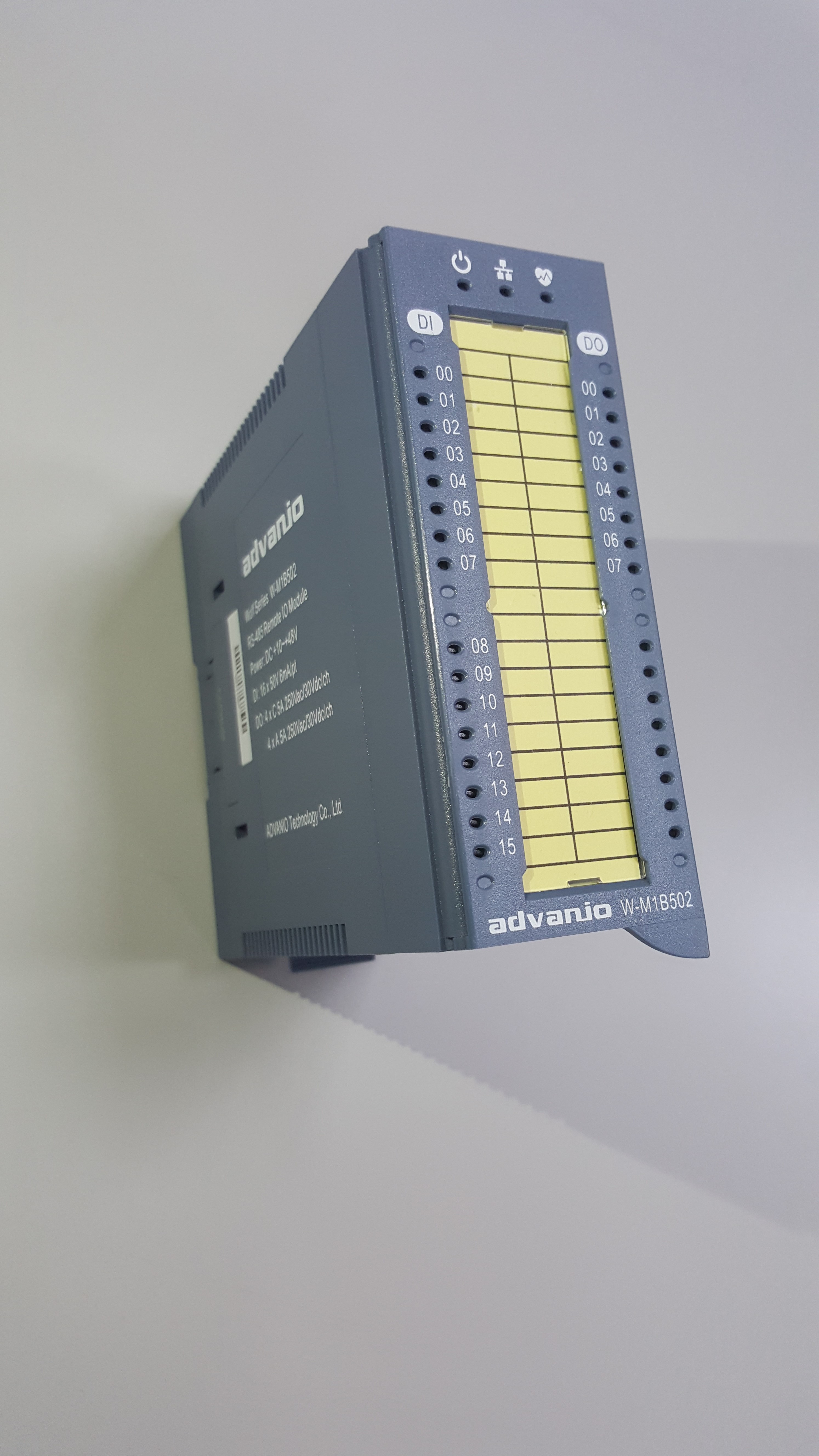
Three front LEDs display power, communication, and system status for quick on‑site troubleshooting.
- Rugged Industrial Reliability:
Built‑in hardware and system watchdogs automatically recover from communication or system faults.
- Modbus/RTU Communication:
Baud rates from 1200 bps to 115.2 kbps; communication distance up to 1.2 km over RS‑485.
Supports voltage, current, and thermocouple inputs on each of 16 channels.
Configurable per channel for ±100 mV, ±500 mV, ±1 V, ±5 V, ±10 V, 0–100 mV, 0–500 mV, 0–1 V, 0–5 V, 0–10 V, ±20 mA, 0–20 mA, 4–20 mA, and thermocouple types J, K, T, E, R, S, B, N.
- High‑Resolution Data Acquisition:
16‑bit A/D conversion with 2.5 samples/sec per channel, ±0.1 % FSR accuracy.
- Independent Channel Configuration:
Each channel can be individually set for voltage, current, or thermocouple input, enabling mixed‑signal acquisition within one module.
- Cold Junction Compensation (CJC):
Integrated thermal sensor for automatic CJC when using thermocouples.
- Sensor Burn‑Out and Disconnection Detection:
Detects open‑circuit or failed sensors for voltage, current, and thermocouple inputs.
- High Isolation and Protection:
3 kV DC isolation between power, communication, and I/O; ±35 V input overvoltage protection; 240 V channel‑to‑channel isolation.
- Wide Power Supply Range:
Operates from +10 V DC to +60 V DC (ripple ≤ 5 V p‑p).
- Compact, Space‑Saving Design:
Slim 47.2 mm vertical housing allows dense DIN‑rail installation; up to 1.5× more modules per panel compared to conventional flat designs.
- Hot‑Swap and Auto‑Configuration:
Modules can be replaced without rewiring; configuration stored in removable EEPROM for quick restoration.
- Programmable Power‑On and Safety Values:
Ensures safe output states during startup or communication failure.
- Easy Node Addressing:
Two rotary switches for Modbus node address (1–247) – no PC required.
- Diagnostic LED Indicators:
Three front LEDs display power, communication, and system status for quick on‑site troubleshooting.
- Rugged Industrial Reliability:
Built‑in hardware and system watchdogs automatically recover from communication or system faults.
- Modbus/RTU Communication:
Baud rates from 1200 bps to 115.2 kbps; communication distance up to 1.2 km over RS‑485.
Comprehensive Product Summary – Advanio W‑M1B106 16‑Channel Universal Analog Input RS‑485 Modbus Module
### 1. Product Overview
Product Name: Wolf Series RS‑485 Remote I/O Module
Model: W‑M1B106
Series: Wolf (W‑M1) Series – RS‑485 Remote I/O Family
Article Number: W‑M1B106
Manufacturer: Advanio Technology Co., Ltd.
Product Type: 16‑Channel Universal Analog Input Module (Voltage/Current/Thermocouple)
Communication Interface: RS‑485, Modbus/RTU Protocol
Manufacturer Background:
Advanio Technology Co., Ltd. is a Taiwan‑based industrial automation and IoT solutions provider specializing in advanced I/O and data acquisition technologies. Founded by engineers with over 20 years of field experience, Advanio designs rugged, modular, and intelligent I/O systems for Industry 4.0, smart factories, and embedded control applications. The Wolf Series represents Advanio’s flagship line of modular RS‑485 remote I/O devices, engineered for reliability, compactness, and ease of integration in harsh industrial environments.
### 2. Key Features
- Universal Analog Input Capability:
Supports voltage, current, and thermocouple inputs on each of 16 channels.
Configurable per channel for ±100 mV, ±500 mV, ±1 V, ±5 V, ±10 V, 0–100 mV, 0–500 mV, 0–1 V, 0–5 V, 0–10 V, ±20 mA, 0–20 mA, 4–20 mA, and thermocouple types J, K, T, E, R, S, B, N.
- High‑Resolution Data Acquisition:
16‑bit A/D conversion with 2.5 samples/sec per channel, ±0.1 % FSR accuracy.
- Independent Channel Configuration:
Each channel can be individually set for voltage, current, or thermocouple input, enabling mixed‑signal acquisition within one module.
- Cold Junction Compensation (CJC):
Integrated thermal sensor for automatic CJC when using thermocouples.
- Sensor Burn‑Out and Disconnection Detection:
Detects open‑circuit or failed sensors for voltage, current, and thermocouple inputs.
- High Isolation and Protection:
3 kV DC isolation between power, communication, and I/O; ±35 V input overvoltage protection; 240 V channel‑to‑channel isolation.
- Wide Power Supply Range:
Operates from +10 V DC to +60 V DC (ripple ≤ 5 V p‑p).
- Compact, Space‑Saving Design:
Slim 47.2 mm vertical housing allows dense DIN‑rail installation; up to 1.5× more modules per panel compared to conventional flat designs.
- Hot‑Swap and Auto‑Configuration:
Modules can be replaced without rewiring; configuration stored in removable EEPROM for quick restoration.
- Programmable Power‑On and Safety Values:
Ensures safe output states during startup or communication failure.
- Easy Node Addressing:
Two rotary switches for Modbus node address (1–247) – no PC required.
- Diagnostic LED Indicators:
Three front LEDs display power, communication, and system status for quick on‑site troubleshooting.
- Rugged Industrial Reliability:
Built‑in hardware and system watchdogs automatically recover from communication or system faults.
- Modbus/RTU Communication:
Baud rates from 1200 bps to 115.2 kbps; communication distance up to 1.2 km over RS‑485.
### 3. Technical Specifications
| Parameter | Specification |
|----------------|------------------|
| Channels | 16 differential analog input channels |
| Input Types | Voltage, Current, Thermocouple (J/K/T/E/R/S/B/N) |
| Voltage Ranges | ±100 mV, ±500 mV, ±1 V, ±5 V, ±10 V, 0–100 mV, 0–500 mV, 0–1 V, 0–5 V, 0–10 V |
| Current Ranges | ±20 mA, 0–20 mA, 4–20 mA (DIP switch selectable) |
| Thermocouple Types | J, K, T, E, R, S, B, N |
| Resolution | 16 bits |
| Sampling Rate | 2.5 samples/sec per channel |
| Accuracy | ±0.1 % FSR |
| Input Impedance | Voltage: 2 MΩ; Current: 120 Ω |
| Common‑Mode Voltage | 35 V max |
| Input Protection | ±35 V continuous |
| Isolation Voltage | 3000 V DC (power, communication, I/O) |
| CMR (50/60 Hz) | 120 dB |
| NMR (50/60 Hz) | 100 dB |
| Span Drift | ±25 ppm/°C |
| Zero Drift | ±6 µV/°C |
| Power Supply | +10 V DC – +60 V DC (reverse polarity protected) |
| Power Consumption | 2.8 W @ 24 V DC |
| Communication Interface | RS‑485, Modbus/RTU |
| Baud Rate | 1200 – 115.2 kbps |
| Communication Distance | Up to 1.2 km |
| Connectors | Plug‑in terminal blocks (#16–30 AWG) |
| Operating Temperature | −25 °C to +70 °C |
| Storage Temperature | −30 °C to +75 °C |
| Humidity | 5 – 95 % RH (non‑condensing) |
| Isolation Protection | 3 kV DC between I/O, power, and communication |
| Dimensions | 47.2 mm (W) × 115.2 mm (H) × 126.7 mm (D) (approx.) |
| Mounting | DIN‑rail 35 mm or wall‑mount |
| Weight | Approx. 130 g |
| Enclosure Material | Industrial‑grade flame‑retardant plastic |
### 4. Functionality
Operating Principle:
The W‑M1B106 converts analog sensor signals into digital data via 16‑bit A/D converters. Each pair of channels shares one ADC, allowing independent configuration per group. The module communicates with a host controller (PLC, PAC, or PC) using the Modbus/RTU protocol over RS‑485. The host polls the module for data, and the module responds with measured values in hexadecimal or engineering units.
Use Cases and Applications:
- Industrial process monitoring and control
- Remote data acquisition systems
- Energy management and power distribution monitoring
- Building automation and HVAC systems
- Laboratory instrumentation and test benches
- Supervisory control and data acquisition (SCADA)
- Security and environmental monitoring
- Automatic test equipment (ATE)
- Smart factory and Industry 4.0 integration
Compatibility:
Fully compatible with Modbus/RTU‑based control systems, SCADA software, and Advanio’s ARIO configuration utility. Can be integrated with PLCs, PACs, or industrial PCs via RS‑485 networks.
### 5. Components & Accessories
Included Items:
- W‑M1B106 module
- Detachable DIN‑rail mounting base (fixed seat)
- 14‑pin plug‑in terminal block for signal wiring
- Plastic grounding tab and buckle
- Quick start guide
Optional Accessories:
- RS‑232 ↔ RS‑485 isolated converter (G‑M1E001)
- USB ↔ RS‑485 converter (G‑M1A001)
- RS‑485 ↔ RS‑485 repeater (G‑M1F001)
- Replacement EEPROM module for configuration backup
Connectors:
- Power input terminal (+VS, GND, FG)
- RS‑485 communication port (D+, D−)
- 16‑channel analog input terminal block
### 6. Installation & Setup
Mounting Options:
- DIN‑Rail Mounting:
Attach the detachable base to a standard DIN 35 mm rail. Modules can be docked side‑by‑side using the 14‑pin connecting pin array for power and communication bus continuity.
Up to 10 modules per rail (≈ 30 W total power).
- Wall Mounting:
Fixed seat can be screwed directly to a panel or wall using designated holes.
Grounding:
Use aluminum DIN rail for frame grounding (FG). If electrical noise is present, isolate the module frame using the provided plastic grounding tab.
Power Wiring:
Connect +10 – +60 V DC to the power input terminal. Keep cable length short to minimize voltage drop. Ripple must not exceed 5 V p‑p.
Communication Wiring:
RS‑485 differential pair (D+, D−) daisy‑chained between modules.
Maximum 32 modules per segment; use repeaters for longer distances or additional nodes.
Termination resistors (120 Ω) recommended at both ends of the bus.
Node Address Configuration:
Two rotary switches on the front panel set the Modbus address (01–247).
Default: 01.
Baud rate and parity configurable via software or Modbus registers.
LED Indicators:
- Power LED: ON = power good; flashes 3× at startup.
- System LED: Flashing = normal; steady = fault.
- Communication LED: Flashing = data exchange; steady = timeout.
EEPROM & Hot‑Swap:
Configuration parameters stored in removable EEPROM.
When replacing a module, transfer the EEPROM to the new unit to restore settings instantly.
Factory Reset:
Press the INIT button for 3 seconds to restore defaults (9600 bps, N,8,1, address 01).
### 7. Performance & Capabilities
- Measurement Accuracy: ±0.1 % FSR
- Resolution: 16 bits (1 part in 65,536)
- Sampling Rate: 2.5 samples/sec/channel
- Input Protection: ±35 V continuous, 240 V channel‑to‑channel isolation
- Noise Rejection: CMR 120 dB, NMR 100 dB @ 50/60 Hz
- Temperature Stability: ±25 ppm/°C span drift, ±6 µV/°C zero drift
- Watchdog Recovery: Hardware (1.6 s fixed) and software (programmable) watchdogs ensure automatic recovery from communication loss.
- Communication Distance: Up to 1.2 km (4000 ft) without repeater.
- Network Expansion: Up to 247 nodes via 8 repeaters.
- Power Efficiency: 2.8 W @ 24 V DC typical.
- Hot‑Swap Capability: Yes, with EEPROM parameter retention.
- Safety Values: Programmable safe output states during watchdog timeout or host failure.
Limitations:
- Sampling rate limited to 2.5 Hz per channel (not for high‑speed acquisition).
- Analog inputs share ADCs in pairs; simultaneous sampling not supported.
- Requires proper grounding and shielding for optimal noise immunity.
### 8. Standards & Compliance
- Electrical Isolation: 3000 V DC between I/O, power, and communication.
- EMC Compliance: Designed and tested for EMI/EMS per industrial EMC standards.
- CE Certification: Recommended installation within CE‑certified industrial chassis.
- FCC Compliance: Complies with FCC Part 15, Class A.
Operation subject to:
(1) Device may not cause harmful interference.
(2) Device must accept any interference received.
- Environmental: RoHS‑compliant materials; operating −25 °C to +70 °C.
- Safety: Reverse polarity protection; overvoltage and surge suppression on inputs.
### 9. Additional Information
Warranty: 5 Years (from original purchase date)
- Covers manufacturing defects and normal operational failures.
- Excludes damage from improper installation, misuse, or unauthorized modification.
- Out‑of‑warranty repairs available at nominal cost.
Maintenance:
- No periodic calibration required under normal conditions.
- Clean with dry air; avoid solvents or moisture ingress.
- Replace EEPROM only with Advanio‑approved parts.
Technical Support:
- Email: service@advanio.com.tw
- Website: [www.advanio.com.tw](http://www.advanio.com.tw)
- Support Response: Within 2 working days.
- Provide model number, serial number, firmware version, and detailed fault description when requesting service.
Firmware & Software:
- Configurable via Advanio ARIO Utility (Windows).
- Supports parameter backup, batch configuration, and live monitoring.
- Firmware updates available through authorized distributors.
RMA Procedure:
1. Contact dealer for RMA number.
2. Provide model, serial number, and failure description.
3. Return product with proof of purchase and completed RMA form.
Manufacturer Address:
Advanio Technology Co., Ltd.
Taipei, Taiwan
### Summary
The Advanio W‑M1B106 is a 16‑channel universal analog input module designed for industrial data acquisition over RS‑485 (Modbus/RTU) networks. It combines high‑accuracy 16‑bit measurement, wide input flexibility (voltage, current, thermocouple), and robust 3 kV isolation in a compact, hot‑swappable form factor. With its wide power range, programmable safety features, and rugged design, the W‑M1B106 is ideal for distributed control systems, process monitoring, and smart factory applications requiring reliable, space‑efficient, and easily maintainable analog input solutions.
### 1. Product Overview
Product Name: Wolf Series RS‑485 Remote I/O Module
Model: W‑M1B106
Series: Wolf (W‑M1) Series – RS‑485 Remote I/O Family
Article Number: W‑M1B106
Manufacturer: Advanio Technology Co., Ltd.
Product Type: 16‑Channel Universal Analog Input Module (Voltage/Current/Thermocouple)
Communication Interface: RS‑485, Modbus/RTU Protocol
Manufacturer Background:
Advanio Technology Co., Ltd. is a Taiwan‑based industrial automation and IoT solutions provider specializing in advanced I/O and data acquisition technologies. Founded by engineers with over 20 years of field experience, Advanio designs rugged, modular, and intelligent I/O systems for Industry 4.0, smart factories, and embedded control applications. The Wolf Series represents Advanio’s flagship line of modular RS‑485 remote I/O devices, engineered for reliability, compactness, and ease of integration in harsh industrial environments.
### 2. Key Features
- Universal Analog Input Capability:
Supports voltage, current, and thermocouple inputs on each of 16 channels.
Configurable per channel for ±100 mV, ±500 mV, ±1 V, ±5 V, ±10 V, 0–100 mV, 0–500 mV, 0–1 V, 0–5 V, 0–10 V, ±20 mA, 0–20 mA, 4–20 mA, and thermocouple types J, K, T, E, R, S, B, N.
- High‑Resolution Data Acquisition:
16‑bit A/D conversion with 2.5 samples/sec per channel, ±0.1 % FSR accuracy.
- Independent Channel Configuration:
Each channel can be individually set for voltage, current, or thermocouple input, enabling mixed‑signal acquisition within one module.
- Cold Junction Compensation (CJC):
Integrated thermal sensor for automatic CJC when using thermocouples.
- Sensor Burn‑Out and Disconnection Detection:
Detects open‑circuit or failed sensors for voltage, current, and thermocouple inputs.
- High Isolation and Protection:
3 kV DC isolation between power, communication, and I/O; ±35 V input overvoltage protection; 240 V channel‑to‑channel isolation.
- Wide Power Supply Range:
Operates from +10 V DC to +60 V DC (ripple ≤ 5 V p‑p).
- Compact, Space‑Saving Design:
Slim 47.2 mm vertical housing allows dense DIN‑rail installation; up to 1.5× more modules per panel compared to conventional flat designs.
- Hot‑Swap and Auto‑Configuration:
Modules can be replaced without rewiring; configuration stored in removable EEPROM for quick restoration.
- Programmable Power‑On and Safety Values:
Ensures safe output states during startup or communication failure.
- Easy Node Addressing:
Two rotary switches for Modbus node address (1–247) – no PC required.
- Diagnostic LED Indicators:
Three front LEDs display power, communication, and system status for quick on‑site troubleshooting.
- Rugged Industrial Reliability:
Built‑in hardware and system watchdogs automatically recover from communication or system faults.
- Modbus/RTU Communication:
Baud rates from 1200 bps to 115.2 kbps; communication distance up to 1.2 km over RS‑485.
### 3. Technical Specifications
| Parameter | Specification |
|----------------|------------------|
| Channels | 16 differential analog input channels |
| Input Types | Voltage, Current, Thermocouple (J/K/T/E/R/S/B/N) |
| Voltage Ranges | ±100 mV, ±500 mV, ±1 V, ±5 V, ±10 V, 0–100 mV, 0–500 mV, 0–1 V, 0–5 V, 0–10 V |
| Current Ranges | ±20 mA, 0–20 mA, 4–20 mA (DIP switch selectable) |
| Thermocouple Types | J, K, T, E, R, S, B, N |
| Resolution | 16 bits |
| Sampling Rate | 2.5 samples/sec per channel |
| Accuracy | ±0.1 % FSR |
| Input Impedance | Voltage: 2 MΩ; Current: 120 Ω |
| Common‑Mode Voltage | 35 V max |
| Input Protection | ±35 V continuous |
| Isolation Voltage | 3000 V DC (power, communication, I/O) |
| CMR (50/60 Hz) | 120 dB |
| NMR (50/60 Hz) | 100 dB |
| Span Drift | ±25 ppm/°C |
| Zero Drift | ±6 µV/°C |
| Power Supply | +10 V DC – +60 V DC (reverse polarity protected) |
| Power Consumption | 2.8 W @ 24 V DC |
| Communication Interface | RS‑485, Modbus/RTU |
| Baud Rate | 1200 – 115.2 kbps |
| Communication Distance | Up to 1.2 km |
| Connectors | Plug‑in terminal blocks (#16–30 AWG) |
| Operating Temperature | −25 °C to +70 °C |
| Storage Temperature | −30 °C to +75 °C |
| Humidity | 5 – 95 % RH (non‑condensing) |
| Isolation Protection | 3 kV DC between I/O, power, and communication |
| Dimensions | 47.2 mm (W) × 115.2 mm (H) × 126.7 mm (D) (approx.) |
| Mounting | DIN‑rail 35 mm or wall‑mount |
| Weight | Approx. 130 g |
| Enclosure Material | Industrial‑grade flame‑retardant plastic |
### 4. Functionality
Operating Principle:
The W‑M1B106 converts analog sensor signals into digital data via 16‑bit A/D converters. Each pair of channels shares one ADC, allowing independent configuration per group. The module communicates with a host controller (PLC, PAC, or PC) using the Modbus/RTU protocol over RS‑485. The host polls the module for data, and the module responds with measured values in hexadecimal or engineering units.
Use Cases and Applications:
- Industrial process monitoring and control
- Remote data acquisition systems
- Energy management and power distribution monitoring
- Building automation and HVAC systems
- Laboratory instrumentation and test benches
- Supervisory control and data acquisition (SCADA)
- Security and environmental monitoring
- Automatic test equipment (ATE)
- Smart factory and Industry 4.0 integration
Compatibility:
Fully compatible with Modbus/RTU‑based control systems, SCADA software, and Advanio’s ARIO configuration utility. Can be integrated with PLCs, PACs, or industrial PCs via RS‑485 networks.
### 5. Components & Accessories
Included Items:
- W‑M1B106 module
- Detachable DIN‑rail mounting base (fixed seat)
- 14‑pin plug‑in terminal block for signal wiring
- Plastic grounding tab and buckle
- Quick start guide
Optional Accessories:
- RS‑232 ↔ RS‑485 isolated converter (G‑M1E001)
- USB ↔ RS‑485 converter (G‑M1A001)
- RS‑485 ↔ RS‑485 repeater (G‑M1F001)
- Replacement EEPROM module for configuration backup
Connectors:
- Power input terminal (+VS, GND, FG)
- RS‑485 communication port (D+, D−)
- 16‑channel analog input terminal block
### 6. Installation & Setup
Mounting Options:
- DIN‑Rail Mounting:
Attach the detachable base to a standard DIN 35 mm rail. Modules can be docked side‑by‑side using the 14‑pin connecting pin array for power and communication bus continuity.
Up to 10 modules per rail (≈ 30 W total power).
- Wall Mounting:
Fixed seat can be screwed directly to a panel or wall using designated holes.
Grounding:
Use aluminum DIN rail for frame grounding (FG). If electrical noise is present, isolate the module frame using the provided plastic grounding tab.
Power Wiring:
Connect +10 – +60 V DC to the power input terminal. Keep cable length short to minimize voltage drop. Ripple must not exceed 5 V p‑p.
Communication Wiring:
RS‑485 differential pair (D+, D−) daisy‑chained between modules.
Maximum 32 modules per segment; use repeaters for longer distances or additional nodes.
Termination resistors (120 Ω) recommended at both ends of the bus.
Node Address Configuration:
Two rotary switches on the front panel set the Modbus address (01–247).
Default: 01.
Baud rate and parity configurable via software or Modbus registers.
LED Indicators:
- Power LED: ON = power good; flashes 3× at startup.
- System LED: Flashing = normal; steady = fault.
- Communication LED: Flashing = data exchange; steady = timeout.
EEPROM & Hot‑Swap:
Configuration parameters stored in removable EEPROM.
When replacing a module, transfer the EEPROM to the new unit to restore settings instantly.
Factory Reset:
Press the INIT button for 3 seconds to restore defaults (9600 bps, N,8,1, address 01).
### 7. Performance & Capabilities
- Measurement Accuracy: ±0.1 % FSR
- Resolution: 16 bits (1 part in 65,536)
- Sampling Rate: 2.5 samples/sec/channel
- Input Protection: ±35 V continuous, 240 V channel‑to‑channel isolation
- Noise Rejection: CMR 120 dB, NMR 100 dB @ 50/60 Hz
- Temperature Stability: ±25 ppm/°C span drift, ±6 µV/°C zero drift
- Watchdog Recovery: Hardware (1.6 s fixed) and software (programmable) watchdogs ensure automatic recovery from communication loss.
- Communication Distance: Up to 1.2 km (4000 ft) without repeater.
- Network Expansion: Up to 247 nodes via 8 repeaters.
- Power Efficiency: 2.8 W @ 24 V DC typical.
- Hot‑Swap Capability: Yes, with EEPROM parameter retention.
- Safety Values: Programmable safe output states during watchdog timeout or host failure.
Limitations:
- Sampling rate limited to 2.5 Hz per channel (not for high‑speed acquisition).
- Analog inputs share ADCs in pairs; simultaneous sampling not supported.
- Requires proper grounding and shielding for optimal noise immunity.
### 8. Standards & Compliance
- Electrical Isolation: 3000 V DC between I/O, power, and communication.
- EMC Compliance: Designed and tested for EMI/EMS per industrial EMC standards.
- CE Certification: Recommended installation within CE‑certified industrial chassis.
- FCC Compliance: Complies with FCC Part 15, Class A.
Operation subject to:
(1) Device may not cause harmful interference.
(2) Device must accept any interference received.
- Environmental: RoHS‑compliant materials; operating −25 °C to +70 °C.
- Safety: Reverse polarity protection; overvoltage and surge suppression on inputs.
### 9. Additional Information
Warranty: 5 Years (from original purchase date)
- Covers manufacturing defects and normal operational failures.
- Excludes damage from improper installation, misuse, or unauthorized modification.
- Out‑of‑warranty repairs available at nominal cost.
Maintenance:
- No periodic calibration required under normal conditions.
- Clean with dry air; avoid solvents or moisture ingress.
- Replace EEPROM only with Advanio‑approved parts.
Technical Support:
- Email: service@advanio.com.tw
- Website: [www.advanio.com.tw](http://www.advanio.com.tw)
- Support Response: Within 2 working days.
- Provide model number, serial number, firmware version, and detailed fault description when requesting service.
Firmware & Software:
- Configurable via Advanio ARIO Utility (Windows).
- Supports parameter backup, batch configuration, and live monitoring.
- Firmware updates available through authorized distributors.
RMA Procedure:
1. Contact dealer for RMA number.
2. Provide model, serial number, and failure description.
3. Return product with proof of purchase and completed RMA form.
Manufacturer Address:
Advanio Technology Co., Ltd.
Taipei, Taiwan
### Summary
The Advanio W‑M1B106 is a 16‑channel universal analog input module designed for industrial data acquisition over RS‑485 (Modbus/RTU) networks. It combines high‑accuracy 16‑bit measurement, wide input flexibility (voltage, current, thermocouple), and robust 3 kV isolation in a compact, hot‑swappable form factor. With its wide power range, programmable safety features, and rugged design, the W‑M1B106 is ideal for distributed control systems, process monitoring, and smart factory applications requiring reliable, space‑efficient, and easily maintainable analog input solutions.
-
 Datasheeet_Advanio_Wolf_W-M1B105-W-M1B106.pdf
PDF Catalog
Datasheeet_Advanio_Wolf_W-M1B105-W-M1B106.pdf
PDF Catalog
-
 Advanio_Catalog_Wolf_Series_General.pdf
PDF Catalog
Advanio_Catalog_Wolf_Series_General.pdf
PDF Catalog


Kein Zubehör vorhanden.