
 LOOKING FOR THE RIGHT
INDUSTRIAL SOLUTION?
Discover embedded, communication and automation solutions tailored to your application.
LCD HMI
We provide industrial computers and embedded systems, such as ARM embedded systems and LCD HMI, to help customers automate their processes and improve their productivity. Our products are designed to be reliable, efficient and cost-effective, making them ideal for use in industrial and commercial applications.
Products
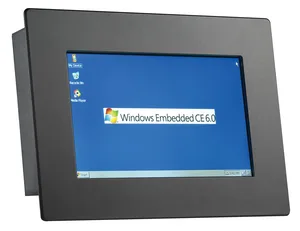 BSP-1070
- **7‑inch WVGA TFT‑LCD Display:** 800 × 480 resolution, 400 cd/m² brightness, LED backlight rated for 50,000 hours. - **ARM9‑Based CPU:** Atmel AT91SAM9G45, 400 MHz, ARM926EJ‑S core with MMU. - **Memory Architecture:** 128 MB SDRAM, 128 MB NAND Flash, and 2 MB Data Flash for system recovery. - **Touch Interface:** 4‑wire resistive touchscreen with 82.5 % transparency and 1 million‑touch minimum lifetime. - **Fanless Operation:** Passive cooling design for silent, maintenance‑free operation. - **Wide Power Input:** 12 V – 40 V DC via Phoenix 3‑pin terminal block. - **Multiple Serial Interfaces:** 3 × RS‑232 (DB‑9), 1 × RS‑422/485 (Phoenix 10‑pin), and 1 × console port. - **USB Connectivity:** 2 × USB 2.0 Type‑A host ports and 1 × USB 2.0 Mini‑AB client port. - **Networking:** 1 × 10/100 Mbps Ethernet (RJ‑45). - **GPIO Support:** 4 programmable digital I/O channels for control and sensing. - **Audio Output:** 3.5 mm phone jack for line‑out. - **Optional Wireless:** Internal Wi‑Fi module available via OEM/ODM request. - **Rugged Construction:** IP65‑rated front panel, steel or stainless‑steel frame, panel or VESA mounting. - **Environmental Tolerance:** Standard 0 – 60 °C; optional T‑model supports −20 – 75 °C. - **Certifications:** CE and FCC Class A compliant. - **Software Flexibility:** Linux or Windows CE pre‑installed; SDKs for C/C++ development. - **System Recovery:** Bootable Data Flash for fail‑safe recovery if NAND Flash fails.
Manufacturer: AdvanIPC
Category: LCD HMI
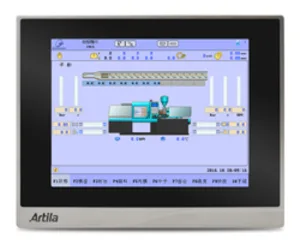 HC-3070
- **High-Performance ARM Processor:** Powered by the **TI AM3352 Sitara ARM Cortex-A8** CPU at **1GHz**, delivering efficient processing for HMI and control applications. - **Integrated Graphics Engine:** Equipped with **SGX530 3D graphics engine** supporting **Direct3D Mobile**, **OpenGL ES 1.1/2.0**, **OpenVG 1.0**, and **OpenMAX**, enabling smooth rendering of graphical interfaces and animations. - **7-inch TFT LCD Display:** Features an **800×480 resolution**, **300 cd/m² brightness**, **1500:1 contrast ratio**, and **140°/120° viewing angles**, ensuring clear visibility in industrial lighting conditions. - **Rugged Industrial Design:** Fanless, compact, and **IP65-compliant front panel** for dust and water resistance, suitable for harsh environments. - **Flexible Connectivity:** Includes **3 serial ports (RS-232/422/485)**, **1 Ethernet port (10/100 Mbps)**, **2 USB 2.0 ports (Host and Client)**, and **1 microSD slot** supporting up to **64GB SDHC**. - **Linux-Based System:** Runs **Linux kernel 4.9.x**, supporting boot from **eMMC** or **microSD**, with optional HMI software and remote management capabilities. - **Mounting Versatility:** Supports **panel mount** and **VESA 75×75mm** mounting options for flexible installation. - **Wide PLC Compatibility:** Compatible with major PLC brands such as **Allen-Bradley**, **Mitsubishi**, **Siemens**, **Omron**, and **Koyo**, as well as **Modbus RTU/TCP Master/Slave** protocols. - **Low Power Consumption:** Operates at **24VDC**, consuming only **8W**, ideal for energy-efficient industrial systems. - **Enhanced Reliability:** Designed for **0–50°C operating temperature**, **10–90% humidity**, and **Level 4 ESD protection** (8kV contact, 15kV air-gap).
Manufacturer: Artila
Category: LCD HMI
HC-3120
- **Processor:** TI Sitara AM3354 ARM Cortex‑A8, 32‑bit RISC architecture, 800 MHz (up to 1 GHz). - **Display:** 12‑inch TFT LCD, 800 × 600 resolution, 16.2 M colors, 600 cd/m² brightness, 1500:1 contrast ratio. - **Touchscreen:** Projected capacitive type, USB‑controlled, explosion‑proof, >85 % light transparency. - **Memory:** 256 MB DDR3 SDRAM (expandable to 512 MB). - **Storage:** 512 MB onboard eMMC NAND Flash; 1 × microSD slot supporting up to 64 GB SDHC. - **Graphics Engine:** PowerVR SGX530 3D graphics accelerator supporting Direct3D Mobile, OpenGL ES 1.1/2.0, OpenVG 1.0, and OpenMAX APIs. - **Connectivity:** - 2 × Gigabit Ethernet (10/100/1000 Mbps, RJ‑45) - 2 × USB 2.0 Host ports (480 Mbps, Type A) - 1 × RS‑232 serial port - 1 × CAN bus 2.0 A/B (up to 1 Mbps; optional second port) - **Power Input:** +18 VDC – +30 VDC (typical +24 VDC), 14.4 W consumption. - **Construction:** Die‑cast aluminum front bezel, metal rear housing, IP65‑rated front panel. - **Mounting:** Panel‑mount and VESA‑mount compatible; fanless design for industrial environments. - **Operating System:** Linux 4.9.x with Barebox bootloader, EXT4 filesystem, and QT5 graphics library. - **Software Environment:** LXDE desktop, Debian package management, pre‑installed development and web tools. - **Operating Range:** 0 °C – 50 °C, 25 – 85 % RH (non‑condensing). The HC‑3120’s combination of robust hardware, industrial‑grade materials, and open Linux software stack makes it a versatile platform for embedded HMI, SCADA, and automation control applications.
Manufacturer: Artila
Category: LCD HMI
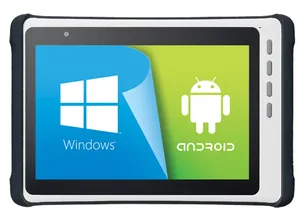 IMT-BT-Android
- **Processor:** Dual-core Intel® Celeron® N2807 SoC (Bay Trail-M) operating at 1.58 GHz (up to 2.16 GHz burst). - **Operating Systems:** Android 4.4.2 (KitKat) preinstalled; Windows Embedded 8.1 and Windows 10 optional. - **Display:** 10.1-inch TFT LCD with 1280×800 WXGA resolution, 600 cd/m² brightness, and Corning® Gorilla® Glass protection. - **Touchscreen:** 2-point projected capacitive touch (PCT) for precise input and glove-friendly operation. - **Wireless Connectivity:** - WLAN: IEEE 802.11 a/b/g/n/ac - WPAN: Bluetooth 4.0 - WWAN: Optional 3.5G HSPA+ or 4G LTE (Mini PCIe module) - **Sensors:** Integrated GPS (uBlox AMY-6M), E-compass, G-sensor, gyroscope, and illuminance sensor. - **Data Capture:** HF 13.56 MHz NFC RFID reader supporting ISO15693, ISO14443A/B, NFC 18000-3 standards, with SAM encryption. - **Cameras:** 5 MP rear camera with flash and autofocus; 2 MP front camera for video conferencing. - **Rugged Design:** IP65 ingress protection, 1.2 m drop resistance (1.5 m with optional protective housing). - **Battery:** 7.4 V, 6300 mAh Li-ion battery with
Manufacturer: Adlink Technology Inc.
Category: LCD HMI
IMT-BT-Win10
- **Processor:** Dual-core Intel® Celeron® N2807 SoC (Bay Trail-M) operating at 1.58 GHz (up to 2.16 GHz burst frequency). - **Display:** 10.1” TFT LCD with 1280×800 WXGA resolution, 600 cd/m² brightness, and Corning® Gorilla® Glass protection. - **Touchscreen:** 2-point projected capacitive touch (PCT) for intuitive multi-touch operation. - **Operating Systems:** Windows Embedded 8.1, Windows 10 IoT CBB Value, or Android 4.4.2 (KitKat). - **Memory & Storage:** 4 GB DDR3L 1333 MHz RAM and 64 GB mSATA SSD (eMMC). - **Wireless Connectivity:** - WLAN: IEEE 802.11 a/b/g/n/ac - WPAN: Bluetooth 4.0 - WWAN (optional): 3.5G HSPA+ or 4G LTE (EU/USA variants) - **Sensors:** Integrated GPS (uBlox AMY-6M), E-compass, G-sensor, gyroscope, and illuminance sensor. - **Data Capture:** HF 13.56 MHz NFC RFID reader supporting ISO15693, ISO14443A/B, NFC 18000-3 standards with SAM encryption. - **Cameras:** 5 MP rear camera with flash and autofocus; 2 MP front camera. - **Rugged Design:** IP65 ingress protection, 1.2 m drop resistance (1.5 m with optional protective housing). - **Battery:** 7.4 V / 6300 mAh Li-ion battery with
Manufacturer: Adlink Technology Inc.
Category: LCD HMI