 SUCHEN SIE DIE PASSENDE
INDUSTRIELLE LÖSUNG?
Entdecken Sie Embedded-, Kommunikations- und Automatisierungslösungen für Ihre Anwendung.

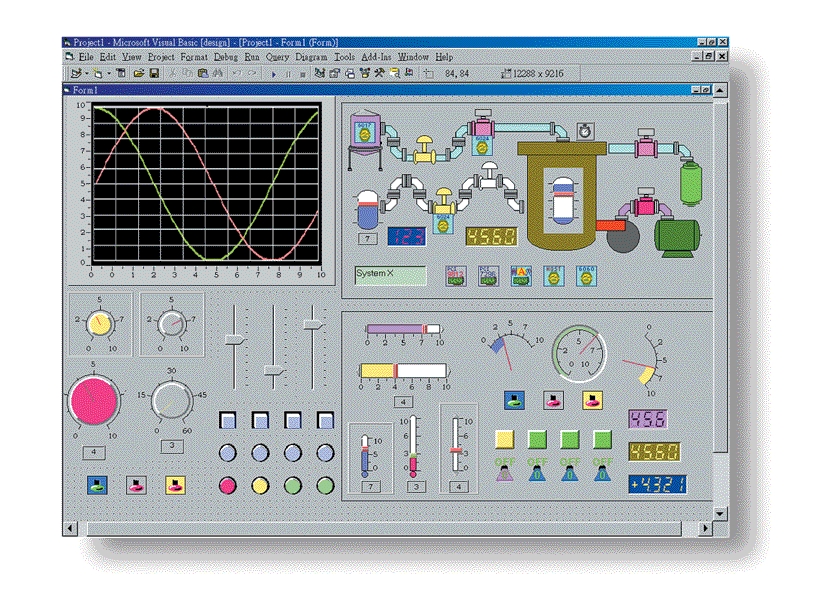
- ActiveX/OCX Interface: Provides an OLE Control Extension (OCX) interface for ADLINK PCI and cPCI cards, enabling straightforward integration into Windows-based applications that support ActiveX controls.
- Broad Hardware Compatibility: Supports a wide range of ADLINK PCI and CompactPCI data acquisition (DAQ), digital I/O, analog I/O, and motion control cards.
- Simplified Development: Allows developers to access hardware functions through intuitive, high-level commands without requiring low-level driver programming.
- Rapid Application Development (RAD) Support: Fully compatible with RAD environments such as Microsoft Visual Basic, Visual C++, Delphi, and LabVIEW (via ActiveX containers).
- Comprehensive Function Library: Includes functions for analog input/output, digital input/output, counter/timer operations, and event handling.
- Plug-and-Play Configuration: Automatically detects installed ADLINK cards and configures communication parameters for immediate use.
- Stable and Reliable Operation: Built on ADLINK’s proven driver architecture, ensuring robust performance in industrial and laboratory environments.
- Cross-Platform Compatibility: Designed for Windows operating systems (Windows 7/8/10/11, 32-bit and 64-bit editions).
- Scalable Integration: Supports multiple ADLINK cards within a single system, allowing complex multi-channel or multi-device configurations.
- Comprehensive Documentation: Includes detailed API references, sample code, and integration guides for rapid deployment.
- Broad Hardware Compatibility: Supports a wide range of ADLINK PCI and CompactPCI data acquisition (DAQ), digital I/O, analog I/O, and motion control cards.
- Simplified Development: Allows developers to access hardware functions through intuitive, high-level commands without requiring low-level driver programming.
- Rapid Application Development (RAD) Support: Fully compatible with RAD environments such as Microsoft Visual Basic, Visual C++, Delphi, and LabVIEW (via ActiveX containers).
- Comprehensive Function Library: Includes functions for analog input/output, digital input/output, counter/timer operations, and event handling.
- Plug-and-Play Configuration: Automatically detects installed ADLINK cards and configures communication parameters for immediate use.
- Stable and Reliable Operation: Built on ADLINK’s proven driver architecture, ensuring robust performance in industrial and laboratory environments.
- Cross-Platform Compatibility: Designed for Windows operating systems (Windows 7/8/10/11, 32-bit and 64-bit editions).
- Scalable Integration: Supports multiple ADLINK cards within a single system, allowing complex multi-channel or multi-device configurations.
- Comprehensive Documentation: Includes detailed API references, sample code, and integration guides for rapid deployment.
Below is a comprehensive, detailed product summary based on the provided content and structured according to your requested format.
## 1. Product Overview
Product Name: OCX Driver for ADLINK Cards
Model: PCIS-OCX
Series: ADLINK PCI/cPCI Software Driver Series
Article Number: PCIS-OCX
Manufacturer: ADLINK Technology Inc.
The PCIS-OCX is a specialized software driver component developed by ADLINK Technology to provide seamless integration and communication between ADLINK’s range of PCI and CompactPCI (cPCI) data acquisition and control cards and Windows-based applications. Designed as an OCX (OLE Control Extension) driver, it enables developers and system integrators to easily interface ADLINK hardware with custom software environments, particularly those built using Microsoft Visual Basic, Visual C++, or other ActiveX-compatible development tools.
This driver package is part of ADLINK’s comprehensive software ecosystem, which supports industrial automation, measurement, and control applications by offering standardized, high-performance interfaces for hardware communication.
## 2. Key Features
- ActiveX/OCX Interface: Provides an OLE Control Extension (OCX) interface for ADLINK PCI and cPCI cards, enabling straightforward integration into Windows-based applications that support ActiveX controls.
- Broad Hardware Compatibility: Supports a wide range of ADLINK PCI and CompactPCI data acquisition (DAQ), digital I/O, analog I/O, and motion control cards.
- Simplified Development: Allows developers to access hardware functions through intuitive, high-level commands without requiring low-level driver programming.
- Rapid Application Development (RAD) Support: Fully compatible with RAD environments such as Microsoft Visual Basic, Visual C++, Delphi, and LabVIEW (via ActiveX containers).
- Comprehensive Function Library: Includes functions for analog input/output, digital input/output, counter/timer operations, and event handling.
- Plug-and-Play Configuration: Automatically detects installed ADLINK cards and configures communication parameters for immediate use.
- Stable and Reliable Operation: Built on ADLINK’s proven driver architecture, ensuring robust performance in industrial and laboratory environments.
- Cross-Platform Compatibility: Designed for Windows operating systems (Windows 7/8/10/11, 32-bit and 64-bit editions).
- Scalable Integration: Supports multiple ADLINK cards within a single system, allowing complex multi-channel or multi-device configurations.
- Comprehensive Documentation: Includes detailed API references, sample code, and integration guides for rapid deployment.
## 3. Technical Specifications
| Parameter | Specification |
|----------------|-------------------|
| Product Type | Software Driver (OCX / ActiveX Control) |
| Model Number | PCIS-OCX |
| Supported Hardware | ADLINK PCI and CompactPCI (cPCI) DAQ, DIO, AIO, and motion control cards |
| Interface Type | OLE Control Extension (OCX) / ActiveX |
| Operating Systems | Microsoft Windows 7, 8, 10, 11 (32-bit and 64-bit) |
| Programming Environments | Visual Basic, Visual C++, Delphi, LabVIEW (ActiveX container), .NET (via COM Interop) |
| Installation Package | Executable installer with driver files, libraries, and documentation |
| File Format | .OCX, .DLL, and associated configuration files |
| Dependencies | ADLINK Base Driver Package (PCIS-DASK or equivalent) |
| License Type | Proprietary, single-user or site license (depending on distribution) |
| Documentation | User manual, API reference, and example projects |
| Dimensions / Weight | Software-only product (no physical dimensions or weight) |
| Supported Bus Types | PCI, CompactPCI (cPCI) |
| Supported Functions | Analog Input/Output, Digital Input/Output, Counter/Timer, Event Handling, Interrupt Management |
## 4. Functionality
The PCIS-OCX driver functions as a middleware layer between ADLINK’s hardware and user-developed software applications. It exposes the hardware’s capabilities through an ActiveX control interface, allowing developers to embed the control directly into their application forms or user interfaces.
### How It Works
1. Installation: The OCX driver is installed on a Windows system along with the ADLINK base driver package.
2. Registration: The OCX component is registered in the Windows system registry, making it available to any ActiveX-compatible application.
3. Integration: Developers insert the OCX control into their application (e.g., a Visual Basic form) and use its properties, methods, and events to communicate with ADLINK hardware.
4. Operation: The OCX driver translates high-level commands (e.g., “ReadAnalogInput”) into low-level hardware instructions, managing data transfer, buffering, and synchronization.
### Use Cases and Applications
- Industrial Automation: Real-time monitoring and control of sensors, actuators, and process variables.
- Laboratory Measurement: Data acquisition from analog and digital instruments for research and testing.
- Machine Control: Integration with motion control cards for precision positioning and feedback systems.
- Embedded Systems: Simplified hardware access for embedded Windows-based control systems.
- Educational and Research Projects: Rapid prototyping and experimentation with ADLINK hardware in academic environments.
### Compatibility
- Compatible with all major ADLINK PCI and cPCI DAQ and control cards.
- Works with ADLINK’s PCIS-DASK driver library for low-level hardware access.
- Supports multi-card configurations and simultaneous operation of multiple OCX instances.
## 5. Components & Accessories
### Included Items
- PCIS-OCX Driver Package: Main software installer containing the OCX control, supporting DLLs, and configuration utilities.
- Documentation: Comprehensive user manual, API reference, and integration guide in PDF format.
- Sample Code: Example projects for Visual Basic, Visual C++, and Delphi demonstrating typical usage scenarios.
- Release Notes: Version history, known issues, and compatibility information.
### Optional Add-ons
- ADLINK Base Driver (PCIS-DASK): Required for low-level hardware communication.
- ADLINK Utility Tools: Diagnostic and configuration utilities for hardware testing.
- Software Development Kits (SDKs): Additional libraries for advanced programming environments.
### Connectors
As a software product, the PCIS-OCX does not include physical connectors. However, it interfaces with ADLINK hardware through the system’s PCI or cPCI bus, utilizing the hardware’s onboard connectors for signal I/O.
## 6. Installation & Setup
### Requirements
- Operating System: Windows 7/8/10/11 (32-bit or 64-bit)
- Processor: Intel or AMD x86/x64 architecture
- Memory: Minimum 2 GB RAM (4 GB recommended)
- Disk Space: Approximately 100 MB for installation
- Privileges: Administrator rights required for installation and driver registration
### Installation Procedure
1. Install Base Driver: Ensure that the ADLINK PCIS-DASK or equivalent base driver is installed.
2. Run Installer: Execute the PCIS-OCX setup file and follow the on-screen instructions.
3. Register OCX: The installer automatically registers the OCX component in the Windows registry.
4. Verify Installation: Use the included diagnostic utility or sample application to confirm proper operation.
### Configuration
- Device Detection: The driver automatically detects installed ADLINK PCI/cPCI cards.
- Parameter Setup: Users can configure channel numbers, sampling rates, and trigger modes through the OCX properties.
- Application Integration: Add the OCX control to your development environment’s toolbox and drag it onto your form or interface.
### Mounting Options
As a software component, no physical mounting is required. The driver operates entirely within the Windows software environment.
## 7. Performance & Capabilities
### Speed and Throughput
- Data Transfer Rate: Dependent on the underlying ADLINK hardware; typically supports high-speed analog and digital I/O operations up to several MS/s (mega-samples per second).
- Latency: Optimized for low-latency communication between application and hardware.
- Multi-Threading: Supports concurrent operations across multiple channels or devices.
### Capacity
- Multi-Device Support: Can manage multiple ADLINK cards simultaneously.
- Channel Management: Provides access to all available analog and digital channels on supported cards.
- Buffering: Supports hardware and software buffering for continuous data acquisition.
### Efficiency
- Optimized API Calls: Reduces overhead by using efficient COM-based communication.
- Event-Driven Architecture: Supports asynchronous event handling for interrupts and data-ready notifications.
### Limitations
- Hardware Dependency: Requires compatible ADLINK PCI or cPCI hardware.
- Operating System Restriction: Windows-only; not supported on Linux or macOS.
- License Restriction: Subject to ADLINK’s software licensing terms.
## 8. Standards & Compliance
- Software Interface Standard: Complies with Microsoft COM and ActiveX standards for OLE Control Extensions (OCX).
- Hardware Compatibility: Fully compatible with ADLINK PCI and CompactPCI hardware adhering to PCI Local Bus and PICMG 2.0 CompactPCI standards.
- Operating System Compliance: Designed for Microsoft Windows operating systems, following Microsoft driver development guidelines.
- Quality Assurance: Developed under ADLINK’s ISO 9001-certified quality management system.
- Regulatory Compliance:
- CE and FCC compliance (in conjunction with ADLINK hardware)
- RoHS-compliant software distribution (no hazardous materials)
## 9. Additional Information
### Warranty
- Software Warranty: Typically includes a one-year limited warranty covering defects in media and installation files.
- Support Period: Ongoing technical support and updates provided during the warranty period.
### Technical Support
- Online Resources: Access to ADLINK’s online knowledge base, FAQs, and driver downloads.
- Email and Phone Support: Direct assistance from ADLINK’s technical support team.
- Software Updates: Periodic updates available through ADLINK’s website to ensure compatibility with new hardware and operating systems.
### Maintenance
- Version Updates: Users are encouraged to maintain the latest version for optimal performance and security.
- Backward Compatibility: Maintains compatibility with previous ADLINK PCI/cPCI card generations.
- Bug Fixes and Enhancements: Regularly updated to address user feedback and improve functionality.
### Documentation and Training
- User Manual: Detailed instructions for installation, configuration, and programming.
- API Reference: Complete list of available methods, properties, and events.
- Training Materials: Tutorials and example projects for rapid learning and deployment.
### Summary
The ADLINK PCIS-OCX driver is a robust, high-level software interface designed to simplify the integration of ADLINK PCI and CompactPCI data acquisition and control cards into Windows-based applications. By leveraging the ActiveX/OCX architecture, it provides developers with a powerful yet user-friendly means of accessing hardware functions without delving into complex driver-level programming.
Ideal for industrial automation, laboratory measurement, and embedded control systems, the PCIS-OCX driver ensures reliable, high-performance communication between software and hardware, backed by ADLINK’s extensive support and quality assurance.
End of Product Summary
## 1. Product Overview
Product Name: OCX Driver for ADLINK Cards
Model: PCIS-OCX
Series: ADLINK PCI/cPCI Software Driver Series
Article Number: PCIS-OCX
Manufacturer: ADLINK Technology Inc.
The PCIS-OCX is a specialized software driver component developed by ADLINK Technology to provide seamless integration and communication between ADLINK’s range of PCI and CompactPCI (cPCI) data acquisition and control cards and Windows-based applications. Designed as an OCX (OLE Control Extension) driver, it enables developers and system integrators to easily interface ADLINK hardware with custom software environments, particularly those built using Microsoft Visual Basic, Visual C++, or other ActiveX-compatible development tools.
This driver package is part of ADLINK’s comprehensive software ecosystem, which supports industrial automation, measurement, and control applications by offering standardized, high-performance interfaces for hardware communication.
## 2. Key Features
- ActiveX/OCX Interface: Provides an OLE Control Extension (OCX) interface for ADLINK PCI and cPCI cards, enabling straightforward integration into Windows-based applications that support ActiveX controls.
- Broad Hardware Compatibility: Supports a wide range of ADLINK PCI and CompactPCI data acquisition (DAQ), digital I/O, analog I/O, and motion control cards.
- Simplified Development: Allows developers to access hardware functions through intuitive, high-level commands without requiring low-level driver programming.
- Rapid Application Development (RAD) Support: Fully compatible with RAD environments such as Microsoft Visual Basic, Visual C++, Delphi, and LabVIEW (via ActiveX containers).
- Comprehensive Function Library: Includes functions for analog input/output, digital input/output, counter/timer operations, and event handling.
- Plug-and-Play Configuration: Automatically detects installed ADLINK cards and configures communication parameters for immediate use.
- Stable and Reliable Operation: Built on ADLINK’s proven driver architecture, ensuring robust performance in industrial and laboratory environments.
- Cross-Platform Compatibility: Designed for Windows operating systems (Windows 7/8/10/11, 32-bit and 64-bit editions).
- Scalable Integration: Supports multiple ADLINK cards within a single system, allowing complex multi-channel or multi-device configurations.
- Comprehensive Documentation: Includes detailed API references, sample code, and integration guides for rapid deployment.
## 3. Technical Specifications
| Parameter | Specification |
|----------------|-------------------|
| Product Type | Software Driver (OCX / ActiveX Control) |
| Model Number | PCIS-OCX |
| Supported Hardware | ADLINK PCI and CompactPCI (cPCI) DAQ, DIO, AIO, and motion control cards |
| Interface Type | OLE Control Extension (OCX) / ActiveX |
| Operating Systems | Microsoft Windows 7, 8, 10, 11 (32-bit and 64-bit) |
| Programming Environments | Visual Basic, Visual C++, Delphi, LabVIEW (ActiveX container), .NET (via COM Interop) |
| Installation Package | Executable installer with driver files, libraries, and documentation |
| File Format | .OCX, .DLL, and associated configuration files |
| Dependencies | ADLINK Base Driver Package (PCIS-DASK or equivalent) |
| License Type | Proprietary, single-user or site license (depending on distribution) |
| Documentation | User manual, API reference, and example projects |
| Dimensions / Weight | Software-only product (no physical dimensions or weight) |
| Supported Bus Types | PCI, CompactPCI (cPCI) |
| Supported Functions | Analog Input/Output, Digital Input/Output, Counter/Timer, Event Handling, Interrupt Management |
## 4. Functionality
The PCIS-OCX driver functions as a middleware layer between ADLINK’s hardware and user-developed software applications. It exposes the hardware’s capabilities through an ActiveX control interface, allowing developers to embed the control directly into their application forms or user interfaces.
### How It Works
1. Installation: The OCX driver is installed on a Windows system along with the ADLINK base driver package.
2. Registration: The OCX component is registered in the Windows system registry, making it available to any ActiveX-compatible application.
3. Integration: Developers insert the OCX control into their application (e.g., a Visual Basic form) and use its properties, methods, and events to communicate with ADLINK hardware.
4. Operation: The OCX driver translates high-level commands (e.g., “ReadAnalogInput”) into low-level hardware instructions, managing data transfer, buffering, and synchronization.
### Use Cases and Applications
- Industrial Automation: Real-time monitoring and control of sensors, actuators, and process variables.
- Laboratory Measurement: Data acquisition from analog and digital instruments for research and testing.
- Machine Control: Integration with motion control cards for precision positioning and feedback systems.
- Embedded Systems: Simplified hardware access for embedded Windows-based control systems.
- Educational and Research Projects: Rapid prototyping and experimentation with ADLINK hardware in academic environments.
### Compatibility
- Compatible with all major ADLINK PCI and cPCI DAQ and control cards.
- Works with ADLINK’s PCIS-DASK driver library for low-level hardware access.
- Supports multi-card configurations and simultaneous operation of multiple OCX instances.
## 5. Components & Accessories
### Included Items
- PCIS-OCX Driver Package: Main software installer containing the OCX control, supporting DLLs, and configuration utilities.
- Documentation: Comprehensive user manual, API reference, and integration guide in PDF format.
- Sample Code: Example projects for Visual Basic, Visual C++, and Delphi demonstrating typical usage scenarios.
- Release Notes: Version history, known issues, and compatibility information.
### Optional Add-ons
- ADLINK Base Driver (PCIS-DASK): Required for low-level hardware communication.
- ADLINK Utility Tools: Diagnostic and configuration utilities for hardware testing.
- Software Development Kits (SDKs): Additional libraries for advanced programming environments.
### Connectors
As a software product, the PCIS-OCX does not include physical connectors. However, it interfaces with ADLINK hardware through the system’s PCI or cPCI bus, utilizing the hardware’s onboard connectors for signal I/O.
## 6. Installation & Setup
### Requirements
- Operating System: Windows 7/8/10/11 (32-bit or 64-bit)
- Processor: Intel or AMD x86/x64 architecture
- Memory: Minimum 2 GB RAM (4 GB recommended)
- Disk Space: Approximately 100 MB for installation
- Privileges: Administrator rights required for installation and driver registration
### Installation Procedure
1. Install Base Driver: Ensure that the ADLINK PCIS-DASK or equivalent base driver is installed.
2. Run Installer: Execute the PCIS-OCX setup file and follow the on-screen instructions.
3. Register OCX: The installer automatically registers the OCX component in the Windows registry.
4. Verify Installation: Use the included diagnostic utility or sample application to confirm proper operation.
### Configuration
- Device Detection: The driver automatically detects installed ADLINK PCI/cPCI cards.
- Parameter Setup: Users can configure channel numbers, sampling rates, and trigger modes through the OCX properties.
- Application Integration: Add the OCX control to your development environment’s toolbox and drag it onto your form or interface.
### Mounting Options
As a software component, no physical mounting is required. The driver operates entirely within the Windows software environment.
## 7. Performance & Capabilities
### Speed and Throughput
- Data Transfer Rate: Dependent on the underlying ADLINK hardware; typically supports high-speed analog and digital I/O operations up to several MS/s (mega-samples per second).
- Latency: Optimized for low-latency communication between application and hardware.
- Multi-Threading: Supports concurrent operations across multiple channels or devices.
### Capacity
- Multi-Device Support: Can manage multiple ADLINK cards simultaneously.
- Channel Management: Provides access to all available analog and digital channels on supported cards.
- Buffering: Supports hardware and software buffering for continuous data acquisition.
### Efficiency
- Optimized API Calls: Reduces overhead by using efficient COM-based communication.
- Event-Driven Architecture: Supports asynchronous event handling for interrupts and data-ready notifications.
### Limitations
- Hardware Dependency: Requires compatible ADLINK PCI or cPCI hardware.
- Operating System Restriction: Windows-only; not supported on Linux or macOS.
- License Restriction: Subject to ADLINK’s software licensing terms.
## 8. Standards & Compliance
- Software Interface Standard: Complies with Microsoft COM and ActiveX standards for OLE Control Extensions (OCX).
- Hardware Compatibility: Fully compatible with ADLINK PCI and CompactPCI hardware adhering to PCI Local Bus and PICMG 2.0 CompactPCI standards.
- Operating System Compliance: Designed for Microsoft Windows operating systems, following Microsoft driver development guidelines.
- Quality Assurance: Developed under ADLINK’s ISO 9001-certified quality management system.
- Regulatory Compliance:
- CE and FCC compliance (in conjunction with ADLINK hardware)
- RoHS-compliant software distribution (no hazardous materials)
## 9. Additional Information
### Warranty
- Software Warranty: Typically includes a one-year limited warranty covering defects in media and installation files.
- Support Period: Ongoing technical support and updates provided during the warranty period.
### Technical Support
- Online Resources: Access to ADLINK’s online knowledge base, FAQs, and driver downloads.
- Email and Phone Support: Direct assistance from ADLINK’s technical support team.
- Software Updates: Periodic updates available through ADLINK’s website to ensure compatibility with new hardware and operating systems.
### Maintenance
- Version Updates: Users are encouraged to maintain the latest version for optimal performance and security.
- Backward Compatibility: Maintains compatibility with previous ADLINK PCI/cPCI card generations.
- Bug Fixes and Enhancements: Regularly updated to address user feedback and improve functionality.
### Documentation and Training
- User Manual: Detailed instructions for installation, configuration, and programming.
- API Reference: Complete list of available methods, properties, and events.
- Training Materials: Tutorials and example projects for rapid learning and deployment.
### Summary
The ADLINK PCIS-OCX driver is a robust, high-level software interface designed to simplify the integration of ADLINK PCI and CompactPCI data acquisition and control cards into Windows-based applications. By leveraging the ActiveX/OCX architecture, it provides developers with a powerful yet user-friendly means of accessing hardware functions without delving into complex driver-level programming.
Ideal for industrial automation, laboratory measurement, and embedded control systems, the PCIS-OCX driver ensures reliable, high-performance communication between software and hardware, backed by ADLINK’s extensive support and quality assurance.
End of Product Summary
Keine Manuals/Kataloge verfügbar.
Kein Zubehör vorhanden.