 LOOKING FOR THE RIGHT
INDUSTRIAL SOLUTION?
Discover embedded, communication and automation solutions tailored to your application.
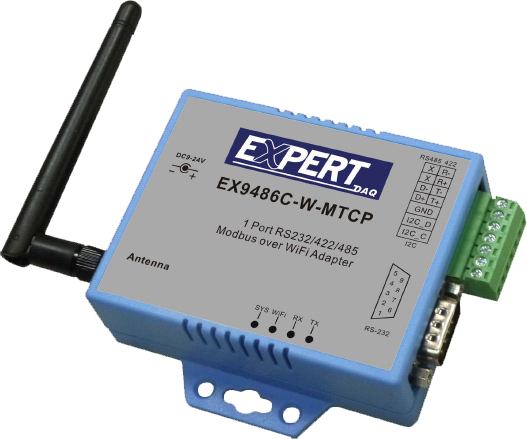
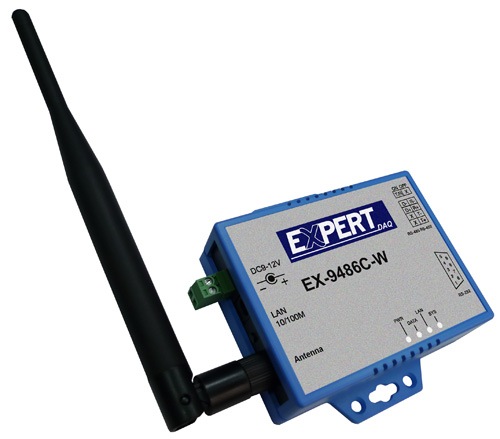
EX9486C-W-MTCP-old
(ARM9) 200M 32Bits CPU SRAM 128MB SRAM 32M RS232*1 & RS485/422*1, Ethernet port*1 & Wi-Fi *1 Modbus TCP(WiFi) to Modbus RTU/ASCII
- Dual‑Protocol Conversion:
Converts between Modbus RTU/ASCII and Modbus TCP over Wi‑Fi or Ethernet. Supports both directions:
- Modbus RTU/ASCII Slave ↔ Modbus TCP Master
- Modbus TCP Slave ↔ Modbus RTU/ASCII Master
- Wireless Connectivity:
Integrated IEEE 802.11 b/g/n Wi‑Fi interface supporting data rates up to 72.2 Mbps (20 MHz bandwidth). Operates in the 2.4 GHz band with up to 100 m transmission distance.
- Ethernet Interface:
10/100 Mbps auto‑detecting RJ‑45 port with 1.5 kV magnetic isolation for secure wired connectivity.
- Multi‑Master/Slave Support:
Handles up to 8 simultaneous TCP Masters and allows a serial Master to access up to 8 TCP Slaves concurrently.
- Flexible Serial Communication:
One RS‑232 (DB9 male) and one RS‑422/485 (4‑pin terminal block) port with configurable baud rates (300 bps–230.4 kbps), parity, data bits, and stop bits.
- Web‑Based Configuration:
Built‑in HTTP/HTTPS web server for configuration via standard browsers (IE, Chrome, Firefox). No proprietary software required.
- Security and Access Control:
Supports login and setup passwords, WEP/WPA/WPA2 encryption, AES, WAPI, and 802.1x authentication.
- Dynamic IP Management:
DHCP client support for automatic IP assignment; static IP configuration also available.
- Firmware Upgradeable:
Remote firmware updates via Ethernet to maintain compatibility with evolving network standards.
- Industrial Design:
Compact, rugged PVC housing suitable for harsh environments. Operating temperature range: −20 °C to +70 °C.
- Ease of Setup:
Default Access Point (AP) mode for initial configuration; SSID broadcast as “EXiot_+MAC address.”
Converts between Modbus RTU/ASCII and Modbus TCP over Wi‑Fi or Ethernet. Supports both directions:
- Modbus RTU/ASCII Slave ↔ Modbus TCP Master
- Modbus TCP Slave ↔ Modbus RTU/ASCII Master
- Wireless Connectivity:
Integrated IEEE 802.11 b/g/n Wi‑Fi interface supporting data rates up to 72.2 Mbps (20 MHz bandwidth). Operates in the 2.4 GHz band with up to 100 m transmission distance.
- Ethernet Interface:
10/100 Mbps auto‑detecting RJ‑45 port with 1.5 kV magnetic isolation for secure wired connectivity.
- Multi‑Master/Slave Support:
Handles up to 8 simultaneous TCP Masters and allows a serial Master to access up to 8 TCP Slaves concurrently.
- Flexible Serial Communication:
One RS‑232 (DB9 male) and one RS‑422/485 (4‑pin terminal block) port with configurable baud rates (300 bps–230.4 kbps), parity, data bits, and stop bits.
- Web‑Based Configuration:
Built‑in HTTP/HTTPS web server for configuration via standard browsers (IE, Chrome, Firefox). No proprietary software required.
- Security and Access Control:
Supports login and setup passwords, WEP/WPA/WPA2 encryption, AES, WAPI, and 802.1x authentication.
- Dynamic IP Management:
DHCP client support for automatic IP assignment; static IP configuration also available.
- Firmware Upgradeable:
Remote firmware updates via Ethernet to maintain compatibility with evolving network standards.
- Industrial Design:
Compact, rugged PVC housing suitable for harsh environments. Operating temperature range: −20 °C to +70 °C.
- Ease of Setup:
Default Access Point (AP) mode for initial configuration; SSID broadcast as “EXiot_+MAC address.”
Comprehensive Product Summary: EX9486C‑W‑MTCP (Wi‑Fi to Modbus Gateway)
### 1. Product Overview
Product Name: EX9486C‑W‑MTCP (Wi‑Fi to Modbus Gateway)
Model: EX9486C‑W‑MTCP‑old
Series: EX94xxC Industrial Modbus Communication Gateways
Article Number: EX9486C‑W‑MTCP‑old
Manufacturer: TOPSCCC (Taiwan)
Version: 2.0 (Manual dated April 24, 2018)
The EX9486C‑W‑MTCP is an industrial‑grade Modbus RTU/ASCII to Wi‑Fi (Modbus TCP) converter designed to bridge serial Modbus devices with modern TCP/IP‑based networks. It enables seamless integration of RS‑232, RS‑422, or RS‑485 serial equipment into Ethernet or wireless LAN environments, allowing remote monitoring and control via Modbus TCP over Wi‑Fi or Ethernet. Built around a 200 MHz ARM9 32‑bit CPU with 128 MB SRAM and 32 MB Flash, the device provides robust performance, high reliability, and flexible configuration for industrial automation, SCADA, and IoT applications.
### 2. Key Features
- Dual‑Protocol Conversion:
Converts between Modbus RTU/ASCII and Modbus TCP over Wi‑Fi or Ethernet. Supports both directions:
- Modbus RTU/ASCII Slave ↔ Modbus TCP Master
- Modbus TCP Slave ↔ Modbus RTU/ASCII Master
- Wireless Connectivity:
Integrated IEEE 802.11 b/g/n Wi‑Fi interface supporting data rates up to 72.2 Mbps (20 MHz bandwidth). Operates in the 2.4 GHz band with up to 100 m transmission distance.
- Ethernet Interface:
10/100 Mbps auto‑detecting RJ‑45 port with 1.5 kV magnetic isolation for secure wired connectivity.
- Multi‑Master/Slave Support:
Handles up to 8 simultaneous TCP Masters and allows a serial Master to access up to 8 TCP Slaves concurrently.
- Flexible Serial Communication:
One RS‑232 (DB9 male) and one RS‑422/485 (4‑pin terminal block) port with configurable baud rates (300 bps–230.4 kbps), parity, data bits, and stop bits.
- Web‑Based Configuration:
Built‑in HTTP/HTTPS web server for configuration via standard browsers (IE, Chrome, Firefox). No proprietary software required.
- Security and Access Control:
Supports login and setup passwords, WEP/WPA/WPA2 encryption, AES, WAPI, and 802.1x authentication.
- Dynamic IP Management:
DHCP client support for automatic IP assignment; static IP configuration also available.
- Firmware Upgradeable:
Remote firmware updates via Ethernet to maintain compatibility with evolving network standards.
- Industrial Design:
Compact, rugged PVC housing suitable for harsh environments. Operating temperature range: −20 °C to +70 °C.
- Ease of Setup:
Default Access Point (AP) mode for initial configuration; SSID broadcast as “EXiot_+MAC address.”
### 3. Technical Specifications
Processor & Memory
- CPU: ARM9 32‑bit, 200 MHz
- SRAM: 128 MB
- Flash Memory: 32 MB
Wireless LAN (Wi‑Fi)
- Standard: IEEE 802.11 b/g/n
- Frequency Band: 2.4 GHz (2.3–2.5 GHz)
- Data Rate: 11/54/72.2 Mbps @ 20 MHz bandwidth
- Modulation: DSSS, OFDM
- Transmission Power:
- 11b: Max 22 dBm
- 11g/n: Max 19 dBm
- Receiver Sensitivity:
- −76 dBm @ 54 Mbps
- −89.5 dBm @ 11 Mbps
- Transmission Distance: Up to 100 m (open space)
- Security: WEP 64/128‑bit, AES, WPA/WPA2‑Personal, WPS 2.0, WAPI
- Antenna: 2 dBi dipole antenna, RP‑SMA connector
- Network Modes: Infrastructure / Access Point (for setup)
- Operation Modes: TCP Server / TCP Client / UDP
- Configuration: HTTP browser setup
- Authentication: Login password protection
Ethernet Interface
- Connector: RJ‑45
- Speed: 10/100 Mbps (auto‑detect)
- Supported Protocols: ARP, IP, ICMP, UDP, TCP, HTTP, DHCP, PPPoE, DDNS, NTP, FTP, Telnet
- Modes: TCP Server / TCP Client / UDP
- Configuration: Web browser or console
- Protection: 1.5 kV magnetic isolation
Serial Communication
- Ports:
- 1 × RS‑232 (DB9 male)
- 1 × RS‑422/485 (4‑pin terminal block)
- RS‑232 Signals: TxD, RxD, GND
- RS‑422 Signals: Tx+, Tx−, Rx+, Rx−
- RS‑485 Signals: Data+, Data−
- Line Protection: 15 kV ESD for all signals
- Baud Rate: 300 bps – 230.4 kbps
- Data Bits: 5, 6, 7, 8
- Stop Bits: 1, 2
- Parity: None, Even, Odd, Space, Mark
Power Requirements
- Input Voltage: 9 – 24 V DC
- Current Consumption: 200 mA @ 12 V DC
- Connector: Terminal block (pin assignment provided in manual)
Environmental Conditions
- Operating Temperature: −20 °C to +70 °C
- Storage Temperature: −25 °C to +80 °C
- Humidity: 10 – 95 % RH (operating), 5 – 95 % RH (storage)
Regulatory Compliance
- Certifications: CE, FCC, RoHS
Physical Characteristics
- Enclosure: Industrial PVC housing
- Mounting: DIN‑rail kit (optional)
- Antenna: External 2 dBi dipole
### 4. Functionality
The EX9486C‑W‑MTCP functions as a transparent gateway between serial Modbus devices and TCP/IP networks. It encapsulates Modbus RTU or ASCII data into Modbus TCP packets for transmission over Wi‑Fi or Ethernet, and vice versa.
Operating Modes:
- Modbus RTU/ASCII Slave → Modbus TCP Master
- Modbus TCP Slave → Modbus RTU/ASCII Master
- TCP to RTU Slave / TCP to ASCII Slave / RTU to TCP Slave / ASCII to TCP Slave / TCP Client to RTU Slave
Use Cases:
- Integrating legacy PLCs, meters, and sensors into modern SCADA systems.
- Remote monitoring of serial devices over wireless LAN or Internet.
- Industrial automation, building management, and energy monitoring systems.
- IoT gateway for Modbus‑based field devices.
Compatibility:
- Works with Modbus TCP/IP servers, Modbus RTU/ASCII devices, and standard Wi‑Fi networks.
- Supports Windows utilities (Windows 2000/2003/Vista/7/8/10).
### 5. Components & Accessories
Package Contents:
1. EX9486C‑W‑MTCP Wi‑Fi to Modbus Gateway unit
2. 2 dBi dipole antenna (RP‑SMA connector)
3. CD‑ROM containing Operation Manual and Configuration Utility
4. Optional: DIN‑rail mounting kit and power adaptor
Connectors:
- RS‑232 (DB9 male):
- Pin 2 = RXD, Pin 3 = TXD, Pin 5 = GND
- RS‑422 (4‑pin terminal):
- Pin 1 = R−, Pin 2 = R+, Pin 3 = T−, Pin 4 = T+
- RS‑485 (4‑pin terminal):
- Pin 3 = D−, Pin 4 = D+
- Power Input: Terminal block, 9–24 V DC
Optional Accessories:
- DIN‑rail mounting bracket
- External power supply (12 V DC)
### 6. Installation & Setup
Requirements:
- PC or notebook with Ethernet or Wi‑Fi adapter
- Wireless Access Point (for Infrastructure mode)
- Power supply (9–24 V DC)
Initial Configuration:
1. Connect power; device defaults to Access Point (AP) mode.
2. SSID broadcast: “EXiot_XX:XX:XX:XX:XX:XX” (MAC‑based).
3. Default Wi‑Fi password: 12345678.
4. Connect PC to the AP and open browser to default IP (e.g., 192.168.0.115).
5. Login credentials: admin / admin.
6. Configure network type (AP or Infrastructure), SSID, encryption, and IP mode (DHCP or Static).
7. Set serial parameters (baud rate, parity, data bits, stop bits).
8. Define Modbus gateway mode and TCP/RTU parameters.
9. Save settings and reboot device.
Reset Procedure:
Hold the reset button for > 25 seconds while powered on to restore factory defaults (AP mode).
Mounting Options:
- Desktop or panel installation
- Optional DIN‑rail mounting kit for industrial cabinets
### 7. Performance & Capabilities
- Processing Power: ARM9 200 MHz ensures stable real‑time data conversion.
- Network Throughput: Up to 72.2 Mbps over Wi‑Fi; 100 Mbps over Ethernet.
- Serial Speed: Up to 230.4 kbps.
- Concurrent Connections: Supports 8 TCP Masters simultaneously; serial Master can access 8 TCP Slaves.
- Transmission Range: Up to 100 m (line‑of‑sight, open area).
- Reliability: 15 kV ESD protection on serial lines; 1.5 kV isolation on Ethernet port.
- Efficiency: Low power consumption (≈ 2.4 W @ 12 V).
- Limitations:
- Wi‑Fi and Ethernet interfaces cannot operate in the same subnet simultaneously.
- Single serial channel (RS‑232/422/485 selectable).
### 8. Standards & Compliance
- Wireless Standards: IEEE 802.11 b/g/n
- Network Protocols: TCP/IP, UDP, HTTP, DHCP, PPPoE, DDNS, NTP, FTP, Telnet
- Modbus Standards: Modbus RTU, Modbus ASCII, Modbus TCP
- Security Standards: WPA/WPA2, WEP, AES, WAPI, 802.1x
- Environmental & Safety:
- CE (European Conformity)
- FCC (U.S. Federal Communications Commission)
- RoHS (Restriction of Hazardous Substances)
These certifications ensure compliance with industrial communication, electromagnetic compatibility, and environmental safety standards.
### 9. Additional Information
Warranty & Support:
- Standard manufacturer warranty (duration per regional policy).
- Technical support available via TOPSCCC website (www.topsccc.com.tw).
- Firmware updates downloadable and installable via Ethernet interface.
Maintenance:
- Periodic firmware updates recommended to maintain security and compatibility.
- Ensure antenna and connectors are securely fastened.
- Avoid exposure to excessive moisture or vibration.
Software Utilities:
- EXiot Setup 1.0.10 (included on CD) for IP search and configuration.
- Compatible with Windows 2000/2003/Vista/7/8/10.
Reset & Recovery:
- Hardware reset button restores factory defaults if configuration errors occur.
- Default AP SSID and password allow quick re‑initialization.
Documentation:
- Operation Manual Version 2.0 (April 24 2018) provides detailed configuration steps, wiring diagrams, and pin assignments.
### Summary
The EX9486C‑W‑MTCP is a compact, high‑performance industrial gateway that bridges traditional serial Modbus networks with modern Ethernet and Wi‑Fi infrastructures. Powered by a 200 MHz ARM9 processor and equipped with robust communication interfaces, it supports flexible Modbus protocol conversions, secure wireless connectivity, and intuitive web‑based management. Its rugged design, wide temperature tolerance, and comprehensive protocol support make it ideal for industrial automation, remote monitoring, and IoT integration where reliable serial‑to‑TCP/IP communication is essential.
With dual network interfaces, advanced security, and multi‑master/slave capability, the EX9486C‑W‑MTCP delivers a cost‑effective, scalable solution for upgrading legacy Modbus systems to wireless or Ethernet‑based architectures without replacing existing field devices.
### 1. Product Overview
Product Name: EX9486C‑W‑MTCP (Wi‑Fi to Modbus Gateway)
Model: EX9486C‑W‑MTCP‑old
Series: EX94xxC Industrial Modbus Communication Gateways
Article Number: EX9486C‑W‑MTCP‑old
Manufacturer: TOPSCCC (Taiwan)
Version: 2.0 (Manual dated April 24, 2018)
The EX9486C‑W‑MTCP is an industrial‑grade Modbus RTU/ASCII to Wi‑Fi (Modbus TCP) converter designed to bridge serial Modbus devices with modern TCP/IP‑based networks. It enables seamless integration of RS‑232, RS‑422, or RS‑485 serial equipment into Ethernet or wireless LAN environments, allowing remote monitoring and control via Modbus TCP over Wi‑Fi or Ethernet. Built around a 200 MHz ARM9 32‑bit CPU with 128 MB SRAM and 32 MB Flash, the device provides robust performance, high reliability, and flexible configuration for industrial automation, SCADA, and IoT applications.
### 2. Key Features
- Dual‑Protocol Conversion:
Converts between Modbus RTU/ASCII and Modbus TCP over Wi‑Fi or Ethernet. Supports both directions:
- Modbus RTU/ASCII Slave ↔ Modbus TCP Master
- Modbus TCP Slave ↔ Modbus RTU/ASCII Master
- Wireless Connectivity:
Integrated IEEE 802.11 b/g/n Wi‑Fi interface supporting data rates up to 72.2 Mbps (20 MHz bandwidth). Operates in the 2.4 GHz band with up to 100 m transmission distance.
- Ethernet Interface:
10/100 Mbps auto‑detecting RJ‑45 port with 1.5 kV magnetic isolation for secure wired connectivity.
- Multi‑Master/Slave Support:
Handles up to 8 simultaneous TCP Masters and allows a serial Master to access up to 8 TCP Slaves concurrently.
- Flexible Serial Communication:
One RS‑232 (DB9 male) and one RS‑422/485 (4‑pin terminal block) port with configurable baud rates (300 bps–230.4 kbps), parity, data bits, and stop bits.
- Web‑Based Configuration:
Built‑in HTTP/HTTPS web server for configuration via standard browsers (IE, Chrome, Firefox). No proprietary software required.
- Security and Access Control:
Supports login and setup passwords, WEP/WPA/WPA2 encryption, AES, WAPI, and 802.1x authentication.
- Dynamic IP Management:
DHCP client support for automatic IP assignment; static IP configuration also available.
- Firmware Upgradeable:
Remote firmware updates via Ethernet to maintain compatibility with evolving network standards.
- Industrial Design:
Compact, rugged PVC housing suitable for harsh environments. Operating temperature range: −20 °C to +70 °C.
- Ease of Setup:
Default Access Point (AP) mode for initial configuration; SSID broadcast as “EXiot_+MAC address.”
### 3. Technical Specifications
Processor & Memory
- CPU: ARM9 32‑bit, 200 MHz
- SRAM: 128 MB
- Flash Memory: 32 MB
Wireless LAN (Wi‑Fi)
- Standard: IEEE 802.11 b/g/n
- Frequency Band: 2.4 GHz (2.3–2.5 GHz)
- Data Rate: 11/54/72.2 Mbps @ 20 MHz bandwidth
- Modulation: DSSS, OFDM
- Transmission Power:
- 11b: Max 22 dBm
- 11g/n: Max 19 dBm
- Receiver Sensitivity:
- −76 dBm @ 54 Mbps
- −89.5 dBm @ 11 Mbps
- Transmission Distance: Up to 100 m (open space)
- Security: WEP 64/128‑bit, AES, WPA/WPA2‑Personal, WPS 2.0, WAPI
- Antenna: 2 dBi dipole antenna, RP‑SMA connector
- Network Modes: Infrastructure / Access Point (for setup)
- Operation Modes: TCP Server / TCP Client / UDP
- Configuration: HTTP browser setup
- Authentication: Login password protection
Ethernet Interface
- Connector: RJ‑45
- Speed: 10/100 Mbps (auto‑detect)
- Supported Protocols: ARP, IP, ICMP, UDP, TCP, HTTP, DHCP, PPPoE, DDNS, NTP, FTP, Telnet
- Modes: TCP Server / TCP Client / UDP
- Configuration: Web browser or console
- Protection: 1.5 kV magnetic isolation
Serial Communication
- Ports:
- 1 × RS‑232 (DB9 male)
- 1 × RS‑422/485 (4‑pin terminal block)
- RS‑232 Signals: TxD, RxD, GND
- RS‑422 Signals: Tx+, Tx−, Rx+, Rx−
- RS‑485 Signals: Data+, Data−
- Line Protection: 15 kV ESD for all signals
- Baud Rate: 300 bps – 230.4 kbps
- Data Bits: 5, 6, 7, 8
- Stop Bits: 1, 2
- Parity: None, Even, Odd, Space, Mark
Power Requirements
- Input Voltage: 9 – 24 V DC
- Current Consumption: 200 mA @ 12 V DC
- Connector: Terminal block (pin assignment provided in manual)
Environmental Conditions
- Operating Temperature: −20 °C to +70 °C
- Storage Temperature: −25 °C to +80 °C
- Humidity: 10 – 95 % RH (operating), 5 – 95 % RH (storage)
Regulatory Compliance
- Certifications: CE, FCC, RoHS
Physical Characteristics
- Enclosure: Industrial PVC housing
- Mounting: DIN‑rail kit (optional)
- Antenna: External 2 dBi dipole
### 4. Functionality
The EX9486C‑W‑MTCP functions as a transparent gateway between serial Modbus devices and TCP/IP networks. It encapsulates Modbus RTU or ASCII data into Modbus TCP packets for transmission over Wi‑Fi or Ethernet, and vice versa.
Operating Modes:
- Modbus RTU/ASCII Slave → Modbus TCP Master
- Modbus TCP Slave → Modbus RTU/ASCII Master
- TCP to RTU Slave / TCP to ASCII Slave / RTU to TCP Slave / ASCII to TCP Slave / TCP Client to RTU Slave
Use Cases:
- Integrating legacy PLCs, meters, and sensors into modern SCADA systems.
- Remote monitoring of serial devices over wireless LAN or Internet.
- Industrial automation, building management, and energy monitoring systems.
- IoT gateway for Modbus‑based field devices.
Compatibility:
- Works with Modbus TCP/IP servers, Modbus RTU/ASCII devices, and standard Wi‑Fi networks.
- Supports Windows utilities (Windows 2000/2003/Vista/7/8/10).
### 5. Components & Accessories
Package Contents:
1. EX9486C‑W‑MTCP Wi‑Fi to Modbus Gateway unit
2. 2 dBi dipole antenna (RP‑SMA connector)
3. CD‑ROM containing Operation Manual and Configuration Utility
4. Optional: DIN‑rail mounting kit and power adaptor
Connectors:
- RS‑232 (DB9 male):
- Pin 2 = RXD, Pin 3 = TXD, Pin 5 = GND
- RS‑422 (4‑pin terminal):
- Pin 1 = R−, Pin 2 = R+, Pin 3 = T−, Pin 4 = T+
- RS‑485 (4‑pin terminal):
- Pin 3 = D−, Pin 4 = D+
- Power Input: Terminal block, 9–24 V DC
Optional Accessories:
- DIN‑rail mounting bracket
- External power supply (12 V DC)
### 6. Installation & Setup
Requirements:
- PC or notebook with Ethernet or Wi‑Fi adapter
- Wireless Access Point (for Infrastructure mode)
- Power supply (9–24 V DC)
Initial Configuration:
1. Connect power; device defaults to Access Point (AP) mode.
2. SSID broadcast: “EXiot_XX:XX:XX:XX:XX:XX” (MAC‑based).
3. Default Wi‑Fi password: 12345678.
4. Connect PC to the AP and open browser to default IP (e.g., 192.168.0.115).
5. Login credentials: admin / admin.
6. Configure network type (AP or Infrastructure), SSID, encryption, and IP mode (DHCP or Static).
7. Set serial parameters (baud rate, parity, data bits, stop bits).
8. Define Modbus gateway mode and TCP/RTU parameters.
9. Save settings and reboot device.
Reset Procedure:
Hold the reset button for > 25 seconds while powered on to restore factory defaults (AP mode).
Mounting Options:
- Desktop or panel installation
- Optional DIN‑rail mounting kit for industrial cabinets
### 7. Performance & Capabilities
- Processing Power: ARM9 200 MHz ensures stable real‑time data conversion.
- Network Throughput: Up to 72.2 Mbps over Wi‑Fi; 100 Mbps over Ethernet.
- Serial Speed: Up to 230.4 kbps.
- Concurrent Connections: Supports 8 TCP Masters simultaneously; serial Master can access 8 TCP Slaves.
- Transmission Range: Up to 100 m (line‑of‑sight, open area).
- Reliability: 15 kV ESD protection on serial lines; 1.5 kV isolation on Ethernet port.
- Efficiency: Low power consumption (≈ 2.4 W @ 12 V).
- Limitations:
- Wi‑Fi and Ethernet interfaces cannot operate in the same subnet simultaneously.
- Single serial channel (RS‑232/422/485 selectable).
### 8. Standards & Compliance
- Wireless Standards: IEEE 802.11 b/g/n
- Network Protocols: TCP/IP, UDP, HTTP, DHCP, PPPoE, DDNS, NTP, FTP, Telnet
- Modbus Standards: Modbus RTU, Modbus ASCII, Modbus TCP
- Security Standards: WPA/WPA2, WEP, AES, WAPI, 802.1x
- Environmental & Safety:
- CE (European Conformity)
- FCC (U.S. Federal Communications Commission)
- RoHS (Restriction of Hazardous Substances)
These certifications ensure compliance with industrial communication, electromagnetic compatibility, and environmental safety standards.
### 9. Additional Information
Warranty & Support:
- Standard manufacturer warranty (duration per regional policy).
- Technical support available via TOPSCCC website (www.topsccc.com.tw).
- Firmware updates downloadable and installable via Ethernet interface.
Maintenance:
- Periodic firmware updates recommended to maintain security and compatibility.
- Ensure antenna and connectors are securely fastened.
- Avoid exposure to excessive moisture or vibration.
Software Utilities:
- EXiot Setup 1.0.10 (included on CD) for IP search and configuration.
- Compatible with Windows 2000/2003/Vista/7/8/10.
Reset & Recovery:
- Hardware reset button restores factory defaults if configuration errors occur.
- Default AP SSID and password allow quick re‑initialization.
Documentation:
- Operation Manual Version 2.0 (April 24 2018) provides detailed configuration steps, wiring diagrams, and pin assignments.
### Summary
The EX9486C‑W‑MTCP is a compact, high‑performance industrial gateway that bridges traditional serial Modbus networks with modern Ethernet and Wi‑Fi infrastructures. Powered by a 200 MHz ARM9 processor and equipped with robust communication interfaces, it supports flexible Modbus protocol conversions, secure wireless connectivity, and intuitive web‑based management. Its rugged design, wide temperature tolerance, and comprehensive protocol support make it ideal for industrial automation, remote monitoring, and IoT integration where reliable serial‑to‑TCP/IP communication is essential.
With dual network interfaces, advanced security, and multi‑master/slave capability, the EX9486C‑W‑MTCP delivers a cost‑effective, scalable solution for upgrading legacy Modbus systems to wireless or Ethernet‑based architectures without replacing existing field devices.
(20180521)Final.webp)
No accessories available.