DK-35A
LOOKING FOR THE RIGHT
INDUSTRIAL SOLUTION?
Discover embedded, communication and automation solutions tailored to your application.
- ARM9 Architecture: Powered by the Atmel AT91RM9200 ARM920T processor (180 MHz, 200 MIPS) with integrated MMU, 16 KB instruction cache, and 16 KB data cache.
- Linux-Ready Platform: Pre-installed with Linux kernel 2.6.x, fully compatible with open-source GNU C/C++ toolchains for both Linux and Windows (Cygwin) environments.
- Dual Ethernet Ports: Two independent 10/100 Mbps Ethernet interfaces (RJ-45) with 1.5 kV magnetic isolation for redundant or segmented networking.
- Four Configurable Serial Ports: Four software-selectable RS-232/422/485 ports (DB9 male connectors) supporting up to 921.6 Kbps baud rate. Port 2 includes full modem control signals.
- USB Expansion: Two USB 2.0 host ports supporting low-speed (1.5 Mbps) and full-speed (12 Mbps) devices such as flash drives, Wi-Fi dongles, and serial adapters.
- Digital I/O: 21 programmable CMOS/TTL-level GPIO channels (DB25 female connector), each configurable as input or output.
- Storage Expansion: Internal SD 1.0-compliant slot supporting up to 2 GB SD (non-SDHC) cards for additional data storage.
- Industrial Design: Fanless, metal enclosure suitable for DIN-rail or wall mounting; wide 9–40 V DC input range; low power consumption (< 3 W).
- Networking & Security: Supports IPv4, TCP/IP, DHCP, NTP, SSL, SSH 1.0/2.0, SNMP v1/v2, and firewall management via iptables.
- Web & Remote Access: Integrated Boa web server, FTP/Telnet/SSH daemons, and SNMP agent for remote configuration and monitoring.
- Development Support: Includes GNU cross-compilation toolchain, example programs, and utilities for serial, GPIO, and system management.
- Linux-Ready Platform: Pre-installed with Linux kernel 2.6.x, fully compatible with open-source GNU C/C++ toolchains for both Linux and Windows (Cygwin) environments.
- Dual Ethernet Ports: Two independent 10/100 Mbps Ethernet interfaces (RJ-45) with 1.5 kV magnetic isolation for redundant or segmented networking.
- Four Configurable Serial Ports: Four software-selectable RS-232/422/485 ports (DB9 male connectors) supporting up to 921.6 Kbps baud rate. Port 2 includes full modem control signals.
- USB Expansion: Two USB 2.0 host ports supporting low-speed (1.5 Mbps) and full-speed (12 Mbps) devices such as flash drives, Wi-Fi dongles, and serial adapters.
- Digital I/O: 21 programmable CMOS/TTL-level GPIO channels (DB25 female connector), each configurable as input or output.
- Storage Expansion: Internal SD 1.0-compliant slot supporting up to 2 GB SD (non-SDHC) cards for additional data storage.
- Industrial Design: Fanless, metal enclosure suitable for DIN-rail or wall mounting; wide 9–40 V DC input range; low power consumption (< 3 W).
- Networking & Security: Supports IPv4, TCP/IP, DHCP, NTP, SSL, SSH 1.0/2.0, SNMP v1/v2, and firewall management via iptables.
- Web & Remote Access: Integrated Boa web server, FTP/Telnet/SSH daemons, and SNMP agent for remote configuration and monitoring.
- Development Support: Includes GNU cross-compilation toolchain, example programs, and utilities for serial, GPIO, and system management.
1. Product Overview
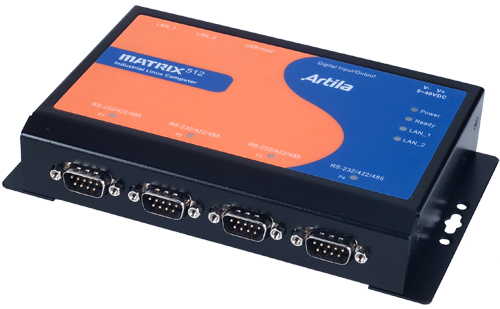
Product Name: Matrix-512
Model: Matrix-512
Series: Matrix Industrial Embedded Computer Series
Article Number: Matrix-512
Manufacturer: Artila Electronics Co., Ltd.
The Matrix-512 is a compact, fanless, ARM9-based industrial embedded computer designed for headless, Linux-based applications. It integrates an Atmel AT91RM9200 ARM920T processor running at 180 MHz, with 64 MB SDRAM and 16 MB NOR Flash memory. The device functions as a standalone web server and embedded controller, offering multiple serial, Ethernet, USB, and digital I/O interfaces. It is engineered for industrial automation, data acquisition, and networked control systems requiring reliable, low-power, and Linux-compatible computing in a small form factor.
2. Key Features
- ARM9 Architecture: Powered by the Atmel AT91RM9200 ARM920T processor (180 MHz, 200 MIPS) with integrated MMU, 16 KB instruction cache, and 16 KB data cache.
- Linux-Ready Platform: Pre-installed with Linux kernel 2.6.x, fully compatible with open-source GNU C/C++ toolchains for both Linux and Windows (Cygwin) environments.
- Dual Ethernet Ports: Two independent 10/100 Mbps Ethernet interfaces (RJ-45) with 1.5 kV magnetic isolation for redundant or segmented networking.
- Four Configurable Serial Ports: Four software-selectable RS-232/422/485 ports (DB9 male connectors) supporting up to 921.6 Kbps baud rate. Port 2 includes full modem control signals.
- USB Expansion: Two USB 2.0 host ports supporting low-speed (1.5 Mbps) and full-speed (12 Mbps) devices such as flash drives, Wi-Fi dongles, and serial adapters.
- Digital I/O: 21 programmable CMOS/TTL-level GPIO channels (DB25 female connector), each configurable as input or output.
- Storage Expansion: Internal SD 1.0-compliant slot supporting up to 2 GB SD (non-SDHC) cards for additional data storage.
- Industrial Design: Fanless, metal enclosure suitable for DIN-rail or wall mounting; wide 9–40 V DC input range; low power consumption (< 3 W).
- Networking & Security: Supports IPv4, TCP/IP, DHCP, NTP, SSL, SSH 1.0/2.0, SNMP v1/v2, and firewall management via iptables.
- Web & Remote Access: Integrated Boa web server, FTP/Telnet/SSH daemons, and SNMP agent for remote configuration and monitoring.
- Development Support: Includes GNU cross-compilation toolchain, example programs, and utilities for serial, GPIO, and system management.
3. Technical Specifications
Processor & Memory
- CPU: Atmel AT91RM9200 (ARM920T core, 180 MHz, 200 MIPS)
- Architecture: ARM9 with MMU
- Cache: 16 KB instruction, 16 KB data
- SDRAM: 64 MB
- Flash Memory: 16 MB NOR type
Networking
- Ethernet Ports: 2 × 10/100 Base‑T (RJ‑45)
- Isolation: 1.5 kV magnetic isolation
- Protocols: IPv4, TCP, UDP, ICMP, ARP, DHCP, NTP, PPP, PPPoE, SNMP v1/v2, SSL, SSH
Serial Communication
- Ports: 4 × RS‑232/422/485 (software selectable)
- Connector: DB9 male
- Baud Rate: Up to 921.6 Kbps
- Parity: None, Even, Odd, Mark, Space
- Data Bits: 5, 6, 7, 8
- Stop Bits: 1, 1.5, 2
- Flow Control: RTS/CTS, XON/XOFF, None
- Port 2: Full modem signal support
USB Interface
- Ports: 2 × USB 2.0 Host
- Data Rate: 1.5 Mbps (low speed), 12 Mbps (full speed)
- Supported Devices: Flash disks, Wi-Fi (IEEE 802.11b/g), USB‑RS232 adapters
Digital I/O (GPIO)
- Channels: 21 × CMOS/TTL-level I/O
- Connector: DB25 female
- Voltage Outputs: VCC3 = 3.3 V DC, VCC5 = 5 V DC
- Ground Pins: Multiple digital grounds
- Programmable: Each pin configurable as input or output
Storage
- Internal SD Slot: SD 1.0 compliant, up to 2 GB (non‑SDHC)
Power & Environmental
- Input Voltage: 9 – 40 V DC
- Power Consumption: 300 mA @ 12 V DC (< 3 W)
- Operating Temperature: 0 °C – 70 °C (32 °F – 158 °F)
- Enclosure: Fanless metal housing
- Dimensions: 160 × 104 × 32 mm
- Mounting: Wall mount (standard), optional DIN‑rail kit (DK‑35A)
Regulatory Compliance
- CE Class A
- FCC Class A
4. Functionality
The Matrix‑512 operates as a compact embedded Linux computer optimized for industrial automation, remote monitoring, and control applications. It functions as a standalone web server or networked controller, capable of running headless (without display or keyboard).
Operation:
- The system boots from onboard Flash using U‑Boot 1.1.2 and loads Linux 2.6.x into SDRAM.
- The root filesystem resides in an 8 MB RAMDISK, while user data and configuration files are stored in an 11 MB Flash partition (/disk).
- Users can expand storage via the internal SD slot or external USB drives.
- Network connectivity is provided through dual Ethernet ports or optional USB Wi‑Fi adapters.
- Serial ports support RS‑232, RS‑422, or RS‑485 communication for industrial devices such as PLCs, sensors, and modems.
- GPIO lines allow direct digital control and monitoring of external equipment.
Applications:
- Industrial automation and process control
- Data acquisition and logging
- Remote equipment monitoring
- Embedded web server or gateway
- Serial‑to‑Ethernet communication bridge
- IoT edge computing node
Compatibility:
- Fully compatible with Linux 2.6.x kernel and standard POSIX libraries.
- Supports GNU C/C++ toolchains for both Linux and Windows (via Cygwin).
- Works with standard networking protocols and USB peripherals.
5. Components & Accessories
Included Items:
1. Matrix‑512 embedded computer unit
2. Wall‑mount bracket
3. Artila CD containing:
- GNU C/C++ cross‑compiler toolchain
- User guide and documentation
- Example source code and utilities
Optional Accessories:
- DK‑35A: DIN‑rail mounting kit
- CB‑DB9MDB9M‑100: Console cable (DB9 M‑to‑DB9 M)
- CB‑DB9FDB9F‑100: Serial console cable (DB9 F‑to‑DB9 F)
Connectors:
- 4 × DB9 male (serial ports)
- 2 × RJ‑45 (Ethernet)
- 2 × USB Type‑A (host)
- 1 × DB25 female (GPIO)
- 1 × DC power input terminal
6. Installation & Setup
Power Requirements:
Supply 9–40 V DC via the power terminal. The Power LED glows solid green when voltage is correctly applied.
Mounting Options:
- Standard wall‑mount bracket included.
- Optional DK‑35A kit for DIN‑rail installation.
Initial Configuration:
- Default LAN 1 IP: 192.168.2.127
- Default LAN 2: DHCP enabled
- Default login: guest / guest
- Supervisor (root) login: root / root
Network Setup:
- Static IP: `ifconfig eth0 192.168.2.127 netmask 255.255.255.0`
- DHCP: `dhcpcd eth1 &`
- Wireless (USB Wi‑Fi): `ifconfig wlan0 up` followed by `iwconfig wlan0 essid <SSID> key <KEY> mode managed`
Serial Configuration:
Use the `setuart` utility to configure each port for RS‑232, RS‑422, or RS‑485 operation. RS‑485 supports automatic data direction control.
GPIO Configuration:
Use `gpioctl` to set digital I/O direction and state. Example: configure DIO1 as input and DIO2 as output.
System Management:
- `update` utility for firmware, kernel, or filesystem updates and disk formatting.
- `update --FORMAT` restores factory defaults (erases user data).
- `armd` daemon manages system services.
File System Layout:
- Root filesystem: RAMDISK (volatile)
- User disk (/disk): Flash storage for persistent data
- Web server files: `/home/httpd` (Boa configuration in `boa.conf`)
7. Performance & Capabilities
- Processing Speed: 180 MHz ARM9 CPU delivering ~200 MIPS.
- Memory Performance: 64 MB SDRAM ensures stable multitasking for embedded applications.
- Storage: 16 MB onboard Flash plus optional 2 GB SD card and USB mass storage.
- Networking: Dual 10/100 Mbps Ethernet interfaces enable redundancy or dual‑network operation.
- Serial Throughput: Up to 921.6 Kbps per port, supporting multiple industrial communication standards.
- Power Efficiency: Consumes less than 3 W, ideal for continuous 24/7 operation.
- Reliability: Fanless design with watchdog timer and real‑time clock ensures robust unattended operation.
- Limitations: SD slot supports up to 2 GB (non‑SDHC); limited onboard Flash (16 MB) requires external storage for large applications.
8. Standards & Compliance
- Operating System: Linux 2.6.x kernel
- Boot Loader: U‑Boot 1.1.2
- File Systems Supported: JFFS2, EXT2/EXT3, VFAT/FAT, NFS
- Network Protocols: IPv4, TCP/IP, UDP, FTP, Telnet, HTTP, PPP, PPPoE, SMTP, SNMP v1/v2, SSL, SSH 1.0/2.0
- Device Drivers: SD/MMC, UART, RTC, Buzzer, GPIO, Ethernet, Watchdog Timer
- USB Host Drivers: Flash disk, Wi‑Fi (IEEE 802.11b/g), RS‑232 adapters
- Regulatory Compliance: CE Class A, FCC Class A
- Environmental Compliance: RoHS‑compliant construction (metal enclosure, fanless design)
9. Additional Information
Warranty & Support:
Artila Electronics provides standard warranty coverage for manufacturing defects and offers technical support via documentation, online resources, and direct contact.
Maintenance:
- Regularly back up user data from the Flash disk (/disk) to external storage before performing updates or formatting.
- Use the watchdog timer for automatic system recovery in unattended deployments.
- Keep firmware and kernel updated using the `update` utility.
Software Development & Updates:
- GNU Toolchain: Includes GCC cross‑compiler, GLIBC POSIX library, and example source code.
- Development Environments: Linux or Windows (via Cygwin).
- Debugging: Supports remote debugging using `gdbserver` and DDD (Data Display Debugger).
- Example Workflow:
1. Compile code with `arm-linux-gcc -g example.c -o example`.
2. Upload to Matrix‑512 via FTP.
3. Run `./gdbserver :9999 example` on the device.
4. Connect from host PC using `ddd --debugger arm-linux-gdb example`.
System Utilities:
- `busybox`: Core Linux utilities
- `tinylogin`: User management
- `telnet`, `ftp`, `ssh`, `scp`: Remote access tools
- `iptables`: Firewall configuration
- `boa`: Web server daemon
- `snmpd`: SNMP agent
- `pppd`: PPP/PPPoE dial‑in/out service
Factory Reset & Recovery:
- Restore defaults via `/update --FORMAT` or by copying files from `/default` to `/etc` and `/home`.
- Default credentials: guest/guest (user), root/root (supervisor).
- Default IP: 192.168.2.127 (LAN 1).
Indicators & Controls:
- Power LED: Solid green when powered.
- Ready LED: Solid green after successful boot.
- Link/Act LEDs: Network link and activity indicators.
- Serial LEDs: Dual‑color indicators for TxD (yellow) and RxD (green).
- Reset Button: Hardware reset (use only if software reboot fails).
Use Case Examples:
- Embedded web‑based control panels
- Serial‑to‑Ethernet gateways for legacy equipment
- Remote data loggers with FTP upload
- Industrial IoT edge nodes with secure SSH access
- Programmable automation controllers (PACs)
Summary
The Artila Matrix‑512 is a robust, Linux‑ready ARM9 embedded computer engineered for industrial and embedded applications requiring reliable, low‑power, and network‑enabled computing. With its dual Ethernet ports, four configurable serial interfaces, 21 GPIO channels, and USB expansion, it provides exceptional flexibility for system integrators and developers. Its open Linux environment, complete with GNU toolchain and remote debugging support, enables rapid development and deployment of custom applications. The fanless metal enclosure, wide voltage range, and industrial temperature tolerance make it ideal for continuous operation in demanding environments.
In essence, the Matrix‑512 combines the stability of Linux, the efficiency of ARM9 architecture, and the connectivity of modern industrial interfaces into a compact, developer‑friendly platform for embedded control, automation, and IoT solutions.

Product Name: Matrix-512
Model: Matrix-512
Series: Matrix Industrial Embedded Computer Series
Article Number: Matrix-512
Manufacturer: Artila Electronics Co., Ltd.
The Matrix-512 is a compact, fanless, ARM9-based industrial embedded computer designed for headless, Linux-based applications. It integrates an Atmel AT91RM9200 ARM920T processor running at 180 MHz, with 64 MB SDRAM and 16 MB NOR Flash memory. The device functions as a standalone web server and embedded controller, offering multiple serial, Ethernet, USB, and digital I/O interfaces. It is engineered for industrial automation, data acquisition, and networked control systems requiring reliable, low-power, and Linux-compatible computing in a small form factor.
2. Key Features
- ARM9 Architecture: Powered by the Atmel AT91RM9200 ARM920T processor (180 MHz, 200 MIPS) with integrated MMU, 16 KB instruction cache, and 16 KB data cache.
- Linux-Ready Platform: Pre-installed with Linux kernel 2.6.x, fully compatible with open-source GNU C/C++ toolchains for both Linux and Windows (Cygwin) environments.
- Dual Ethernet Ports: Two independent 10/100 Mbps Ethernet interfaces (RJ-45) with 1.5 kV magnetic isolation for redundant or segmented networking.
- Four Configurable Serial Ports: Four software-selectable RS-232/422/485 ports (DB9 male connectors) supporting up to 921.6 Kbps baud rate. Port 2 includes full modem control signals.
- USB Expansion: Two USB 2.0 host ports supporting low-speed (1.5 Mbps) and full-speed (12 Mbps) devices such as flash drives, Wi-Fi dongles, and serial adapters.
- Digital I/O: 21 programmable CMOS/TTL-level GPIO channels (DB25 female connector), each configurable as input or output.
- Storage Expansion: Internal SD 1.0-compliant slot supporting up to 2 GB SD (non-SDHC) cards for additional data storage.
- Industrial Design: Fanless, metal enclosure suitable for DIN-rail or wall mounting; wide 9–40 V DC input range; low power consumption (< 3 W).
- Networking & Security: Supports IPv4, TCP/IP, DHCP, NTP, SSL, SSH 1.0/2.0, SNMP v1/v2, and firewall management via iptables.
- Web & Remote Access: Integrated Boa web server, FTP/Telnet/SSH daemons, and SNMP agent for remote configuration and monitoring.
- Development Support: Includes GNU cross-compilation toolchain, example programs, and utilities for serial, GPIO, and system management.
3. Technical Specifications
Processor & Memory
- CPU: Atmel AT91RM9200 (ARM920T core, 180 MHz, 200 MIPS)
- Architecture: ARM9 with MMU
- Cache: 16 KB instruction, 16 KB data
- SDRAM: 64 MB
- Flash Memory: 16 MB NOR type
Networking
- Ethernet Ports: 2 × 10/100 Base‑T (RJ‑45)
- Isolation: 1.5 kV magnetic isolation
- Protocols: IPv4, TCP, UDP, ICMP, ARP, DHCP, NTP, PPP, PPPoE, SNMP v1/v2, SSL, SSH
Serial Communication
- Ports: 4 × RS‑232/422/485 (software selectable)
- Connector: DB9 male
- Baud Rate: Up to 921.6 Kbps
- Parity: None, Even, Odd, Mark, Space
- Data Bits: 5, 6, 7, 8
- Stop Bits: 1, 1.5, 2
- Flow Control: RTS/CTS, XON/XOFF, None
- Port 2: Full modem signal support
USB Interface
- Ports: 2 × USB 2.0 Host
- Data Rate: 1.5 Mbps (low speed), 12 Mbps (full speed)
- Supported Devices: Flash disks, Wi-Fi (IEEE 802.11b/g), USB‑RS232 adapters
Digital I/O (GPIO)
- Channels: 21 × CMOS/TTL-level I/O
- Connector: DB25 female
- Voltage Outputs: VCC3 = 3.3 V DC, VCC5 = 5 V DC
- Ground Pins: Multiple digital grounds
- Programmable: Each pin configurable as input or output
Storage
- Internal SD Slot: SD 1.0 compliant, up to 2 GB (non‑SDHC)
Power & Environmental
- Input Voltage: 9 – 40 V DC
- Power Consumption: 300 mA @ 12 V DC (< 3 W)
- Operating Temperature: 0 °C – 70 °C (32 °F – 158 °F)
- Enclosure: Fanless metal housing
- Dimensions: 160 × 104 × 32 mm
- Mounting: Wall mount (standard), optional DIN‑rail kit (DK‑35A)
Regulatory Compliance
- CE Class A
- FCC Class A
4. Functionality
The Matrix‑512 operates as a compact embedded Linux computer optimized for industrial automation, remote monitoring, and control applications. It functions as a standalone web server or networked controller, capable of running headless (without display or keyboard).
Operation:
- The system boots from onboard Flash using U‑Boot 1.1.2 and loads Linux 2.6.x into SDRAM.
- The root filesystem resides in an 8 MB RAMDISK, while user data and configuration files are stored in an 11 MB Flash partition (/disk).
- Users can expand storage via the internal SD slot or external USB drives.
- Network connectivity is provided through dual Ethernet ports or optional USB Wi‑Fi adapters.
- Serial ports support RS‑232, RS‑422, or RS‑485 communication for industrial devices such as PLCs, sensors, and modems.
- GPIO lines allow direct digital control and monitoring of external equipment.
Applications:
- Industrial automation and process control
- Data acquisition and logging
- Remote equipment monitoring
- Embedded web server or gateway
- Serial‑to‑Ethernet communication bridge
- IoT edge computing node
Compatibility:
- Fully compatible with Linux 2.6.x kernel and standard POSIX libraries.
- Supports GNU C/C++ toolchains for both Linux and Windows (via Cygwin).
- Works with standard networking protocols and USB peripherals.
5. Components & Accessories
Included Items:
1. Matrix‑512 embedded computer unit
2. Wall‑mount bracket
3. Artila CD containing:
- GNU C/C++ cross‑compiler toolchain
- User guide and documentation
- Example source code and utilities
Optional Accessories:
- DK‑35A: DIN‑rail mounting kit
- CB‑DB9MDB9M‑100: Console cable (DB9 M‑to‑DB9 M)
- CB‑DB9FDB9F‑100: Serial console cable (DB9 F‑to‑DB9 F)
Connectors:
- 4 × DB9 male (serial ports)
- 2 × RJ‑45 (Ethernet)
- 2 × USB Type‑A (host)
- 1 × DB25 female (GPIO)
- 1 × DC power input terminal
6. Installation & Setup
Power Requirements:
Supply 9–40 V DC via the power terminal. The Power LED glows solid green when voltage is correctly applied.
Mounting Options:
- Standard wall‑mount bracket included.
- Optional DK‑35A kit for DIN‑rail installation.
Initial Configuration:
- Default LAN 1 IP: 192.168.2.127
- Default LAN 2: DHCP enabled
- Default login: guest / guest
- Supervisor (root) login: root / root
Network Setup:
- Static IP: `ifconfig eth0 192.168.2.127 netmask 255.255.255.0`
- DHCP: `dhcpcd eth1 &`
- Wireless (USB Wi‑Fi): `ifconfig wlan0 up` followed by `iwconfig wlan0 essid <SSID> key <KEY> mode managed`
Serial Configuration:
Use the `setuart` utility to configure each port for RS‑232, RS‑422, or RS‑485 operation. RS‑485 supports automatic data direction control.
GPIO Configuration:
Use `gpioctl` to set digital I/O direction and state. Example: configure DIO1 as input and DIO2 as output.
System Management:
- `update` utility for firmware, kernel, or filesystem updates and disk formatting.
- `update --FORMAT` restores factory defaults (erases user data).
- `armd` daemon manages system services.
File System Layout:
- Root filesystem: RAMDISK (volatile)
- User disk (/disk): Flash storage for persistent data
- Web server files: `/home/httpd` (Boa configuration in `boa.conf`)
7. Performance & Capabilities
- Processing Speed: 180 MHz ARM9 CPU delivering ~200 MIPS.
- Memory Performance: 64 MB SDRAM ensures stable multitasking for embedded applications.
- Storage: 16 MB onboard Flash plus optional 2 GB SD card and USB mass storage.
- Networking: Dual 10/100 Mbps Ethernet interfaces enable redundancy or dual‑network operation.
- Serial Throughput: Up to 921.6 Kbps per port, supporting multiple industrial communication standards.
- Power Efficiency: Consumes less than 3 W, ideal for continuous 24/7 operation.
- Reliability: Fanless design with watchdog timer and real‑time clock ensures robust unattended operation.
- Limitations: SD slot supports up to 2 GB (non‑SDHC); limited onboard Flash (16 MB) requires external storage for large applications.
8. Standards & Compliance
- Operating System: Linux 2.6.x kernel
- Boot Loader: U‑Boot 1.1.2
- File Systems Supported: JFFS2, EXT2/EXT3, VFAT/FAT, NFS
- Network Protocols: IPv4, TCP/IP, UDP, FTP, Telnet, HTTP, PPP, PPPoE, SMTP, SNMP v1/v2, SSL, SSH 1.0/2.0
- Device Drivers: SD/MMC, UART, RTC, Buzzer, GPIO, Ethernet, Watchdog Timer
- USB Host Drivers: Flash disk, Wi‑Fi (IEEE 802.11b/g), RS‑232 adapters
- Regulatory Compliance: CE Class A, FCC Class A
- Environmental Compliance: RoHS‑compliant construction (metal enclosure, fanless design)
9. Additional Information
Warranty & Support:
Artila Electronics provides standard warranty coverage for manufacturing defects and offers technical support via documentation, online resources, and direct contact.
Maintenance:
- Regularly back up user data from the Flash disk (/disk) to external storage before performing updates or formatting.
- Use the watchdog timer for automatic system recovery in unattended deployments.
- Keep firmware and kernel updated using the `update` utility.
Software Development & Updates:
- GNU Toolchain: Includes GCC cross‑compiler, GLIBC POSIX library, and example source code.
- Development Environments: Linux or Windows (via Cygwin).
- Debugging: Supports remote debugging using `gdbserver` and DDD (Data Display Debugger).
- Example Workflow:
1. Compile code with `arm-linux-gcc -g example.c -o example`.
2. Upload to Matrix‑512 via FTP.
3. Run `./gdbserver :9999 example` on the device.
4. Connect from host PC using `ddd --debugger arm-linux-gdb example`.
System Utilities:
- `busybox`: Core Linux utilities
- `tinylogin`: User management
- `telnet`, `ftp`, `ssh`, `scp`: Remote access tools
- `iptables`: Firewall configuration
- `boa`: Web server daemon
- `snmpd`: SNMP agent
- `pppd`: PPP/PPPoE dial‑in/out service
Factory Reset & Recovery:
- Restore defaults via `/update --FORMAT` or by copying files from `/default` to `/etc` and `/home`.
- Default credentials: guest/guest (user), root/root (supervisor).
- Default IP: 192.168.2.127 (LAN 1).
Indicators & Controls:
- Power LED: Solid green when powered.
- Ready LED: Solid green after successful boot.
- Link/Act LEDs: Network link and activity indicators.
- Serial LEDs: Dual‑color indicators for TxD (yellow) and RxD (green).
- Reset Button: Hardware reset (use only if software reboot fails).
Use Case Examples:
- Embedded web‑based control panels
- Serial‑to‑Ethernet gateways for legacy equipment
- Remote data loggers with FTP upload
- Industrial IoT edge nodes with secure SSH access
- Programmable automation controllers (PACs)
Summary
The Artila Matrix‑512 is a robust, Linux‑ready ARM9 embedded computer engineered for industrial and embedded applications requiring reliable, low‑power, and network‑enabled computing. With its dual Ethernet ports, four configurable serial interfaces, 21 GPIO channels, and USB expansion, it provides exceptional flexibility for system integrators and developers. Its open Linux environment, complete with GNU toolchain and remote debugging support, enables rapid development and deployment of custom applications. The fanless metal enclosure, wide voltage range, and industrial temperature tolerance make it ideal for continuous operation in demanding environments.
In essence, the Matrix‑512 combines the stability of Linux, the efficiency of ARM9 architecture, and the connectivity of modern industrial interfaces into a compact, developer‑friendly platform for embedded control, automation, and IoT solutions.
-
ds_matrix512.pdf
PDF Catalog
-
Warranty Declaration.pdf
PDF Catalog
-
matrix512_QIG.pdf
Manual
-
Serial Console Cable.pdf
Manual
-
gdbserver_HOW_TO.pdf
Manual
- DK-35A - DIN rail mounting kit (2pcs, 4 screws)
- CB-RJ45F9-150 - Data Cable DB9f Matrix-5xx series
- CB-DBCON-100 - Console Cable Matrix-512