 LOOKING FOR THE RIGHT
INDUSTRIAL SOLUTION?
Discover embedded, communication and automation solutions tailored to your application.
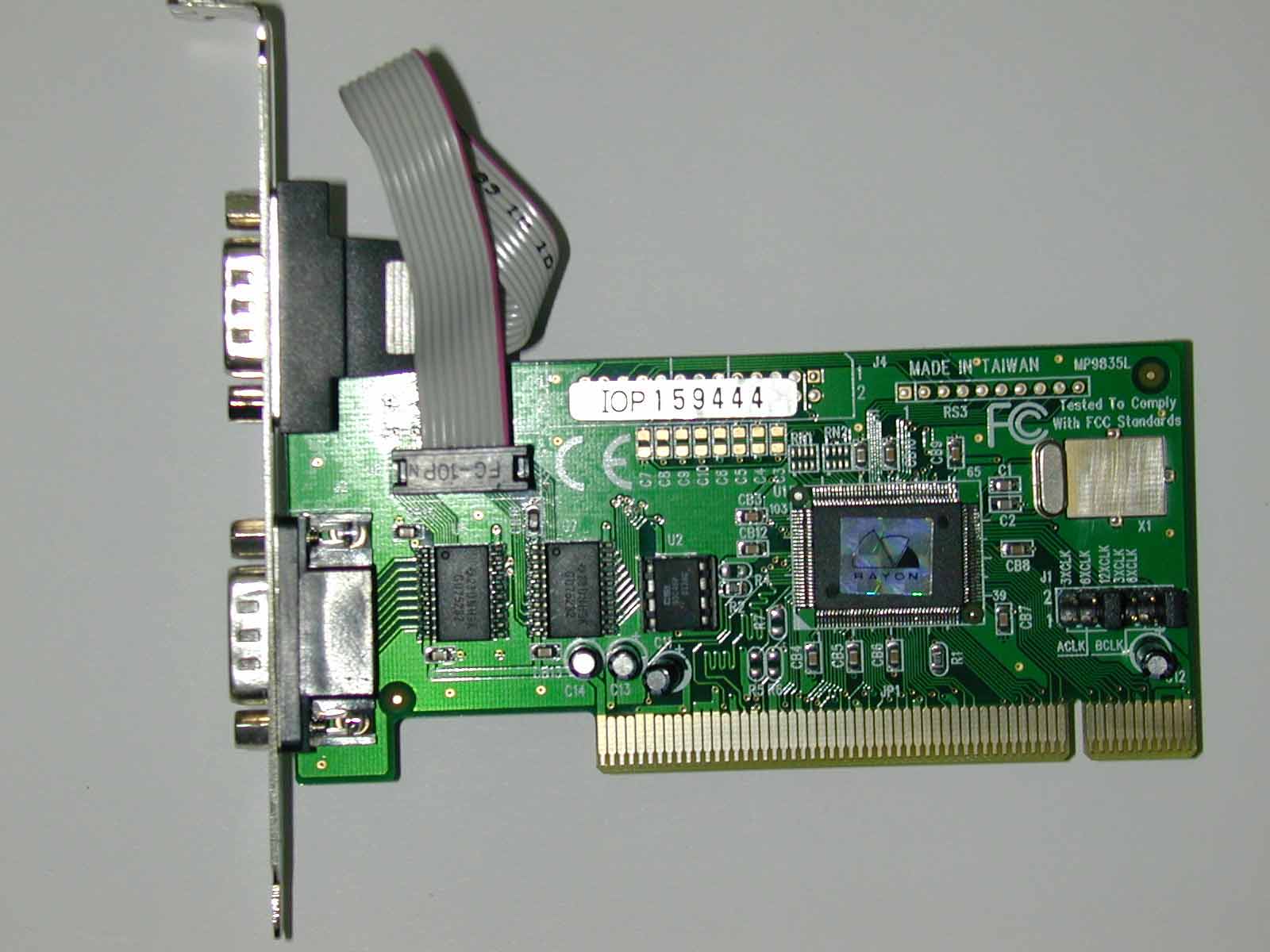
- Dual RS232 Serial Ports: Two independent RS232 communication ports for serial device connectivity.
- Low Profile PCI Design: Compact form factor (121 × 55 mm) suitable for small form factor PCs and industrial systems.
- Plug & Play PCI Interface: Fully compliant with PCI Local Bus Specification Rev. 2.1, supporting automatic resource assignment by BIOS.
- 16C550 UART Compatibility: Each port uses a 16C550-compatible UART with 16-byte transmit and receive FIFOs for efficient data handling.
- High-Speed Communication: Supports baud rates from 50 bps up to 115,200 bps (standard 1.8432 MHz crystal) or up to 921,600 bps with optional 14.7456 MHz crystal.
- Shared IRQ Support: One sharable interrupt request (IRQ) mapping for both ports, reducing system resource usage.
- Flexible I/O Mapping: Six 8-byte I/O address blocks automatically assigned by PCI BIOS.
- Wide OS Compatibility: Supports DOS, Windows 95/98/ME/NT/2000/XP, Linux, and SCO OpenServer.
- Universal PCI Voltage Support: Operates in 5V or 3.3V PCI slots (33 MHz bus).
- Robust Construction: Designed for industrial reliability and long-term operation.
- Rayon ASIC Controller: Custom PCI controller ASIC ensures stable communication and full compliance with PCI bus standards.
- Low Profile PCI Design: Compact form factor (121 × 55 mm) suitable for small form factor PCs and industrial systems.
- Plug & Play PCI Interface: Fully compliant with PCI Local Bus Specification Rev. 2.1, supporting automatic resource assignment by BIOS.
- 16C550 UART Compatibility: Each port uses a 16C550-compatible UART with 16-byte transmit and receive FIFOs for efficient data handling.
- High-Speed Communication: Supports baud rates from 50 bps up to 115,200 bps (standard 1.8432 MHz crystal) or up to 921,600 bps with optional 14.7456 MHz crystal.
- Shared IRQ Support: One sharable interrupt request (IRQ) mapping for both ports, reducing system resource usage.
- Flexible I/O Mapping: Six 8-byte I/O address blocks automatically assigned by PCI BIOS.
- Wide OS Compatibility: Supports DOS, Windows 95/98/ME/NT/2000/XP, Linux, and SCO OpenServer.
- Universal PCI Voltage Support: Operates in 5V or 3.3V PCI slots (33 MHz bus).
- Robust Construction: Designed for industrial reliability and long-term operation.
- Rayon ASIC Controller: Custom PCI controller ASIC ensures stable communication and full compliance with PCI bus standards.
Comprehensive Product Summary – Rayon Technology P232L PCI 2-Port RS232 Card (Low Profile)
### 1. Product Overview
Product Name: PCI 2-Port RS232 Card (Low Profile)
Model Number: P232L
Series: RAYON PCIPORT Series
Article Number: P232L
Manufacturer: Rayon Technology Inc.
Country of Origin: Taiwan R.O.C.
Manual Revision: Rev. 1.00 (October 19, 2003)
Manufacturer Contact:
- Rayon Technology Co., Ltd.
2F, No. 177, Chung-Shan 2 Road, Lu-Chou City, Taipei Hsien, Taiwan R.O.C.
Tel: +886 2 82858362 | Fax: +886 2 82857065 | Email: rayon@ms1.hinet.net
- European Support (Acceed GmbH)
Arnoldstraße 19, 40479 Düsseldorf, Germany
Tel/Fax: +49 211 938898 0 | Email: rayon@acceed.com
### 2. Key Features
- Dual RS232 Serial Ports: Two independent RS232 communication ports for serial device connectivity.
- Low Profile PCI Design: Compact form factor (121 × 55 mm) suitable for small form factor PCs and industrial systems.
- Plug & Play PCI Interface: Fully compliant with PCI Local Bus Specification Rev. 2.1, supporting automatic resource assignment by BIOS.
- 16C550 UART Compatibility: Each port uses a 16C550-compatible UART with 16-byte transmit and receive FIFOs for efficient data handling.
- High-Speed Communication: Supports baud rates from 50 bps up to 115,200 bps (standard 1.8432 MHz crystal) or up to 921,600 bps with optional 14.7456 MHz crystal.
- Shared IRQ Support: One sharable interrupt request (IRQ) mapping for both ports, reducing system resource usage.
- Flexible I/O Mapping: Six 8-byte I/O address blocks automatically assigned by PCI BIOS.
- Wide OS Compatibility: Supports DOS, Windows 95/98/ME/NT/2000/XP, Linux, and SCO OpenServer.
- Universal PCI Voltage Support: Operates in 5V or 3.3V PCI slots (33 MHz bus).
- Robust Construction: Designed for industrial reliability and long-term operation.
- Rayon ASIC Controller: Custom PCI controller ASIC ensures stable communication and full compliance with PCI bus standards.
### 3. Technical Specifications
Physical Dimensions: 121 mm (L) × 55 mm (H)
Form Factor: Low Profile PCI card
Weight: Approx. 80–100 g (typical)
Bus Interface: PCI Local Bus, 32-bit, 33 MHz, 5V/3.3V signaling
Serial Controller: 16C550A-compatible UART
Clock Frequency: 1.8432 MHz (standard), optional 14.7456 MHz
Baud Rate Range: 50 bps to 115.2 Kbps (standard), up to 921.6 Kbps (optional)
Communication Standard: RS232C (EIA/TIA-232)
Connector Type: Two DB9 male connectors (on bracket or via cable)
I/O Addressing: 6 × 8-byte I/O blocks assigned by PCI BIOS
Interrupts: 1 shared IRQ (PCI BIOS assigned, IRQ shareable)
Flow Control: Hardware (RTS/CTS) and software (XON/XOFF)
Operating Voltage: 5V or 3.3V PCI slot
Power Consumption: < 2.5 W typical
Operating Temperature: 0°C to 55°C
Storage Temperature: -20°C to 85°C
Relative Humidity: 5%–95% non-condensing
Compliance: PCI 2.1, CE, FCC Class B (typical for Rayon PCIPORT series)
### 4. Functionality
The P232L provides two independent RS232 serial communication channels through a single PCI interface card. Each channel is managed by a 16C550-compatible UART, offering 16-byte transmit and receive FIFOs to minimize CPU overhead and prevent data loss during high-speed communication.
Operation Principle:
- The card interfaces with the host system via the PCI bus.
- The PCI BIOS automatically assigns I/O addresses and IRQs.
- Each serial port operates independently, supporting asynchronous serial communication.
- The card supports both hardware and software flow control to ensure reliable data transfer.
Use Cases & Applications:
- Industrial automation and control systems
- POS (Point-of-Sale) terminals
- Serial device servers and console management
- Modems, barcode scanners, and instrumentation interfaces
- Legacy serial device integration in modern PCs
Compatibility:
- Fully compatible with standard RS232 devices.
- Works with all major operating systems supporting serial communication.
- Supports up to one P232L card per system (as per BIOS resource mapping).
### 5. Components & Accessories
Included Items:
- 1 × P232L PCI 2-Port RS232 Card (Low Profile)
- 1 × Low-profile bracket (pre-installed or included)
- 1 × User Manual (digital or printed)
- 1 × Driver Diskette or driver package (DOS/Windows/Linux/SCO)
Optional Accessories:
- DB9-to-DB25 adapter cables
- RS232 extension cables
- TB485 converter (for DB9 to terminal block, optional for RS485 applications in other models)
Connectors:
- Two DB9 male connectors for RS232 communication
- Standard pinout per EIA/TIA-232 specification
### 6. Installation & Setup
System Requirements:
- PC/AT compatible system with available PCI slot (5V or 3.3V, 33 MHz)
- Supported operating system (DOS, Windows 95/98/ME/NT/2000/XP, Linux, SCO OpenServer)
Installation Procedure:
1. Power off the computer and unplug it.
2. Insert the P232L card into an available PCI slot.
3. Secure the card with the bracket screw.
4. Connect serial devices to the DB9 connectors.
5. Power on the system.
6. The PCI BIOS will automatically detect and assign resources.
7. Install the appropriate driver for your operating system.
Driver Installation:
- Windows 2000/XP: Plug & Play detection; specify driver path (A:\WIN2000).
- Windows NT4: Manual installation via Control Panel → Network → Add Adapter → “Other” → specify A:\P220\NT4.
- Windows 95/98/ME: Plug & Play detection; specify A:\WIN95.
- DOS: Copy driver files from diskette and run `P984` or `PCIPORT` utility.
- Linux: Extract driver package (`tar xvf /dev/fd0`), run `./Install`, rebuild kernel modules.
- SCO OpenServer: Use `/etc/custom` or manual installation via `/etc/pciport/build`.
Jumper Configuration:
- JP1: Card number selection (ON = first card, OFF = second card).
*Note: Only one P232L card per system is recommended.*
Mounting Options:
- Standard PCI slot or low-profile PCI slot (with included bracket).
### 7. Performance & Capabilities
Data Throughput:
- Up to 115.2 Kbps per port (standard crystal)
- Up to 921.6 Kbps per port (optional high-speed crystal)
FIFO Buffers:
- 16-byte transmit and 16-byte receive buffers per port
Interrupt Handling:
- Shared IRQ mode supported (IRQ assigned by PCI BIOS)
- Reduces CPU interrupt load by buffering multiple characters per interrupt
Efficiency:
- Intelligent buffering minimizes CPU overhead
- Plug & Play configuration eliminates manual resource conflicts
Limitations:
- Supports only RS232 interface (no RS422/485 on this model)
- One card per system recommended due to IRQ mapping constraints
- No isolation or surge protection (available on other Rayon models such as P422I or P485)
### 8. Standards & Compliance
Bus Interface Standard: PCI Local Bus Specification Revision 2.1
Serial Interface Standard: EIA/TIA RS232C
UART Compatibility: 16C550A
Electrical Compliance: 5V/3.3V PCI signaling
Software Compatibility:
- Microsoft Windows (DOS, 95, 98, ME, NT, 2000, XP)
- Linux (kernel 2.4.x and later, source-based driver installation)
- SCO OpenServer
Regulatory Compliance:
- CE and FCC Class B (typical for Rayon PCIPORT series)
- RoHS compliance (for later production batches)
Industry Standards Supported:
- Plug & Play (PnP) resource allocation
- IRQ sharing per PCI specification
- Hardware flow control (RTS/CTS)
- Software flow control (XON/XOFF)
### 9. Additional Information
Warranty:
- 1-year limited warranty covering defects in materials and workmanship.
- Excludes damage from misuse, unauthorized servicing, or electrical faults.
Repair & RMA Procedure:
- Contact Rayon or Acceed support for Return Material Authorization (RMA).
- Provide model number, serial number, reason for return, and purchase order reference.
- Products under warranty repaired at no cost; out-of-warranty repairs subject to flat-rate service charge.
Maintenance:
- Keep card and connectors free of dust and debris.
- Avoid electrostatic discharge (ESD) during handling.
- Ensure proper grounding when connecting external devices.
Support & Updates:
- Driver updates and documentation available via Acceed (Europe) or Rayon (Taiwan) websites.
- Email support for Linux driver integration and troubleshooting.
Troubleshooting Highlights:
- If the card is not detected, verify PCI slot integrity and BIOS resource allocation.
- Ensure correct driver path during installation (e.g., A:\WIN2000 for Windows 2000).
- For communication issues, test with loopback connector and terminal utility (RAYONTTY.EXE).
- Check IRQ conflicts in BIOS setup if data transmission fails.
Environmental & Safety Notes:
- Operate within specified temperature and humidity ranges.
- Do not insert or remove the card while the system is powered on.
- Use anti-static precautions during installation.
### Summary
The Rayon P232L PCI 2-Port RS232 Card (Low Profile) is a compact, high-performance serial communication interface designed for industrial and commercial PC systems requiring reliable RS232 connectivity. Featuring dual 16C550-compatible UARTs, automatic PCI resource configuration, and broad OS support, the P232L delivers efficient serial communication with minimal CPU load. Its low-profile design makes it ideal for embedded and space-constrained applications.
With full compliance to PCI 2.1 standards, support for shared IRQs, and compatibility across multiple operating systems, the P232L provides a robust and flexible solution for integrating legacy serial devices into modern computing environments.
Key Advantages:
- Dual high-speed RS232 ports on a single PCI card
- Plug & Play installation with BIOS-assigned resources
- Low-profile form factor for compact systems
- Comprehensive driver support across major OS platforms
- Proven reliability from Rayon Technology’s PCIPORT series
End of Product Summary – Rayon Technology P232L PCI 2-Port RS232 Card (Low Profile)
### 1. Product Overview
Product Name: PCI 2-Port RS232 Card (Low Profile)
Model Number: P232L
Series: RAYON PCIPORT Series
Article Number: P232L
Manufacturer: Rayon Technology Inc.
Country of Origin: Taiwan R.O.C.
Manual Revision: Rev. 1.00 (October 19, 2003)
Manufacturer Contact:
- Rayon Technology Co., Ltd.
2F, No. 177, Chung-Shan 2 Road, Lu-Chou City, Taipei Hsien, Taiwan R.O.C.
Tel: +886 2 82858362 | Fax: +886 2 82857065 | Email: rayon@ms1.hinet.net
- European Support (Acceed GmbH)
Arnoldstraße 19, 40479 Düsseldorf, Germany
Tel/Fax: +49 211 938898 0 | Email: rayon@acceed.com
### 2. Key Features
- Dual RS232 Serial Ports: Two independent RS232 communication ports for serial device connectivity.
- Low Profile PCI Design: Compact form factor (121 × 55 mm) suitable for small form factor PCs and industrial systems.
- Plug & Play PCI Interface: Fully compliant with PCI Local Bus Specification Rev. 2.1, supporting automatic resource assignment by BIOS.
- 16C550 UART Compatibility: Each port uses a 16C550-compatible UART with 16-byte transmit and receive FIFOs for efficient data handling.
- High-Speed Communication: Supports baud rates from 50 bps up to 115,200 bps (standard 1.8432 MHz crystal) or up to 921,600 bps with optional 14.7456 MHz crystal.
- Shared IRQ Support: One sharable interrupt request (IRQ) mapping for both ports, reducing system resource usage.
- Flexible I/O Mapping: Six 8-byte I/O address blocks automatically assigned by PCI BIOS.
- Wide OS Compatibility: Supports DOS, Windows 95/98/ME/NT/2000/XP, Linux, and SCO OpenServer.
- Universal PCI Voltage Support: Operates in 5V or 3.3V PCI slots (33 MHz bus).
- Robust Construction: Designed for industrial reliability and long-term operation.
- Rayon ASIC Controller: Custom PCI controller ASIC ensures stable communication and full compliance with PCI bus standards.
### 3. Technical Specifications
Physical Dimensions: 121 mm (L) × 55 mm (H)
Form Factor: Low Profile PCI card
Weight: Approx. 80–100 g (typical)
Bus Interface: PCI Local Bus, 32-bit, 33 MHz, 5V/3.3V signaling
Serial Controller: 16C550A-compatible UART
Clock Frequency: 1.8432 MHz (standard), optional 14.7456 MHz
Baud Rate Range: 50 bps to 115.2 Kbps (standard), up to 921.6 Kbps (optional)
Communication Standard: RS232C (EIA/TIA-232)
Connector Type: Two DB9 male connectors (on bracket or via cable)
I/O Addressing: 6 × 8-byte I/O blocks assigned by PCI BIOS
Interrupts: 1 shared IRQ (PCI BIOS assigned, IRQ shareable)
Flow Control: Hardware (RTS/CTS) and software (XON/XOFF)
Operating Voltage: 5V or 3.3V PCI slot
Power Consumption: < 2.5 W typical
Operating Temperature: 0°C to 55°C
Storage Temperature: -20°C to 85°C
Relative Humidity: 5%–95% non-condensing
Compliance: PCI 2.1, CE, FCC Class B (typical for Rayon PCIPORT series)
### 4. Functionality
The P232L provides two independent RS232 serial communication channels through a single PCI interface card. Each channel is managed by a 16C550-compatible UART, offering 16-byte transmit and receive FIFOs to minimize CPU overhead and prevent data loss during high-speed communication.
Operation Principle:
- The card interfaces with the host system via the PCI bus.
- The PCI BIOS automatically assigns I/O addresses and IRQs.
- Each serial port operates independently, supporting asynchronous serial communication.
- The card supports both hardware and software flow control to ensure reliable data transfer.
Use Cases & Applications:
- Industrial automation and control systems
- POS (Point-of-Sale) terminals
- Serial device servers and console management
- Modems, barcode scanners, and instrumentation interfaces
- Legacy serial device integration in modern PCs
Compatibility:
- Fully compatible with standard RS232 devices.
- Works with all major operating systems supporting serial communication.
- Supports up to one P232L card per system (as per BIOS resource mapping).
### 5. Components & Accessories
Included Items:
- 1 × P232L PCI 2-Port RS232 Card (Low Profile)
- 1 × Low-profile bracket (pre-installed or included)
- 1 × User Manual (digital or printed)
- 1 × Driver Diskette or driver package (DOS/Windows/Linux/SCO)
Optional Accessories:
- DB9-to-DB25 adapter cables
- RS232 extension cables
- TB485 converter (for DB9 to terminal block, optional for RS485 applications in other models)
Connectors:
- Two DB9 male connectors for RS232 communication
- Standard pinout per EIA/TIA-232 specification
### 6. Installation & Setup
System Requirements:
- PC/AT compatible system with available PCI slot (5V or 3.3V, 33 MHz)
- Supported operating system (DOS, Windows 95/98/ME/NT/2000/XP, Linux, SCO OpenServer)
Installation Procedure:
1. Power off the computer and unplug it.
2. Insert the P232L card into an available PCI slot.
3. Secure the card with the bracket screw.
4. Connect serial devices to the DB9 connectors.
5. Power on the system.
6. The PCI BIOS will automatically detect and assign resources.
7. Install the appropriate driver for your operating system.
Driver Installation:
- Windows 2000/XP: Plug & Play detection; specify driver path (A:\WIN2000).
- Windows NT4: Manual installation via Control Panel → Network → Add Adapter → “Other” → specify A:\P220\NT4.
- Windows 95/98/ME: Plug & Play detection; specify A:\WIN95.
- DOS: Copy driver files from diskette and run `P984` or `PCIPORT` utility.
- Linux: Extract driver package (`tar xvf /dev/fd0`), run `./Install`, rebuild kernel modules.
- SCO OpenServer: Use `/etc/custom` or manual installation via `/etc/pciport/build`.
Jumper Configuration:
- JP1: Card number selection (ON = first card, OFF = second card).
*Note: Only one P232L card per system is recommended.*
Mounting Options:
- Standard PCI slot or low-profile PCI slot (with included bracket).
### 7. Performance & Capabilities
Data Throughput:
- Up to 115.2 Kbps per port (standard crystal)
- Up to 921.6 Kbps per port (optional high-speed crystal)
FIFO Buffers:
- 16-byte transmit and 16-byte receive buffers per port
Interrupt Handling:
- Shared IRQ mode supported (IRQ assigned by PCI BIOS)
- Reduces CPU interrupt load by buffering multiple characters per interrupt
Efficiency:
- Intelligent buffering minimizes CPU overhead
- Plug & Play configuration eliminates manual resource conflicts
Limitations:
- Supports only RS232 interface (no RS422/485 on this model)
- One card per system recommended due to IRQ mapping constraints
- No isolation or surge protection (available on other Rayon models such as P422I or P485)
### 8. Standards & Compliance
Bus Interface Standard: PCI Local Bus Specification Revision 2.1
Serial Interface Standard: EIA/TIA RS232C
UART Compatibility: 16C550A
Electrical Compliance: 5V/3.3V PCI signaling
Software Compatibility:
- Microsoft Windows (DOS, 95, 98, ME, NT, 2000, XP)
- Linux (kernel 2.4.x and later, source-based driver installation)
- SCO OpenServer
Regulatory Compliance:
- CE and FCC Class B (typical for Rayon PCIPORT series)
- RoHS compliance (for later production batches)
Industry Standards Supported:
- Plug & Play (PnP) resource allocation
- IRQ sharing per PCI specification
- Hardware flow control (RTS/CTS)
- Software flow control (XON/XOFF)
### 9. Additional Information
Warranty:
- 1-year limited warranty covering defects in materials and workmanship.
- Excludes damage from misuse, unauthorized servicing, or electrical faults.
Repair & RMA Procedure:
- Contact Rayon or Acceed support for Return Material Authorization (RMA).
- Provide model number, serial number, reason for return, and purchase order reference.
- Products under warranty repaired at no cost; out-of-warranty repairs subject to flat-rate service charge.
Maintenance:
- Keep card and connectors free of dust and debris.
- Avoid electrostatic discharge (ESD) during handling.
- Ensure proper grounding when connecting external devices.
Support & Updates:
- Driver updates and documentation available via Acceed (Europe) or Rayon (Taiwan) websites.
- Email support for Linux driver integration and troubleshooting.
Troubleshooting Highlights:
- If the card is not detected, verify PCI slot integrity and BIOS resource allocation.
- Ensure correct driver path during installation (e.g., A:\WIN2000 for Windows 2000).
- For communication issues, test with loopback connector and terminal utility (RAYONTTY.EXE).
- Check IRQ conflicts in BIOS setup if data transmission fails.
Environmental & Safety Notes:
- Operate within specified temperature and humidity ranges.
- Do not insert or remove the card while the system is powered on.
- Use anti-static precautions during installation.
### Summary
The Rayon P232L PCI 2-Port RS232 Card (Low Profile) is a compact, high-performance serial communication interface designed for industrial and commercial PC systems requiring reliable RS232 connectivity. Featuring dual 16C550-compatible UARTs, automatic PCI resource configuration, and broad OS support, the P232L delivers efficient serial communication with minimal CPU load. Its low-profile design makes it ideal for embedded and space-constrained applications.
With full compliance to PCI 2.1 standards, support for shared IRQs, and compatibility across multiple operating systems, the P232L provides a robust and flexible solution for integrating legacy serial devices into modern computing environments.
Key Advantages:
- Dual high-speed RS232 ports on a single PCI card
- Plug & Play installation with BIOS-assigned resources
- Low-profile form factor for compact systems
- Comprehensive driver support across major OS platforms
- Proven reliability from Rayon Technology’s PCIPORT series
End of Product Summary – Rayon Technology P232L PCI 2-Port RS232 Card (Low Profile)
-
 PCI-Port-015.pdf
Manual
PCI-Port-015.pdf
Manual
No accessories available.