 LOOKING FOR THE RIGHT
INDUSTRIAL SOLUTION?
Discover embedded, communication and automation solutions tailored to your application.
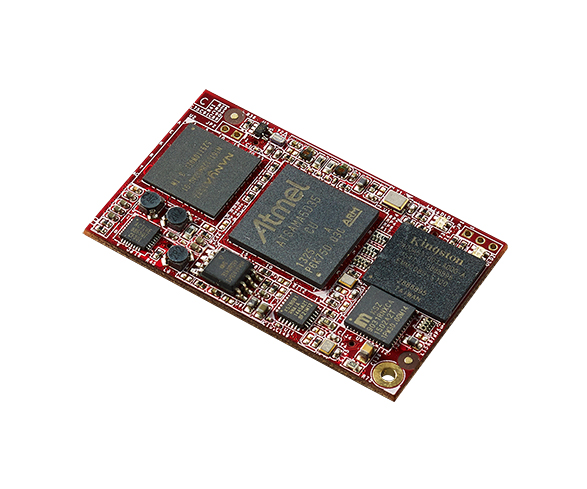
- Processor: Atmel ATSAMA5D35 ARM Cortex‑A5 MPU, 536 MHz, with MMU and VFPv4 floating‑point unit.
- Memory: 512 MB LPDDR2 SDRAM, 8 GB eMMC Flash, and 8 MB DataFlash for system backup.
- Operating System: Linux kernel 4.9.x with EXT4 file system and Barebox bootloader.
- Networking: Dual Ethernet interfaces — one Gigabit (Micrel KSZ9031RNXCA) and one 10/100 Mbps (Micrel KSZ8081RNAIA).
- Interfaces: SPI, I²C, I²S, UART × 4, CAN × 2, USB 2.0 Host × 2, SD 2.0 (SDHC), GPIO × 21.
- Power Efficiency: Single 5 V DC input, typical consumption 0.75 W (< 1 W max).
- Compact Form Factor: SoM dimensions 50 × 30 mm, 50 × 2 pins (1.27 mm pitch).
- Development Environment: GCC 6.2.0 + glibc 2.24 toolchain, in‑place C/C++ compilation, apt‑based package management.
- Pre‑installed Software: Web servers (Apache/Nginx/Lighttpd), databases (MySQL/SQLite3/PostgreSQL), scripting languages (PHP/Python/Perl/NodeJS), and administration tools (Webmin).
- Evaluation Board (CB‑Matrix‑700): Provides RJ‑45 Ethernet ports, USB 2.0 hosts, serial ports (RS‑232/485), microSD socket, RTC, watchdog, buzzer, and flexible power input (9–48 V DC).
- Applications: Industrial automation, data acquisition, communication gateways, embedded Linux development, and IoT edge computing.
- Memory: 512 MB LPDDR2 SDRAM, 8 GB eMMC Flash, and 8 MB DataFlash for system backup.
- Operating System: Linux kernel 4.9.x with EXT4 file system and Barebox bootloader.
- Networking: Dual Ethernet interfaces — one Gigabit (Micrel KSZ9031RNXCA) and one 10/100 Mbps (Micrel KSZ8081RNAIA).
- Interfaces: SPI, I²C, I²S, UART × 4, CAN × 2, USB 2.0 Host × 2, SD 2.0 (SDHC), GPIO × 21.
- Power Efficiency: Single 5 V DC input, typical consumption 0.75 W (< 1 W max).
- Compact Form Factor: SoM dimensions 50 × 30 mm, 50 × 2 pins (1.27 mm pitch).
- Development Environment: GCC 6.2.0 + glibc 2.24 toolchain, in‑place C/C++ compilation, apt‑based package management.
- Pre‑installed Software: Web servers (Apache/Nginx/Lighttpd), databases (MySQL/SQLite3/PostgreSQL), scripting languages (PHP/Python/Perl/NodeJS), and administration tools (Webmin).
- Evaluation Board (CB‑Matrix‑700): Provides RJ‑45 Ethernet ports, USB 2.0 hosts, serial ports (RS‑232/485), microSD socket, RTC, watchdog, buzzer, and flexible power input (9–48 V DC).
- Applications: Industrial automation, data acquisition, communication gateways, embedded Linux development, and IoT edge computing.
1. Product Overview
Product Name: M‑A5D35 Cortex‑A5 Evaluation Kit
Model: M‑A5D35‑Starter‑Kit
Series: M‑A5D35 Linux‑Ready Cortex‑A5 System‑on‑Module (SoM)
Article Number: M‑A5D35‑Starter‑Kit
Manufacturer: Artila Electronics Co., Ltd. (www.artila.com)
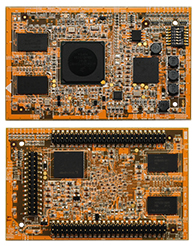
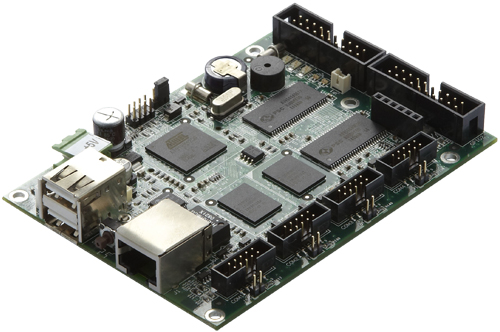
The M‑A5D35‑Starter‑Kit is a complete evaluation and development platform built around Artila’s M‑A5D35 System‑on‑Module (SoM). It integrates an Atmel/Microchip ATSAMA5D35 ARM Cortex‑A5 processor running at 536 MHz, pre‑installed Linux OS, and a comprehensive set of I/O interfaces. The kit includes the M‑A5D35 SoM mounted on a carrier board (CB‑Matrix‑700) with dual Ethernet ports, USB host ports, serial interfaces, SD socket, and power management circuitry. It is designed for rapid prototyping and deployment of industrial control, automation, and IoT gateway applications.
2. Key Features
- Processor: Atmel ATSAMA5D35 ARM Cortex‑A5 MPU, 536 MHz, with MMU and VFPv4 floating‑point unit.
- Memory: 512 MB LPDDR2 SDRAM, 8 GB eMMC Flash, and 8 MB DataFlash for system backup.
- Operating System: Linux kernel 4.9.x with EXT4 file system and Barebox bootloader.
- Networking: Dual Ethernet interfaces — one Gigabit (Micrel KSZ9031RNXCA) and one 10/100 Mbps (Micrel KSZ8081RNAIA).
- Interfaces: SPI, I²C, I²S, UART × 4, CAN × 2, USB 2.0 Host × 2, SD 2.0 (SDHC), GPIO × 21.
- Power Efficiency: Single 5 V DC input, typical consumption 0.75 W (< 1 W max).
- Compact Form Factor: SoM dimensions 50 × 30 mm, 50 × 2 pins (1.27 mm pitch).
- Development Environment: GCC 6.2.0 + glibc 2.24 toolchain, in‑place C/C++ compilation, apt‑based package management.
- Pre‑installed Software: Web servers (Apache/Nginx/Lighttpd), databases (MySQL/SQLite3/PostgreSQL), scripting languages (PHP/Python/Perl/NodeJS), and administration tools (Webmin).
- Evaluation Board (CB‑Matrix‑700): Provides RJ‑45 Ethernet ports, USB 2.0 hosts, serial ports (RS‑232/485), microSD socket, RTC, watchdog, buzzer, and flexible power input (9–48 V DC).
- Applications: Industrial automation, data acquisition, communication gateways, embedded Linux development, and IoT edge computing.
3. Technical Specifications
CPU / Memory
- Processor: Atmel ATSAMA5D35 ARM Cortex‑A5 MPU (ARMv7‑A Thumb‑2 ISA)
- Clock Frequency: 536 MHz
- Caches: 32 KB Instruction + 32 KB Data
- SDRAM: 512 MB LPDDR2
- Flash: 8 GB eMMC + 8 MB DataFlash
- Internal SRAM: 128 KB
- Internal ROM: 160 KB with bootloader
Networking
- 1 × Gigabit Ethernet (10/100/1000 Mbps, Micrel KSZ9031RNXCA)
- 1 × 10/100 Mbps Ethernet (Micrel KSZ8081RNAIA)
- Transformer isolation: 1.5 kV
- IEEE 1588 support
USB
- 2 × USB 2.0 Hi‑Speed Host ports (480 Mbps)
- 1 × USB Device port (DDP/DDM)
- Console access via USB CDC/ACM
UART / Serial
- 4 × UARTs (TX, RX, RTS, CTS)
- Baud rate up to 921.6 kbps
- Parity: None/Even/Odd/Mark/Space
- Stop bits: 1/1.5/2
- Flow control: RTS/CTS, XON/XOFF, None
- Signal level: 3.3 V CMOS
- Configurable RS‑232/RS‑485 modes
CAN
- 2 × CAN 2.0 A/B controllers (8 mailboxes each)
- Shared pins with UART1 CTS for CAN1 TX
GPIO
- 21 programmable digital I/O pins
- Logic levels: CMOS/TTL compatible
- Input low: –0.3 V min / +0.8 V max
- Input high: +2.0 V min / +3.6 V max
- Output low: +0.4 V max @ 8 mA
- Output high: +2.9 V min @ 8 mA
SPI / I²C / I²S / SD
- SPI: MISO, MOSI, CLK, CS0–CS3
- I²C: Data + Clock (400 kbit/s SMBus compatible)
- I²S: TX/RX data, clock, sync lines
- SD 2.0 interface (SDHC compatible)
Power
- Input Voltage: +5 V DC (4.75–5.25 V range)
- Typical Consumption: 0.75 W
- External watchdog input/output
Physical
- Dimensions: 50 mm (W) × 30 mm (L)
- Connectors: 2 × 50‑pin female headers (1.27 mm pitch)
- Mounting hole: 1 × M2 (2.0 mm diameter)
Environmental
- Low‑power operation (< 1 W)
- Industrial temperature range (dependent on carrier board design)
4. Functionality
The M‑A5D35 SoM serves as a compact embedded computing core. It integrates CPU, memory, and essential peripherals, exposing all signals through dual 50‑pin headers (CN1 and CN2). The Starter Kit’s carrier board (CB‑Matrix‑700) provides standard connectors for Ethernet, USB, serial, and SD interfaces, enabling immediate evaluation.
Use Cases & Applications
- Industrial controllers and PLC gateways
- IoT edge nodes and data loggers
- Communication protocol converters (Modbus, CAN, Ethernet)
- Embedded Linux training and software development
- Automation and remote monitoring systems
Compatibility
- Boot from on‑board eMMC or external SD card
- Supports USB Wi‑Fi dongles (RT8192/RT5390 chipsets)
- Compatible with Artila’s Matrix‑7xx series industrial computers
- Works with standard Linux utilities and network protocols (TCP/IP, SSH, SNMP, SSL)
5. Components & Accessories
Included in Starter Kit
- M‑A5D35 SoM (512 MB SDRAM, 8 GB eMMC)
- CB‑Matrix‑700 carrier board
- Pre‑installed Linux kernel and file system
- Console cable (91‑PHDF9‑050, 4‑pin header to DB9 female, 50 cm)
- Documentation and software resources
Optional Accessories
- DK‑35A (36‑DK35A‑000): DIN‑rail mounting kit
- PWR‑12V‑1A (31‑62100‑000): 110–240 VAC to 12 V DC 1 A power adapter
Connectors and Headers
- CN1: Ethernet, USB, SPI, GPIO, debug, power (+5 V, GND)
- CN2: CAN, UART, I²C, I²S, SD, VBAT, watchdog signals
6. Installation & Setup
Power Requirements
- SoM operates on 5 V DC; carrier board accepts 9–48 V DC input.
Mounting Options
- Wall‑mount (default) or DIN‑rail (optional kit DK‑35A).
Initial Operation
1. Connect power and console cable (USB or serial).
2. Use terminal software (Putty, minicom) with 115200 bps, N81, VT100.
3. Default login: root / root.
4. Network defaults: eth0 (DHCP), eth1 (192.168.2.127/24).
5. Access via SSH or Webmin (https://192.168.2.127:10000).
Software Package Management
- Uses standard `apt-get` commands with Artila’s repository.
- Supports installation of web servers, databases, and development tools.
Development Environment Setup
- Cross‑compile using Yocto‑based toolchain (poky glibc 2.0.2).
- Native compilation supported on device via gcc/g++.
- Eclipse IDE integration available with Yocto plug‑ins.
7. Performance & Capabilities
- CPU Speed: 536 MHz ARM Cortex‑A5 with VFPv4 FPU.
- Memory Bandwidth: 32‑bit multi‑port DDR controller (166 MHz bus).
- Storage: 8 GB eMMC (boot + root + user disk), 8 MB DataFlash (backup).
- Networking: Dual Ethernet with hardware MAC/PHY and transformers.
- USB Throughput: 480 Mbps (Hi‑Speed mode).
- Serial Performance: Up to 921.6 kbps per UART.
- Power Efficiency: < 1 W typical at 5 V input.
- Reliability: Hardware watchdog, RTC with battery backup, 1.5 kV LAN isolation.
- Limitations: No GPU or display controller on SoM variant; limited to headless applications.
8. Standards & Compliance
- Processor Compliance: ARM Cortex‑A5 (ARMv7‑A architecture).
- Ethernet: IEEE 802.3 10/100/1000 Mbps standards.
- USB: USB 2.0 Hi‑Speed (480 Mbps).
- CAN: ISO 11898 (CAN 2.0 A/B).
- SD: SD 2.0 / SDHC compliant.
- File System: EXT4 Linux standard.
- Security Features: AES (128/192/256‑bit), DES/3DES, SHA‑1/256/512, TRNG.
- Software Stack: IPv4, TCP/IP, UDP, DHCP, NTP, FTP, HTTP, PPP, SNMP v1/v3, SSL, SSH.
- Regulatory: Designed for industrial embedded applications (CE/FCC compliance dependent on final integration).
9. Additional Information
Warranty & Support
- Standard manufacturer warranty (terms per Artila policy).
- Technical support and software updates available via Artila website.
- Documentation: Hardware Guide v1.0 (July 2017), Software Guide v1.0 (Oct 2017).
Maintenance & Updates
- Firmware and Linux image updates available from Artila download portal.
- Factory restore image provided for system recovery via bootable SD card.
- Supports apt‑based software upgrades and security patches.
Developer Resources
- Cross‑compilation toolchain and Yocto SDK available for Linux hosts.
- Example projects and Eclipse integration guides included.
- GPIO, UART, SPI, I²C accessible via standard Linux device drivers.
Web Administration
- Webmin interface for remote system management (HTTPS port 10000).
- Default credentials: admin / admin.
Restoration Procedure
- Download restore image from Artila site.
- Create bootable SD card using Win32DiskImager or `dd`.
- Boot from SD and execute `restore` command to reflash system.
Software Ecosystem
- Pre‑installed utilities: bash, busybox, telnet, ftp, iptables, ssh server.
- Daemons: pppd, snmpd, inetd, ftpd, nginx, crond.
- Supports Python 2.7 and Python 3.5 interpreters with pip package manager.
- PHP 5.6 support via php‑cli, php‑cgi, php‑fpm packages.
GPIO Mapping Example
- Bank A: PA0–PA31 (gpiochip0 #0–31)
- Bank B: PB0–PB31 (gpiochip32 #32–63)
- Bank C: PC0–PC31 (gpiochip64 #64–95)
- Bank D: PD0–PD31 (gpiochip96 #96–127)
- Bank E: PE0–PE31 (gpiochip128 #128–159)
Wireless Support
- USB Wi‑Fi dongles supported via drivers: rtl8xxxu, rt2800usb.
- WPA/WPA2 configuration via `/etc/wpa_supplicant.conf`.
Cellular Connectivity (Matrix‑710/713 models)
- miniPCIe slot for 3G/4G/LTE modules.
- PPP configuration via `/etc/ppp/peers/3g`.
Development Tools & Integration
- Eclipse IDE support with Yocto ADT plug‑ins.
- Remote debugging via SSH and RSE.
- Example “Hello World” C/C++ projects provided.
Summary
The Artila M‑A5D35 Starter Kit delivers a robust, Linux‑ready embedded computing platform centered on the ATSAMA5D35 Cortex‑A5 MPU. With its dual Ethernet interfaces, USB connectivity, multiple serial ports, and comprehensive software stack, it is optimized for industrial automation and IoT gateway applications. The compact 50 × 30 mm SoM consumes less than 1 W and runs a fully featured Linux environment with gcc toolchain and apt‑based package management. The CB‑Matrix‑700 carrier board extends the SoM into a ready‑to‑use evaluation kit with standard connectors and power options. Comprehensive documentation, cross‑development tools, and Webmin administration make the M‑A5D35 Starter Kit a complete solution for developers seeking a low‑power, high‑integration ARM Cortex‑A5 platform for embedded Linux projects.
Product Name: M‑A5D35 Cortex‑A5 Evaluation Kit
Model: M‑A5D35‑Starter‑Kit
Series: M‑A5D35 Linux‑Ready Cortex‑A5 System‑on‑Module (SoM)
Article Number: M‑A5D35‑Starter‑Kit
Manufacturer: Artila Electronics Co., Ltd. (www.artila.com)
The M‑A5D35‑Starter‑Kit is a complete evaluation and development platform built around Artila’s M‑A5D35 System‑on‑Module (SoM). It integrates an Atmel/Microchip ATSAMA5D35 ARM Cortex‑A5 processor running at 536 MHz, pre‑installed Linux OS, and a comprehensive set of I/O interfaces. The kit includes the M‑A5D35 SoM mounted on a carrier board (CB‑Matrix‑700) with dual Ethernet ports, USB host ports, serial interfaces, SD socket, and power management circuitry. It is designed for rapid prototyping and deployment of industrial control, automation, and IoT gateway applications.
2. Key Features
- Processor: Atmel ATSAMA5D35 ARM Cortex‑A5 MPU, 536 MHz, with MMU and VFPv4 floating‑point unit.
- Memory: 512 MB LPDDR2 SDRAM, 8 GB eMMC Flash, and 8 MB DataFlash for system backup.
- Operating System: Linux kernel 4.9.x with EXT4 file system and Barebox bootloader.
- Networking: Dual Ethernet interfaces — one Gigabit (Micrel KSZ9031RNXCA) and one 10/100 Mbps (Micrel KSZ8081RNAIA).
- Interfaces: SPI, I²C, I²S, UART × 4, CAN × 2, USB 2.0 Host × 2, SD 2.0 (SDHC), GPIO × 21.
- Power Efficiency: Single 5 V DC input, typical consumption 0.75 W (< 1 W max).
- Compact Form Factor: SoM dimensions 50 × 30 mm, 50 × 2 pins (1.27 mm pitch).
- Development Environment: GCC 6.2.0 + glibc 2.24 toolchain, in‑place C/C++ compilation, apt‑based package management.
- Pre‑installed Software: Web servers (Apache/Nginx/Lighttpd), databases (MySQL/SQLite3/PostgreSQL), scripting languages (PHP/Python/Perl/NodeJS), and administration tools (Webmin).
- Evaluation Board (CB‑Matrix‑700): Provides RJ‑45 Ethernet ports, USB 2.0 hosts, serial ports (RS‑232/485), microSD socket, RTC, watchdog, buzzer, and flexible power input (9–48 V DC).
- Applications: Industrial automation, data acquisition, communication gateways, embedded Linux development, and IoT edge computing.
3. Technical Specifications
CPU / Memory
- Processor: Atmel ATSAMA5D35 ARM Cortex‑A5 MPU (ARMv7‑A Thumb‑2 ISA)
- Clock Frequency: 536 MHz
- Caches: 32 KB Instruction + 32 KB Data
- SDRAM: 512 MB LPDDR2
- Flash: 8 GB eMMC + 8 MB DataFlash
- Internal SRAM: 128 KB
- Internal ROM: 160 KB with bootloader
Networking
- 1 × Gigabit Ethernet (10/100/1000 Mbps, Micrel KSZ9031RNXCA)
- 1 × 10/100 Mbps Ethernet (Micrel KSZ8081RNAIA)
- Transformer isolation: 1.5 kV
- IEEE 1588 support
USB
- 2 × USB 2.0 Hi‑Speed Host ports (480 Mbps)
- 1 × USB Device port (DDP/DDM)
- Console access via USB CDC/ACM
UART / Serial
- 4 × UARTs (TX, RX, RTS, CTS)
- Baud rate up to 921.6 kbps
- Parity: None/Even/Odd/Mark/Space
- Stop bits: 1/1.5/2
- Flow control: RTS/CTS, XON/XOFF, None
- Signal level: 3.3 V CMOS
- Configurable RS‑232/RS‑485 modes
CAN
- 2 × CAN 2.0 A/B controllers (8 mailboxes each)
- Shared pins with UART1 CTS for CAN1 TX
GPIO
- 21 programmable digital I/O pins
- Logic levels: CMOS/TTL compatible
- Input low: –0.3 V min / +0.8 V max
- Input high: +2.0 V min / +3.6 V max
- Output low: +0.4 V max @ 8 mA
- Output high: +2.9 V min @ 8 mA
SPI / I²C / I²S / SD
- SPI: MISO, MOSI, CLK, CS0–CS3
- I²C: Data + Clock (400 kbit/s SMBus compatible)
- I²S: TX/RX data, clock, sync lines
- SD 2.0 interface (SDHC compatible)
Power
- Input Voltage: +5 V DC (4.75–5.25 V range)
- Typical Consumption: 0.75 W
- External watchdog input/output
Physical
- Dimensions: 50 mm (W) × 30 mm (L)
- Connectors: 2 × 50‑pin female headers (1.27 mm pitch)
- Mounting hole: 1 × M2 (2.0 mm diameter)
Environmental
- Low‑power operation (< 1 W)
- Industrial temperature range (dependent on carrier board design)
4. Functionality
The M‑A5D35 SoM serves as a compact embedded computing core. It integrates CPU, memory, and essential peripherals, exposing all signals through dual 50‑pin headers (CN1 and CN2). The Starter Kit’s carrier board (CB‑Matrix‑700) provides standard connectors for Ethernet, USB, serial, and SD interfaces, enabling immediate evaluation.
Use Cases & Applications
- Industrial controllers and PLC gateways
- IoT edge nodes and data loggers
- Communication protocol converters (Modbus, CAN, Ethernet)
- Embedded Linux training and software development
- Automation and remote monitoring systems
Compatibility
- Boot from on‑board eMMC or external SD card
- Supports USB Wi‑Fi dongles (RT8192/RT5390 chipsets)
- Compatible with Artila’s Matrix‑7xx series industrial computers
- Works with standard Linux utilities and network protocols (TCP/IP, SSH, SNMP, SSL)
5. Components & Accessories
Included in Starter Kit
- M‑A5D35 SoM (512 MB SDRAM, 8 GB eMMC)
- CB‑Matrix‑700 carrier board
- Pre‑installed Linux kernel and file system
- Console cable (91‑PHDF9‑050, 4‑pin header to DB9 female, 50 cm)
- Documentation and software resources
Optional Accessories
- DK‑35A (36‑DK35A‑000): DIN‑rail mounting kit
- PWR‑12V‑1A (31‑62100‑000): 110–240 VAC to 12 V DC 1 A power adapter
Connectors and Headers
- CN1: Ethernet, USB, SPI, GPIO, debug, power (+5 V, GND)
- CN2: CAN, UART, I²C, I²S, SD, VBAT, watchdog signals
6. Installation & Setup
Power Requirements
- SoM operates on 5 V DC; carrier board accepts 9–48 V DC input.
Mounting Options
- Wall‑mount (default) or DIN‑rail (optional kit DK‑35A).
Initial Operation
1. Connect power and console cable (USB or serial).
2. Use terminal software (Putty, minicom) with 115200 bps, N81, VT100.
3. Default login: root / root.
4. Network defaults: eth0 (DHCP), eth1 (192.168.2.127/24).
5. Access via SSH or Webmin (https://192.168.2.127:10000).
Software Package Management
- Uses standard `apt-get` commands with Artila’s repository.
- Supports installation of web servers, databases, and development tools.
Development Environment Setup
- Cross‑compile using Yocto‑based toolchain (poky glibc 2.0.2).
- Native compilation supported on device via gcc/g++.
- Eclipse IDE integration available with Yocto plug‑ins.
7. Performance & Capabilities
- CPU Speed: 536 MHz ARM Cortex‑A5 with VFPv4 FPU.
- Memory Bandwidth: 32‑bit multi‑port DDR controller (166 MHz bus).
- Storage: 8 GB eMMC (boot + root + user disk), 8 MB DataFlash (backup).
- Networking: Dual Ethernet with hardware MAC/PHY and transformers.
- USB Throughput: 480 Mbps (Hi‑Speed mode).
- Serial Performance: Up to 921.6 kbps per UART.
- Power Efficiency: < 1 W typical at 5 V input.
- Reliability: Hardware watchdog, RTC with battery backup, 1.5 kV LAN isolation.
- Limitations: No GPU or display controller on SoM variant; limited to headless applications.
8. Standards & Compliance
- Processor Compliance: ARM Cortex‑A5 (ARMv7‑A architecture).
- Ethernet: IEEE 802.3 10/100/1000 Mbps standards.
- USB: USB 2.0 Hi‑Speed (480 Mbps).
- CAN: ISO 11898 (CAN 2.0 A/B).
- SD: SD 2.0 / SDHC compliant.
- File System: EXT4 Linux standard.
- Security Features: AES (128/192/256‑bit), DES/3DES, SHA‑1/256/512, TRNG.
- Software Stack: IPv4, TCP/IP, UDP, DHCP, NTP, FTP, HTTP, PPP, SNMP v1/v3, SSL, SSH.
- Regulatory: Designed for industrial embedded applications (CE/FCC compliance dependent on final integration).
9. Additional Information
Warranty & Support
- Standard manufacturer warranty (terms per Artila policy).
- Technical support and software updates available via Artila website.
- Documentation: Hardware Guide v1.0 (July 2017), Software Guide v1.0 (Oct 2017).
Maintenance & Updates
- Firmware and Linux image updates available from Artila download portal.
- Factory restore image provided for system recovery via bootable SD card.
- Supports apt‑based software upgrades and security patches.
Developer Resources
- Cross‑compilation toolchain and Yocto SDK available for Linux hosts.
- Example projects and Eclipse integration guides included.
- GPIO, UART, SPI, I²C accessible via standard Linux device drivers.
Web Administration
- Webmin interface for remote system management (HTTPS port 10000).
- Default credentials: admin / admin.
Restoration Procedure
- Download restore image from Artila site.
- Create bootable SD card using Win32DiskImager or `dd`.
- Boot from SD and execute `restore` command to reflash system.
Software Ecosystem
- Pre‑installed utilities: bash, busybox, telnet, ftp, iptables, ssh server.
- Daemons: pppd, snmpd, inetd, ftpd, nginx, crond.
- Supports Python 2.7 and Python 3.5 interpreters with pip package manager.
- PHP 5.6 support via php‑cli, php‑cgi, php‑fpm packages.
GPIO Mapping Example
- Bank A: PA0–PA31 (gpiochip0 #0–31)
- Bank B: PB0–PB31 (gpiochip32 #32–63)
- Bank C: PC0–PC31 (gpiochip64 #64–95)
- Bank D: PD0–PD31 (gpiochip96 #96–127)
- Bank E: PE0–PE31 (gpiochip128 #128–159)
Wireless Support
- USB Wi‑Fi dongles supported via drivers: rtl8xxxu, rt2800usb.
- WPA/WPA2 configuration via `/etc/wpa_supplicant.conf`.
Cellular Connectivity (Matrix‑710/713 models)
- miniPCIe slot for 3G/4G/LTE modules.
- PPP configuration via `/etc/ppp/peers/3g`.
Development Tools & Integration
- Eclipse IDE support with Yocto ADT plug‑ins.
- Remote debugging via SSH and RSE.
- Example “Hello World” C/C++ projects provided.
Summary
The Artila M‑A5D35 Starter Kit delivers a robust, Linux‑ready embedded computing platform centered on the ATSAMA5D35 Cortex‑A5 MPU. With its dual Ethernet interfaces, USB connectivity, multiple serial ports, and comprehensive software stack, it is optimized for industrial automation and IoT gateway applications. The compact 50 × 30 mm SoM consumes less than 1 W and runs a fully featured Linux environment with gcc toolchain and apt‑based package management. The CB‑Matrix‑700 carrier board extends the SoM into a ready‑to‑use evaluation kit with standard connectors and power options. Comprehensive documentation, cross‑development tools, and Webmin administration make the M‑A5D35 Starter Kit a complete solution for developers seeking a low‑power, high‑integration ARM Cortex‑A5 platform for embedded Linux projects.
-
 M-A5D35_Datasheet.pdf
PDF Catalog
M-A5D35_Datasheet.pdf
PDF Catalog
-
 Warranty Declaration.pdf
PDF Catalog
Warranty Declaration.pdf
PDF Catalog
-
 M-A5D35_Hardware_Guide.pdf
Manual
M-A5D35_Hardware_Guide.pdf
Manual
-
 M-A5D35_Software_Guide.pdf
Manual
M-A5D35_Software_Guide.pdf
Manual
No accessories available.