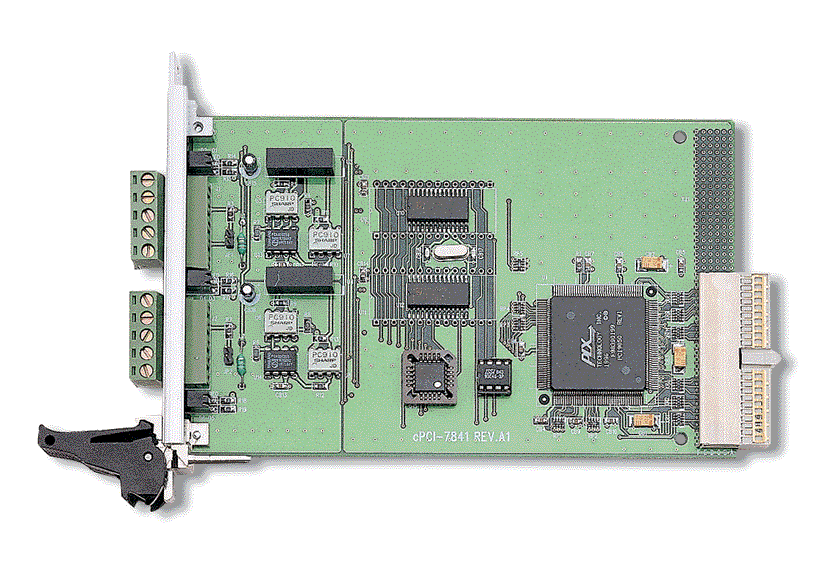
Comprehensive Product Summary – ADLINK PM‑7841 Dual‑Port Isolated CAN Interface Card
### 1. Product Overview
Product Name: PM‑7841 Dual‑Port Isolated CAN Interface Card
Model Number: PM‑7841
Series: NuCOM® 7841 Series (includes PCI‑7841, cPCI‑7841, and PM‑7841 variants)
Article Number: PM‑7841
Manufacturer: ADLINK Technology Inc.
Product Type: PC/104 form‑factor dual‑port isolated Controller Area Network (CAN) interface card
Release Information:
- First Edition: June 1, 1998
- Revision 3.00: May 28, 2000
Bus Interface: PC/104 (ISA‑compatible stackable embedded bus)
The PM‑7841 is part of ADLINK’s NuCOM 7841 family of CAN interface adapters designed for industrial automation and embedded control systems. It provides two independent, optically isolated CAN channels that can operate separately or be bridged, supporting CAN 2.0A and 2.0B protocols. The card integrates Philips SJA1000 CAN controllers and 82C250/82C251 transceivers, offering robust communication with high noise immunity and electrical isolation for reliable operation in harsh industrial environments.
### 2. Key Features
- Dual Independent CAN Channels: Two fully isolated CAN ports capable of independent or bridged operation.
- CAN 2.0A/B Compatibility: Compliant with Bosch CAN specification 2.0 parts A (11‑bit) and B (29‑bit).
- Optical Isolation: 1000 Vrms galvanic isolation between CAN bus and logic circuitry, ensuring protection against ground loops and electrical surges.
- High‑Speed Communication: Programmable transfer rate up to 1 Mbps; supports standard DeviceNet baud rates of 125 Kbps, 250 Kbps, and 500 Kbps.
- Integrated CAN Controller: Utilizes Philips SJA1000 CAN controller with advanced bus arbitration, error detection, automatic retransmission, and error correction.
- Direct Memory Mapping: Provides memory‑mapped access to CAN controller registers for efficient data handling.
- Software Programmable Addressing: Base I/O address and memory mapping configurable via DIP switch and software.
- Bridge Function Support: Enables inter‑port communication for network bridging or redundancy.
- PC/104 Industry Form Factor: Compact, stackable design for embedded and industrial PC applications.
- Comprehensive Software Support: Includes DOS library, Windows 95/98/NT drivers, and example programs.
- DeviceNet, CANopen, and SDS Protocol Support: Provides a powerful master interface for higher‑layer industrial communication protocols.
- Diagnostic LEDs: On‑board LEDs for port status indication (supported on cPCI‑7841 and PM‑7841).
- Termination Control: On‑board 120 Ω termination resistors selectable via jumpers (JP1, JP2).
- Robust Environmental Tolerance: Designed for 0 °C to 60 °C operation and up to 95% non‑condensing humidity.
### 3. Technical Specifications
Bus Interface: PC/104 (ISA‑compatible)
Ports: 2 independent CAN channels (CAN 2.0A/B compliant)
CAN Controller: Philips SJA1000
CAN Transceiver: Philips 82C250 or 82C251
Signal Lines: CAN_H, CAN_L
Isolation Voltage: 1000 Vrms (optical isolation)
Connectors: Dual 5‑pin male connectors (J1, J2)
Base Address Configuration: 5‑position DIP switch (SW1), selectable from 0x200 – 0x3F0
IRQ Configuration: Jumper selectable (default IRQ15)
Memory‑Mapped Space: 128 bytes (software programmable)
Power Requirements:
- Typical: 400 mA @ +5 VDC
- Maximum: 900 mA @ +5 VDC (without external devices)
Dimensions: 90.17 mm (L) × 95.89 mm (H)
Operating Temperature: 0 °C – 60 °C
Storage Temperature: −20 °C – 80 °C
Humidity: 5 % – 95 % RH, non‑condensing
Form Factor: PC/104 stackable embedded module
Weight: Approximately 100 g (typical for PC/104 modules)
### 4. Functionality
The PM‑7841 provides a dual‑channel CAN interface for embedded and industrial PCs using the PC/104 bus. Each channel operates independently, allowing simultaneous communication with two separate CAN networks or bridging between them. The onboard SJA1000 controllers handle message arbitration, error detection, and retransmission automatically, minimizing CPU overhead.
Operation Principle:
- The host system communicates with the PM‑7841 via I/O‑mapped or memory‑mapped registers.
- Each CAN port can be configured for standard (11‑bit) or extended (29‑bit) identifiers.
- Baud rates are selectable through software or auto‑detection routines.
- The card supports interrupt‑driven and polled operation modes.
- CAN messages are transmitted and received through driver functions such as `CanSendMsg()` and `CanRcvMsg()`.
Use Cases and Applications:
- Industrial automation and process control systems
- Manufacturing equipment communication networks
- Distributed I/O and sensor/actuator control
- Product testing and data acquisition systems
- DeviceNet or CANopen master/slave implementations
- Embedded control systems requiring reliable fieldbus communication
Compatibility:
- Compatible with PC/104 embedded systems and ISA‑bus industrial PCs.
- Software libraries support DOS, Windows 95/98, and Windows NT environments.
- Supports integration with ADLINK’s CANopen and DeviceNet software stacks.
### 5. Components & Accessories
Package Contents:
- PM‑7841 Dual‑Port PC/104 Isolated CAN Interface Card
- ADLINK “All‑xxxx” CD‑ROM containing drivers, libraries, and example code
- User’s Manual (PDF or printed)
On‑Board Components:
- Two SJA1000 CAN controllers
- Two 82C250/82C251 CAN transceivers
- Optical isolation circuitry (1000 Vrms)
- Dual 5‑pin male CAN connectors (J1, J2)
- Two termination jumpers (JP1, JP2) for 120 Ω resistors
- DIP switch SW1 for base address configuration
- Jumper block for IRQ selection (JP3, JP4)
- Diagnostic LEDs for port activity and status
Optional Accessories:
- CAN bus cables (DB‑9 or 5‑pin to open‑end)
- External termination resistors (if required)
- PC/104 stackable spacers and mounting hardware
### 6. Installation & Setup
Pre‑Installation Precautions:
- Handle the card on a grounded anti‑static mat.
- Wear an anti‑static wrist strap connected to the same ground point.
- Inspect the module for shipping damage before installation.
- Do not apply power if physical damage is observed.
Installation Steps:
1. Power off the host PC/104 system.
2. Insert the PM‑7841 into the PC/104 stack, aligning the bus connectors.
3. Secure the module using standoffs or spacers.
4. Configure the base I/O address using DIP switch SW1 (default 0x200).
5. Set the desired IRQ level via jumpers (default IRQ15).
6. Connect CAN network cables to J1 and J2 connectors.
7. Enable or disable termination resistors using JP1 (Port 0) and JP2 (Port 1).
8. Power on the system and install the appropriate software drivers.
Base Address Configuration:
- Address range: 0x200 – 0x3F0 (16 consecutive I/O locations).
- Configured via 5‑position DIP switch (SW1).
- Default factory setting: 0x200.
IRQ Level Configuration:
- Selectable via jumpers JP3/JP4.
- Default: IRQ15.
- Ensure no other device shares the same interrupt line.
Termination Configuration:
- Each CAN port includes a 120 Ω resistor.
- JP1 enables termination for Port 0; JP2 for Port 1.
- Termination should be enabled only at the ends of the CAN bus.
### 7. Performance & Capabilities
Communication Speed:
- Programmable up to 1 Mbps.
- Standard DeviceNet rates: 125 Kbps, 250 Kbps, 500 Kbps.
- User‑defined baud rates supported via software parameters (BRP, TSEG1, TSEG2, SJW, SAM).
Data Handling:
- Hardware FIFO buffers for transmit and receive queues.
- Driver‑level memory buffers for extended message storage.
- Supports up to 21 CAN packets in FIFO under certain configurations.
Error Management:
- Automatic retransmission on error detection.
- Functions for error monitoring and recovery:
- `CanGetErrorCode()`, `CanClearOverrun()`, `CanGetRxErrorCount()`, `CanSetTxErrorCount()`.
- Programmable error warning limits and interrupt‑driven event handling.
Efficiency:
- Low CPU overhead due to hardware arbitration and interrupt‑driven design.
- Supports callback and event‑based notification under DOS and Windows environments.
Limitations:
- FIFO depth limited to 64 bytes (hardware constraint).
- Requires proper termination and grounding for optimal noise immunity.
- Shared IRQs not supported; each card must have a unique interrupt line.
### 8. Standards & Compliance
Protocol Standards:
- CAN Specification 2.0A (11‑bit identifiers)
- CAN Specification 2.0B (29‑bit identifiers)
- DeviceNet and CANopen application layer compatibility
Electrical & Mechanical Standards:
- PC/104 (ISA‑compatible) mechanical and electrical interface
- Optical isolation: 1000 Vrms
- Signal lines: CAN_H, CAN_L per ISO 11898
Software & OS Compatibility:
- DOS library and sample code
- Windows 95/98/NT driver support
- C/C++ and Visual Basic API libraries
Regulatory Compliance:
- Designed for industrial EMC environments
- Meets general CE and FCC Class A industrial computing standards (typical for ADLINK products of this class)
Safety & Reliability:
- Isolation and surge protection for industrial fieldbus environments
- Operating temperature and humidity ratings suitable for factory automation systems
### 9. Additional Information
Warranty:
Standard ADLINK limited hardware warranty (typically one year from date of purchase; refer to ADLINK terms).
Technical Support:
- ADLINK Technology Inc. provides driver updates, sample code, and technical documentation via its support portal.
- Email and phone support available through regional ADLINK offices.
Maintenance:
- No periodic maintenance required beyond ensuring clean connectors and proper grounding.
- Avoid exposure to excessive dust, moisture, or vibration.
- Verify termination and cable integrity periodically in field installations.
Software Updates & Libraries:
- ADLINK “All‑xxxx” CD‑ROM includes:
- DOS and Windows drivers
- Example source code for C/C++ and Visual Basic
- API reference for CAN and DeviceNet functions
- Functions include initialization (`PM7841_Install()`), configuration (`CanConfigPort()`), message handling (`CanSendMsg()`, `CanRcvMsg()`), and DeviceNet operations (`DNetOpenExp()`, `DNetScan()`, `DNetSetBaud()`, etc.).
- Libraries support both low‑level CAN access and high‑level DeviceNet communication.
Driver Functionality Overview:
- Initialization: `PM7841_Install(base, irq, memorySpace)`
- Port Management: `CanOpenDriver()`, `CanCloseDriver()`
- Configuration: `CanConfigPort()`, `CanDetectBaudrate()`
- I/O Operations: `CanSendMsg()`, `CanRcvMsg()`, `CanRead()`, `CanWrite()`
- Error Handling: `CanGetErrorCode()`, `CanSetErrorWarningLimit()`
- Event Handling: `CanInstallCallBack()` (DOS), `CanInstallEvent()` (Windows)
- DeviceNet Layer: `SendDeviceNetPacket()`, `RcvDeviceNetPacket()`, `DNetOpenIO()`, `DNetScan()`, `DNetSetID()`, `DNetSetBaud()`, `DNetAsmIn()`, `DNetAsmOut()`, `DNetSetSafeOut()`, etc.
Maintenance Recommendations:
- Ensure firmware and driver versions are matched to the operating system.
- Use shielded twisted‑pair CAN cables for optimal signal integrity.
- Maintain proper bus termination and topology to prevent reflection and data loss.
Product Lifecycle & Compatibility:
- The PM‑7841 remains compatible with legacy PC/104 systems and continues to be supported by ADLINK’s unified CAN driver suite.
- Successor models (e.g., PCI‑7841, cPCI‑7841) share the same software interface, ensuring code portability across platforms.
### Summary
The ADLINK PM‑7841 Dual‑Port Isolated CAN Interface Card is a robust, industrial‑grade communication module designed for embedded PC/104 systems requiring reliable CAN bus connectivity. With dual isolated channels, full CAN 2.0A/B compliance, and comprehensive software support for both low‑level and high‑level protocols (CANopen, DeviceNet, SDS), the PM‑7841 provides a flexible and high‑performance solution for automation, control, and data acquisition applications. Its optical isolation, configurable base address and IRQ, and extensive driver library make it suitable for integration into a wide range of industrial and embedded environments where deterministic, noise‑immune communication is essential.


 LOOKING FOR THE RIGHT
 PCI7841 Manual.PDF
Manual
PCI7841 Manual.PDF
Manual