
RQX-59: Analyses its environment and navigates
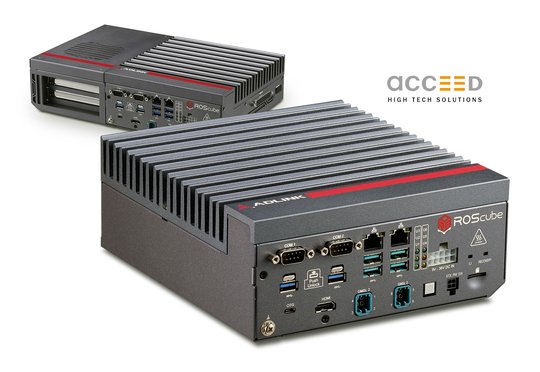
The new RQX-59 AI controller is part of the ROScube-X family and is based on Nvidia’s Jetson AGX Orin module. The SoM (System-on-Module) combines the energy-efficient Cortex-A78AE (64-bit) ARM processor with a GPU featuring up to 2048 CUDA processing units and 64 Tensor cores. This enables AI models for object recognition, depth estimation or semantic segmentation to be processed directly within the vehicle or robot. A power budget starting at around 40 W is likely to be attractive for battery-powered mobile applications, without having to compromise on sophisticated models.
Today, autonomous mobile robots, driverless transport systems and research platforms for automated driving require two key capabilities: reliable environmental perception and real-time responsiveness. Multiple cameras, radar and LiDAR sensors must work together with precision. Data streams must be fused and AI models executed locally, without cloud latency, resilient to interference and in a compact form. It is precisely to meet these requirements that the German distributor Acceed is positioning the new RQX-59, an edge controller for ROS 2-based robotics, which not only delivers AI computing power but also provides a field-proven platform for synchronous multi-sensor processing.
A key feature of the system is its ability to process footage from multiple automotive cameras in a synchronised manner. It supports GMSL (Gigabit Multimedia Serial Link, a high-speed SerDes camera protocol from the automotive sector) and FPD-Link III (Flat Panel Display Link) video technologies, each with frame synchronisation across multiple streams. This function is crucial for robust 360-degree environmental sensing, reliable object detection at high speeds and precise SLAM (Simultaneous Localisation and Mapping) procedures. This saves developers the need for separate hardware synchronisation modules and reduces integration risks, as sensor fusion is already supported within the platform.
The communication features are practical. Two Gigabit Ethernet ports, six USB 3.0 ports (two of which are lockable), serial interfaces (RS-232/RS-485), M.2 slots for NVMe SSDs, and wireless modules for Wi-Fi 6, Bluetooth 5.2 and optional 5G. Depending on the model, 32 GB or 64 GB of LPDDR5 memory is available, supplemented by onboard eMMC for the operating system. For more demanding AI workloads or additional sensor technology, the E variant can be equipped with an expansion box featuring PCIe slots.
It is not only in terms of computing power that the focus on mobile applications is evident. Supply voltages ranging from 9 to 36 V with reverse polarity protection allow for use in vehicles and robots. The shock- and vibration-resistant design, compliant with IEC standards, demonstrates its suitability for industrial use. On the software side, Ubuntu is supplied with Nvidia JetPack (including the CUDA toolchain, TensorRT optimisation library and driver stack for Jetson hardware) as well as the Neuron SDK for ROS 2 integration from the manufacturer Adlink. This reduces the effort required for in-house driver development and speeds up practical trials with cameras and sensors from the automotive sector.
With the RQX-59, Acceed presents a robust, technically sophisticated platform for developers looking to create autonomous mobile systems and deploy them in the field. Anyone wishing to synchronise multiple cameras with precision and perform AI inference directly on-site will find reliable support in this new embedded controller.