 LOOKING FOR THE RIGHT
INDUSTRIAL SOLUTION?
Discover embedded, communication and automation solutions tailored to your application.
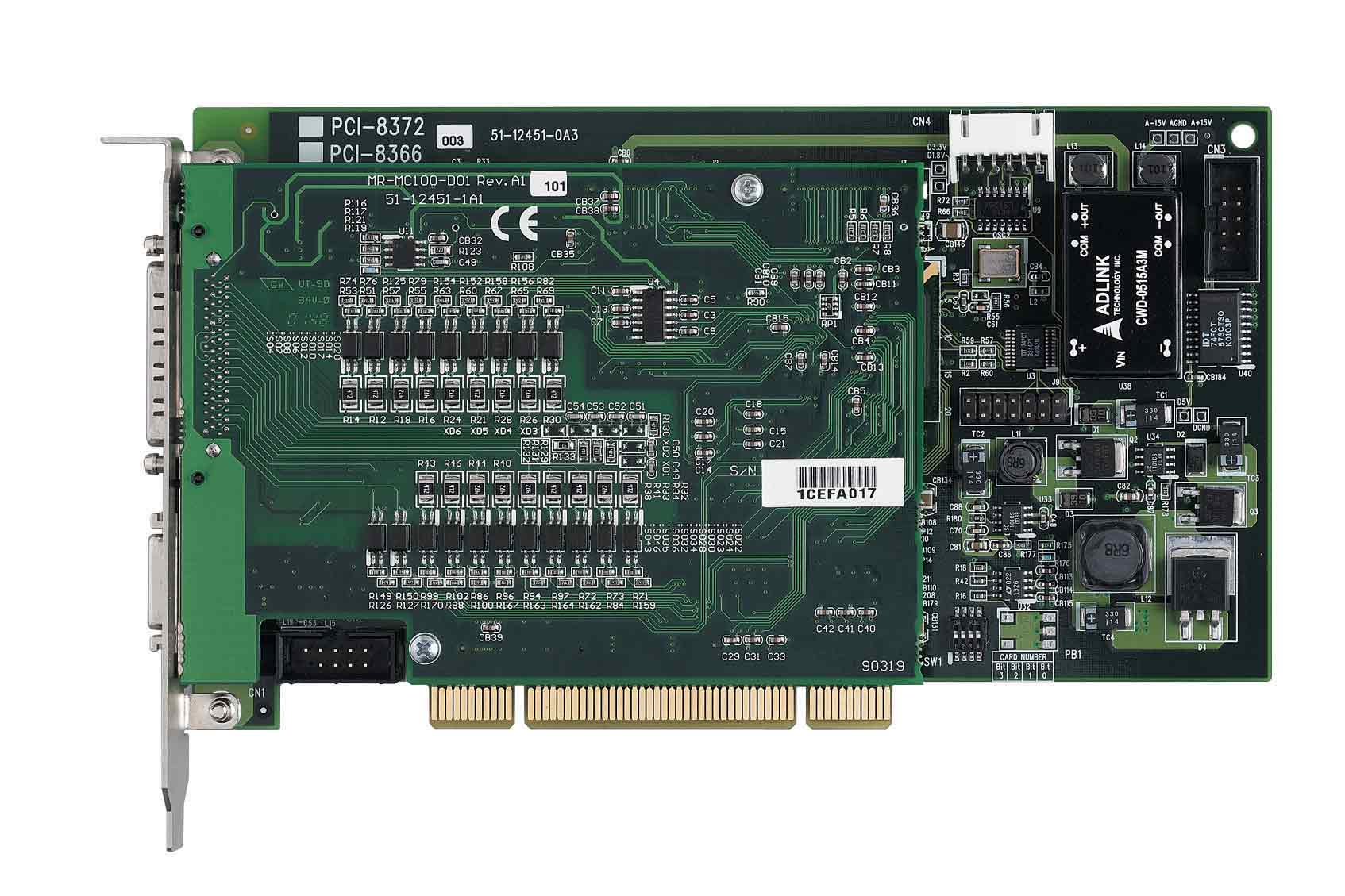
- 12-Axis SSCNET II Control: Supports up to 12 servo amplifiers per card (6 for PCI-8366+ variant).
- High-Speed Serial Communication: SSCNET II protocol with 5.625 MHz bit rate and 0.888 ms servo update cycle.
- Long-Distance Connectivity: Supports up to 30 m cable length per 6-axis group.
- Onboard DSP: TI TMS320C6711, 200 MHz, 1200 MFLOPS for real-time motion computation.
- Multi-Axis Synchronization: All axes synchronized within SSCNET cycle for precise interpolation.
- Advanced Motion Profiles: Supports trapezoidal and S-curve velocity profiles, linear and circular interpolation, and continuous trajectory motion.
- Integrated I/O: 2 isolated digital inputs/outputs, 6 TTL outputs, 2 analog outputs, and encoder feedback channels.
- Software Tools: Bundled with Motion Creator (Windows-based configuration and tuning software) and DLL libraries for C/C++/VB programming.
- Scalability: Up to 15 cards per system, enabling control of up to 180 axes.
- Noise Immunity: Differential serial communication minimizes EMI and improves reliability.
- Servo Diagnostics: Real-time monitoring of servo parameters, alarms, and tuning data.
- Compact PCI Variant: cPCI-8312H version supports 12 axes and dual HSL network ports.
- High-Speed Serial Communication: SSCNET II protocol with 5.625 MHz bit rate and 0.888 ms servo update cycle.
- Long-Distance Connectivity: Supports up to 30 m cable length per 6-axis group.
- Onboard DSP: TI TMS320C6711, 200 MHz, 1200 MFLOPS for real-time motion computation.
- Multi-Axis Synchronization: All axes synchronized within SSCNET cycle for precise interpolation.
- Advanced Motion Profiles: Supports trapezoidal and S-curve velocity profiles, linear and circular interpolation, and continuous trajectory motion.
- Integrated I/O: 2 isolated digital inputs/outputs, 6 TTL outputs, 2 analog outputs, and encoder feedback channels.
- Software Tools: Bundled with Motion Creator (Windows-based configuration and tuning software) and DLL libraries for C/C++/VB programming.
- Scalability: Up to 15 cards per system, enabling control of up to 180 axes.
- Noise Immunity: Differential serial communication minimizes EMI and improves reliability.
- Servo Diagnostics: Real-time monitoring of servo parameters, alarms, and tuning data.
- Compact PCI Variant: cPCI-8312H version supports 12 axes and dual HSL network ports.
Comprehensive Product Summary: ADLINK PCI-8372 SSCNET Motion Control Card
### 1. Product Overview
Product Name: PCI-8372
Model: PCI-8372+
Series: SSCNET Motion Control Card Series
Article Number: PCI-8372
Manufacturer: ADLINK Technology Inc.
Part Number: 50-1H001-1020
Revision: Manual Rev. 2.04 (June 13, 2008)
Manufacturer Address: 9F, No. 166, Jian Yi Road, Chungho City, Taipei 235, Taiwan
Website: [www.adlinktech.com](http://www.adlinktech.com)
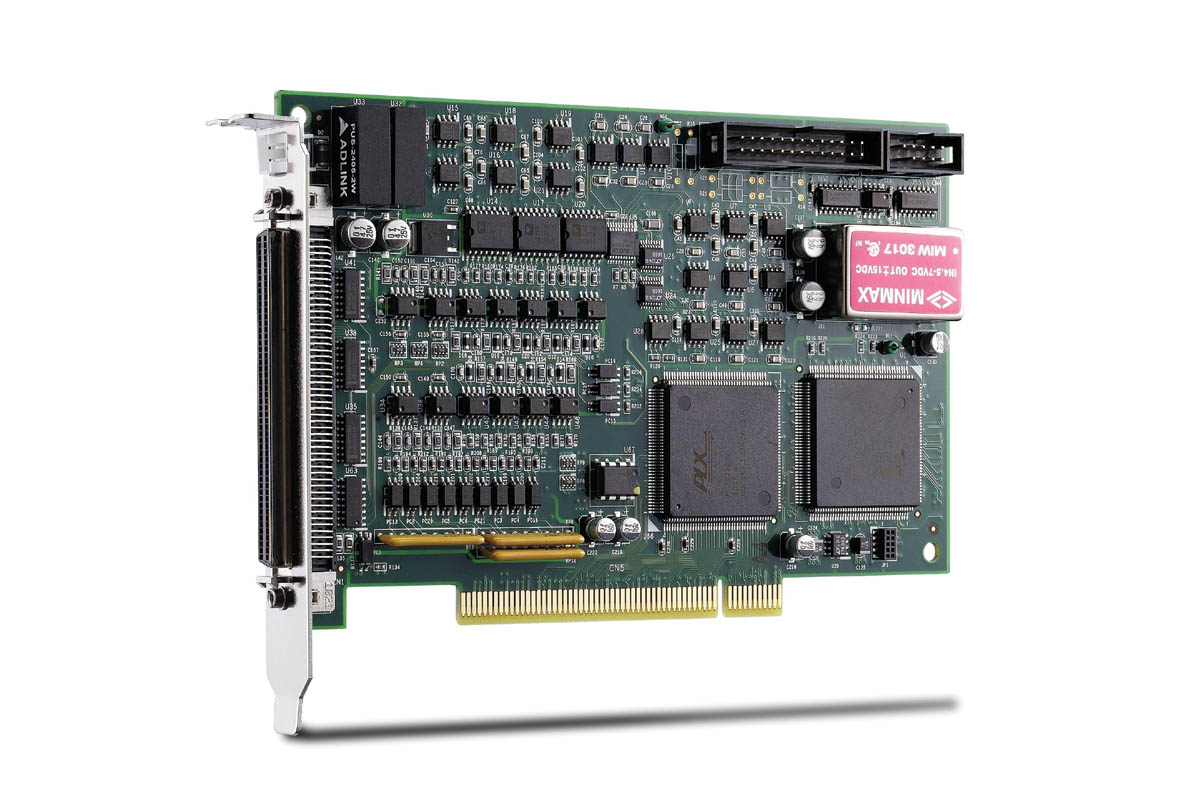
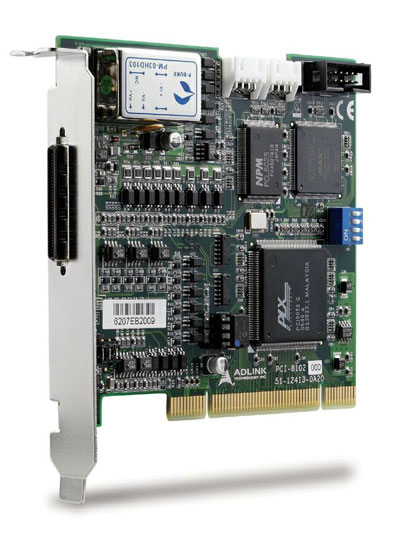
The ADLINK PCI-8372 is a high-performance 12-axis motion control card designed for industrial automation systems. It interfaces with Mitsubishi MR-J2S-B type servo amplifiers via SSCNET II, providing deterministic, high-speed serial communication for precise multi-axis motion control. The card integrates a TI TMS320C6711 DSP for real-time motion computation, reducing host CPU load and enabling complex motion profiles.
### 2. Key Features
- 12-Axis SSCNET II Control: Supports up to 12 servo amplifiers per card (6 for PCI-8366+ variant).
- High-Speed Serial Communication: SSCNET II protocol with 5.625 MHz bit rate and 0.888 ms servo update cycle.
- Long-Distance Connectivity: Supports up to 30 m cable length per 6-axis group.
- Onboard DSP: TI TMS320C6711, 200 MHz, 1200 MFLOPS for real-time motion computation.
- Multi-Axis Synchronization: All axes synchronized within SSCNET cycle for precise interpolation.
- Advanced Motion Profiles: Supports trapezoidal and S-curve velocity profiles, linear and circular interpolation, and continuous trajectory motion.
- Integrated I/O: 2 isolated digital inputs/outputs, 6 TTL outputs, 2 analog outputs, and encoder feedback channels.
- Software Tools: Bundled with Motion Creator (Windows-based configuration and tuning software) and DLL libraries for C/C++/VB programming.
- Scalability: Up to 15 cards per system, enabling control of up to 180 axes.
- Noise Immunity: Differential serial communication minimizes EMI and improves reliability.
- Servo Diagnostics: Real-time monitoring of servo parameters, alarms, and tuning data.
- Compact PCI Variant: cPCI-8312H version supports 12 axes and dual HSL network ports.
### 3. Technical Specifications
Bus Interface:
- PCI Rev. 2.2, 33 MHz, 32-bit, 5V signaling
- Memory usage: 16 KB
- IRQ assigned by PCI controller
Processor:
- DSP: TI TMS320C6711
- Clock: 200 MHz
- Performance: 1200 MFLOPS
Communication:
- Protocol: SSCNET II
- Physical Layer: RS-485
- Bit Rate: 5.625 MHz
- Max Cable Length: 30 m per 6 axes
- Error Detection: CRC
- Servo Update Rate: 0.888 ms
Axis Control:
- PCI-8372: 12 axes
- PCI-8366+: 6 axes
- cPCI-8312H: 12 axes + 2 HSL ports
Motion Profiles:
- Trapezoidal and S-curve velocity profiles
- Linear and circular interpolation (2–4 axes)
- Continuous trajectory motion with smoothing
- Home return, dwell, and sequence motion control
I/O and Feedback:
- Digital Inputs: 2 isolated DI (0–24V, 500 Vrms isolation)
- Digital Outputs: 2 isolated DO (open collector, 6.5 mA sink)
- TTL Outputs: 6 channels (3–5V logic)
- Analog Outputs: 2 channels, ±10V, 16-bit resolution, ±3% gain error
- Analog Inputs (cPCI only): 2 channels, ±10V/±5V/±2.5V, 16-bit, 250 kS/s
- Encoder Inputs: 3 channels, 32-bit, 5 MHz max, differential A/B/Z
- Pulse Outputs (cPCI only): 2 channels, OUT/DIR or CW/CCW, 4.16 MHz max
Power Consumption:
- +5V @ 1A typical
Environmental Conditions:
- Operating Temperature: 0°C to 55°C
- Storage Temperature: -20°C to 75°C
- Humidity: 10–90% RH, non-condensing
- Vibration: JIS C 0911 compliant (10–150 Hz, 1G)
- Shock: 10G, 3 directions
- Noise Resistance: 1500 Vp-p, 25–60 Hz
- Cooling: Self-cooled
Physical Dimensions:
- PCI form factor, 68-pin VHDIC I/O connector
- SSCNET connector: 3M 10220-52A2JL
### 4. Functionality
Operation Principle:
The PCI-8372 acts as a master controller communicating with servo amplifiers via SSCNET II. The onboard DSP handles trajectory generation, interpolation, and servo loop management, while the host PC issues high-level commands through dual-port RAM.
Supported Motion Types:
- Single-axis velocity and point-to-point (P-to-P) motion
- Multi-axis coordinated motion (linear/circular interpolation)
- Continuous trajectory motion with dwell and smoothing
- Home return and absolute positioning
- On-the-fly velocity and position modification
- Sequence motion control with pattern buffering
Applications:
- Semiconductor equipment
- CNC machinery
- Robotics and pick-and-place systems
- Precision inspection and assembly automation
- Multi-axis synchronization and contouring
Compatibility:
- Mitsubishi MR-J2S-B SSCNET servo amplifiers
- Windows 95/98/NT/2000/XP/2003/7 (via DLL libraries)
- Motion Creator software for configuration and tuning
### 5. Components & Accessories
Included Items:
- PCI-8372 SSCNET Motion Control Card
- ADLINK All-in-One CD (drivers, utilities, manuals)
- User’s Manual (PDF)
- Function Library (DLLs and header files)
Connectors:
- CN1: SSCNET connector (20-pin, 3M 10220-52A2JL)
- CN5: 68-pin VHDIC I/O connector (motion I/O, encoder, analog)
- CN3: TTL output connector (10-pin)
- HS1A–HS2B: RJ-45 HSL communication ports (cPCI only)
Optional Accessories:
- SSCNET cables (MR-J2HBUS)
- External encoder cables
- HSL expansion modules (for cPCI-8312H)
### 6. Installation & Setup
Hardware Installation:
1. Power off the PC and peripherals.
2. Insert the PCI-8372 into a 32-bit PCI slot (or cPCI slot for 8312H).
3. Secure the card with screws.
4. Power on the system.
5. Verify LED indicators (green/red) for self-test completion.
LED Indicators:
- Both LEDs blink during self-test (~2 seconds).
- LEDs off: normal operation.
- Continuous ON: DSP or power fault.
Software Installation:
1. Run the ADLINK All-in-One CD installer.
2. Select “Motion Control → SSCNET Series.”
3. Install drivers and utilities.
4. Reboot and verify card detection in Motion Creator.
Utilities:
- KernelUpdate.exe: DSP firmware update tool.
- SSCNET Communication Test Utility: Verifies network integrity.
- Motion Creator: Configuration, tuning, and motion testing GUI.
### 7. Performance & Capabilities
Motion Control Performance:
- Servo update rate: 0.888 ms
- Position resolution: 32-bit encoder input
- Max encoder speed: 5 MHz
- Max pulse output: 4.16 MHz (cPCI)
- Analog output resolution: 16-bit
- Analog input sampling: 250 kS/s
DSP Performance:
- 1200 MFLOPS floating-point computation
- Real-time frame-based trajectory generation
- Deterministic control cycle for synchronized multi-axis motion
System Capacity:
- Up to 15 cards per system (180 axes total)
- 30 m SSCNET cable per 6-axis group
Limitations:
- SSCNET II protocol only (not compatible with SSCNET III)
- Requires Mitsubishi MR-J2S-B servo amplifiers
- Windows OS environment required for Motion Creator
### 8. Standards & Compliance
- Electrical Safety: IEC and JIS C 0911/0912 compliant
- EMC: Designed for industrial noise immunity (1500 Vp-p)
- Environmental: RoHS compliant (lead-free manufacturing)
- Software Interface: PCI 2.2 compliant, Windows DLL API
- Servo Compatibility: Mitsubishi MR-J2S-B SSCNET II amplifiers
- Quality Assurance: Manufactured under ISO 9001 standards
### 9. Additional Information
Warranty:
- 2-year limited warranty (1 year in China)
- Covers manufacturing defects and hardware failures
- Excludes damage from misuse, improper installation, or environmental factors
Technical Support:
- Email: service@adlinktech.com
- Phone: +886-2-82265877
- Fax: +886-2-82265717
- RMA portal: [http://rma.adlinktech.com/policy](http://rma.adlinktech.com/policy)
Maintenance & Updates:
- Firmware updates via KernelUpdate utility
- Self-calibration for analog channels (no manual adjustment required)
- Regular driver and library updates available from ADLINK website
Software Development Support:
- C/C++/VB DLL libraries with full API documentation
- Function categories: system initialization, motion control, I/O, monitoring, tuning, interrupts, and safety
- Example code and Motion Creator integration for rapid prototyping
Safety & Protection Features:
- Emergency stop input (EMG)
- Software and hardware limit switches (PEL/MEL)
- Interlock function for collision avoidance
- Position difference auto-stop protection
- Watchdog timer and CRC error detection
### Summary
The ADLINK PCI-8372 SSCNET Motion Control Card is a robust, high-precision motion controller engineered for industrial automation requiring deterministic, synchronized multi-axis control. Its integration of a high-performance DSP, SSCNET II communication, and comprehensive I/O capabilities make it ideal for complex motion applications such as robotics, semiconductor manufacturing, and CNC systems. With its modular scalability, advanced motion functions, and comprehensive software ecosystem, the PCI-8372 delivers both flexibility and reliability for demanding motion control environments.
### 1. Product Overview
Product Name: PCI-8372
Model: PCI-8372+
Series: SSCNET Motion Control Card Series
Article Number: PCI-8372
Manufacturer: ADLINK Technology Inc.
Part Number: 50-1H001-1020
Revision: Manual Rev. 2.04 (June 13, 2008)
Manufacturer Address: 9F, No. 166, Jian Yi Road, Chungho City, Taipei 235, Taiwan
Website: [www.adlinktech.com](http://www.adlinktech.com)
The ADLINK PCI-8372 is a high-performance 12-axis motion control card designed for industrial automation systems. It interfaces with Mitsubishi MR-J2S-B type servo amplifiers via SSCNET II, providing deterministic, high-speed serial communication for precise multi-axis motion control. The card integrates a TI TMS320C6711 DSP for real-time motion computation, reducing host CPU load and enabling complex motion profiles.
### 2. Key Features
- 12-Axis SSCNET II Control: Supports up to 12 servo amplifiers per card (6 for PCI-8366+ variant).
- High-Speed Serial Communication: SSCNET II protocol with 5.625 MHz bit rate and 0.888 ms servo update cycle.
- Long-Distance Connectivity: Supports up to 30 m cable length per 6-axis group.
- Onboard DSP: TI TMS320C6711, 200 MHz, 1200 MFLOPS for real-time motion computation.
- Multi-Axis Synchronization: All axes synchronized within SSCNET cycle for precise interpolation.
- Advanced Motion Profiles: Supports trapezoidal and S-curve velocity profiles, linear and circular interpolation, and continuous trajectory motion.
- Integrated I/O: 2 isolated digital inputs/outputs, 6 TTL outputs, 2 analog outputs, and encoder feedback channels.
- Software Tools: Bundled with Motion Creator (Windows-based configuration and tuning software) and DLL libraries for C/C++/VB programming.
- Scalability: Up to 15 cards per system, enabling control of up to 180 axes.
- Noise Immunity: Differential serial communication minimizes EMI and improves reliability.
- Servo Diagnostics: Real-time monitoring of servo parameters, alarms, and tuning data.
- Compact PCI Variant: cPCI-8312H version supports 12 axes and dual HSL network ports.
### 3. Technical Specifications
Bus Interface:
- PCI Rev. 2.2, 33 MHz, 32-bit, 5V signaling
- Memory usage: 16 KB
- IRQ assigned by PCI controller
Processor:
- DSP: TI TMS320C6711
- Clock: 200 MHz
- Performance: 1200 MFLOPS
Communication:
- Protocol: SSCNET II
- Physical Layer: RS-485
- Bit Rate: 5.625 MHz
- Max Cable Length: 30 m per 6 axes
- Error Detection: CRC
- Servo Update Rate: 0.888 ms
Axis Control:
- PCI-8372: 12 axes
- PCI-8366+: 6 axes
- cPCI-8312H: 12 axes + 2 HSL ports
Motion Profiles:
- Trapezoidal and S-curve velocity profiles
- Linear and circular interpolation (2–4 axes)
- Continuous trajectory motion with smoothing
- Home return, dwell, and sequence motion control
I/O and Feedback:
- Digital Inputs: 2 isolated DI (0–24V, 500 Vrms isolation)
- Digital Outputs: 2 isolated DO (open collector, 6.5 mA sink)
- TTL Outputs: 6 channels (3–5V logic)
- Analog Outputs: 2 channels, ±10V, 16-bit resolution, ±3% gain error
- Analog Inputs (cPCI only): 2 channels, ±10V/±5V/±2.5V, 16-bit, 250 kS/s
- Encoder Inputs: 3 channels, 32-bit, 5 MHz max, differential A/B/Z
- Pulse Outputs (cPCI only): 2 channels, OUT/DIR or CW/CCW, 4.16 MHz max
Power Consumption:
- +5V @ 1A typical
Environmental Conditions:
- Operating Temperature: 0°C to 55°C
- Storage Temperature: -20°C to 75°C
- Humidity: 10–90% RH, non-condensing
- Vibration: JIS C 0911 compliant (10–150 Hz, 1G)
- Shock: 10G, 3 directions
- Noise Resistance: 1500 Vp-p, 25–60 Hz
- Cooling: Self-cooled
Physical Dimensions:
- PCI form factor, 68-pin VHDIC I/O connector
- SSCNET connector: 3M 10220-52A2JL
### 4. Functionality
Operation Principle:
The PCI-8372 acts as a master controller communicating with servo amplifiers via SSCNET II. The onboard DSP handles trajectory generation, interpolation, and servo loop management, while the host PC issues high-level commands through dual-port RAM.
Supported Motion Types:
- Single-axis velocity and point-to-point (P-to-P) motion
- Multi-axis coordinated motion (linear/circular interpolation)
- Continuous trajectory motion with dwell and smoothing
- Home return and absolute positioning
- On-the-fly velocity and position modification
- Sequence motion control with pattern buffering
Applications:
- Semiconductor equipment
- CNC machinery
- Robotics and pick-and-place systems
- Precision inspection and assembly automation
- Multi-axis synchronization and contouring
Compatibility:
- Mitsubishi MR-J2S-B SSCNET servo amplifiers
- Windows 95/98/NT/2000/XP/2003/7 (via DLL libraries)
- Motion Creator software for configuration and tuning
### 5. Components & Accessories
Included Items:
- PCI-8372 SSCNET Motion Control Card
- ADLINK All-in-One CD (drivers, utilities, manuals)
- User’s Manual (PDF)
- Function Library (DLLs and header files)
Connectors:
- CN1: SSCNET connector (20-pin, 3M 10220-52A2JL)
- CN5: 68-pin VHDIC I/O connector (motion I/O, encoder, analog)
- CN3: TTL output connector (10-pin)
- HS1A–HS2B: RJ-45 HSL communication ports (cPCI only)
Optional Accessories:
- SSCNET cables (MR-J2HBUS)
- External encoder cables
- HSL expansion modules (for cPCI-8312H)
### 6. Installation & Setup
Hardware Installation:
1. Power off the PC and peripherals.
2. Insert the PCI-8372 into a 32-bit PCI slot (or cPCI slot for 8312H).
3. Secure the card with screws.
4. Power on the system.
5. Verify LED indicators (green/red) for self-test completion.
LED Indicators:
- Both LEDs blink during self-test (~2 seconds).
- LEDs off: normal operation.
- Continuous ON: DSP or power fault.
Software Installation:
1. Run the ADLINK All-in-One CD installer.
2. Select “Motion Control → SSCNET Series.”
3. Install drivers and utilities.
4. Reboot and verify card detection in Motion Creator.
Utilities:
- KernelUpdate.exe: DSP firmware update tool.
- SSCNET Communication Test Utility: Verifies network integrity.
- Motion Creator: Configuration, tuning, and motion testing GUI.
### 7. Performance & Capabilities
Motion Control Performance:
- Servo update rate: 0.888 ms
- Position resolution: 32-bit encoder input
- Max encoder speed: 5 MHz
- Max pulse output: 4.16 MHz (cPCI)
- Analog output resolution: 16-bit
- Analog input sampling: 250 kS/s
DSP Performance:
- 1200 MFLOPS floating-point computation
- Real-time frame-based trajectory generation
- Deterministic control cycle for synchronized multi-axis motion
System Capacity:
- Up to 15 cards per system (180 axes total)
- 30 m SSCNET cable per 6-axis group
Limitations:
- SSCNET II protocol only (not compatible with SSCNET III)
- Requires Mitsubishi MR-J2S-B servo amplifiers
- Windows OS environment required for Motion Creator
### 8. Standards & Compliance
- Electrical Safety: IEC and JIS C 0911/0912 compliant
- EMC: Designed for industrial noise immunity (1500 Vp-p)
- Environmental: RoHS compliant (lead-free manufacturing)
- Software Interface: PCI 2.2 compliant, Windows DLL API
- Servo Compatibility: Mitsubishi MR-J2S-B SSCNET II amplifiers
- Quality Assurance: Manufactured under ISO 9001 standards
### 9. Additional Information
Warranty:
- 2-year limited warranty (1 year in China)
- Covers manufacturing defects and hardware failures
- Excludes damage from misuse, improper installation, or environmental factors
Technical Support:
- Email: service@adlinktech.com
- Phone: +886-2-82265877
- Fax: +886-2-82265717
- RMA portal: [http://rma.adlinktech.com/policy](http://rma.adlinktech.com/policy)
Maintenance & Updates:
- Firmware updates via KernelUpdate utility
- Self-calibration for analog channels (no manual adjustment required)
- Regular driver and library updates available from ADLINK website
Software Development Support:
- C/C++/VB DLL libraries with full API documentation
- Function categories: system initialization, motion control, I/O, monitoring, tuning, interrupts, and safety
- Example code and Motion Creator integration for rapid prototyping
Safety & Protection Features:
- Emergency stop input (EMG)
- Software and hardware limit switches (PEL/MEL)
- Interlock function for collision avoidance
- Position difference auto-stop protection
- Watchdog timer and CRC error detection
### Summary
The ADLINK PCI-8372 SSCNET Motion Control Card is a robust, high-precision motion controller engineered for industrial automation requiring deterministic, synchronized multi-axis control. Its integration of a high-performance DSP, SSCNET II communication, and comprehensive I/O capabilities make it ideal for complex motion applications such as robotics, semiconductor manufacturing, and CNC systems. With its modular scalability, advanced motion functions, and comprehensive software ecosystem, the PCI-8372 delivers both flexibility and reliability for demanding motion control environments.


No accessories available.